

• Welcome to Photrio!
    Registration is fast and free. Join today to unlock search, see fewer ads, and access all forum features.
    Click here to sign up

Stop loss for Hasselblad circular polarizer?

1972

A
1972

  • 11
  • 7
  • 105

Forum statistics

Threads
202,584
Messages
2,842,763
Members
101,390
Latest member
Kman35743
Recent bookmarks
0

nickalpin

Member
Allowing Ads
Joined
Jan 25, 2010
Messages
2
Location
Winter Park,
Format
Medium Format
Hello, my first post to the forum after many months of lurking and learning :smile:

I recently purchased a circular polarizer (B50) from KEH for my Hasselblad 150mm f/4 Sonnar. I'm attempting to verify the stop loss so that I can compensate either on the lens or light meter. Would anyone have information on how to figure this out? Does the '-1' mean one stop of light is lost? Photo of the filter is below.
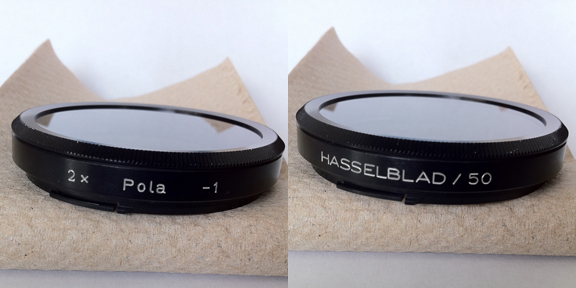
5118207650_873a14870b_o.jpg
 
I'm thinking both the 2X and the -1 indicate one stop of light transmission loss. In my experience, polarizing filters reduce transmission by anywhere from 1.5 stops to 2 stops depending on manufacturer and field conditions. I've not used a Hasselblad polarizing filter, however. I would buy a roll of transparency film and do a simple field test on a bright, sunny day.

Peter Gomena
 
The filter may be round, but it's not a circular polarizer. :wink:

The numbers on the rim are what you are after: "-1" means one stop loss, "2x" means the same, expressed as a shutterspeed factor.
Those figures are correct.
 
Thank you both for your replies. I was hoping the numbers would reflect those values but didn't want to assume. I suppose my assumption regarding 'circular' was that since the filter can be turned it's circular.. :laugh:
 
We just know.
:wink:

Hasselblad never sold circular polarizers, because no Hasselblad camera needs one.
 
To elaborate a little on Q.G.'s statement.
Film cameras don't need a circular polarizer, only digital cameras need them so you are fine with this filter.
 
That's not quite correct, Jan.
Whether a camera needs a circular polarizer or not depends on how its metering systems (either exposure or auto focus, or both) gets the light it needs to do what it should do.
If there are reflecting surfaces in the light path from lens to metering system, light polarized by a polarizer on the lens might (not necessarily - it depends) not reach the metering system. That, depending on how the filter is oriented, i.e. in what plane the light behind it is polarized.
So film cameras too may need a circular polarizer.
 
I think Q.G. would be more correct if instead of referring to "reflecting surfaces" he referred to beam splitters or other systems that reflect part of the light and transmit the rest.
 
Some auto focus slrs use beam splitters. Those cameras need circular polarizors, the rest, including Hasselblad, do not.

Steve
 
The New Canon F1 is an example of a manual focus camera that uses beam splitters in its metering system. There are others. You need to use circular polarizers with them.

I think (but cannot find any confirmation for this) that the Canon AE1 was another.

EDIT: A Leicaflex SL is another example of a manual focus camera that uses beam splitters in its metering system and therefore requires a circular polarizer.
 
Last edited by a moderator:
An easy way to check if a polarizer is linear or circular is to look through it and rotate it, first in the normal position and then in a reversed position. A linear polarizer will give the same effect both ways, circular polarizers only work one way.
 
I stand corrected then.
Will the mirror then not be a reflecting surface?

Yes.
And some cameras, or rather their metering systems, may have a problem with that.

"May", because having a reflecting surface (mirror, secondary mirror behind a semi-transparant spot in the main mirror, semi-silvered surface in a beam splitter prism, etc.) does not automatically mean it is sensitive to the direction of polarisation.
 
I think Q.G. would be more correct if instead of referring to "reflecting surfaces" he referred to beam splitters or other systems that reflect part of the light and transmit the rest.

Not reflecting all of the light is not a condition for (possibly) being senstive to polarisation.
The thing to worry about in beam splitters too is the reflecting part. That it passes on some of the light is not relevant, unless that light is used for the metering systems (i.e. the light used for the metering systems is not reflected).

So i would be more correct if i would refer to reflecting surfaces. And so i did.
:wink:
 
I stand corrected then.
Will the mirror then not be a reflecting surface?

Hi Jan, The mirrors on cameras that require circular polarizers have portions that are indeed transparant to allow light through, and the polarized light that enteres the camera not only effects the exposure but the auto focus mechanism also on most modern SLRs.
 
Again, it's not the semi-transparancy of beam splitters or mirrors that could be an issue. It's the reflecting thing they do.

If an AF or metering system is located in the prism housing, i.e. after the mirror, they could have poblems with polarised light.
 
Photrio.com contains affiliate links to products. We may receive a commission for purchases made through these links.
To read our full affiliate disclosure statement please click Here.

PHOTRIO PARTNERS EQUALLY FUNDING OUR COMMUNITY:


Ilford ADOX Freestyle Photographic Stearman Press Weldon Color Lab Blue Moon Camera & Machine
Top Bottom
