• Welcome to Photrio!
    Registration is fast and free. Join today to unlock search, see fewer ads, and access all forum features.
    Click here to sign up

Stand development???

Recent Classifieds

Forum statistics

Threads
201,990
Messages
2,833,397
Members
101,052
Latest member
frenetteaidan
Recent bookmarks
0

removedacct3

Member
Allowing Ads
Joined
Mar 19, 2009
Messages
628
Location
-
Format
Multi Format
One contra... not every film or developer is suited for stand development
 
Joined
Jan 21, 2003
Messages
15,715
Location
Switzerland
Format
Multi Format
Uneven development is very common when doing standing development.

But some possibilities are undeniable. When you use highly dilute developers (Rodinal is especially good for this, according to my own experience), for a long time without agitating, areas of the negative that received a lot of exposure will have the developer that's adjacent to the film plane exhausted pretty quickly.
And areas of the film that did not receive a lot of exposure will have the developer last for a pretty long time, improving shadow detail (and subsequently film speed).
I have seen prints from Tri-X negatives exposed at EI 25,000 processed this way, and the results were acceptable. Not great. But acceptable.
Developing this way will 'even out' differences in exposure and density from frame to frame on a roll of film. Overexposed frames can live pretty happily next to underexposed ones.

You can also gain some edge effects where areas of high density are directly adjacent to areas of low density. Sharp shifts in tonality, along an edge, will get this 'super sharp' appearance. Some like it, others don't.

It's something that isn't for everybody, but that can yield some pretty impressive results with enough practice. See Steve Sherman, for example.

- Thomas

 

vedmak

Member
Allowing Ads
Joined
Sep 12, 2009
Messages
328
Location
Chicago
Format
Analog
try pmk

if the question is clear tonal separation in extreme lighting conditions, pyro developers will blow the socks off the stand development. In one of his books saint Ansel had a picture of a light bulb developed in pyro developer, try to do that one on a working light bulb with Xtol:cool:
 
Joined
Jan 21, 2003
Messages
15,715
Location
Switzerland
Format
Multi Format
In one of his books saint Ansel had a picture of a light bulb developed in pyro developer, try to do that one on a working light bulb with Xtol:cool:

(I think I will. Sounds like a challenge.) :smile:
 

Travis Nunn

Member
Allowing Ads
Joined
Jul 3, 2005
Messages
1,601
Location
Midlothian, VA
Format
Medium Format
This might be a good thread to read....
(there was a url link here which no longer exists)
 

Dan Henderson

Member
Allowing Ads
Joined
Feb 6, 2005
Messages
1,880
Location
Blue Ridge,
Format
4x5 Format
Some people cite uneven development and/or "bromide drag" with stand development.

I have never tried stand development, defined as the only agitation being at the beginning of development. But I have been using semi-stand development, which I define as 1-1/2 minutes of initial agitation followed by 10 seconds of agitation at the half point in the total developing time. I have been using this routine with Pyrocat HD for about 6 months and I am getting nice, snappy, printable negatives with no ill effects.
 

Marco B

Subscriber
Allowing Ads
Joined
Jan 13, 2005
Messages
2,736
Location
The Netherla
Format
Multi Format
if the question is clear tonal separation in extreme lighting conditions, pyro developers will blow the socks off the stand development. In one of his books saint Ansel had a picture of a light bulb developed in pyro developer, try to do that one on a working light bulb with Xtol:cool:

You mean something like this :whistling:...

Tri-X 400 in D76 1:1 at 6.30 minutes pull development, deliberately overexposed for detail in shadows ("Expose for the shadows"), I measured an about 11-13 stop / EV range.

You don't have to be a saint :wink: , nor risk uneven development as in stand, to do this (if you can afford to have slightly longer exposure times):

dn1_0266_17.jpg


dn1_0267_7.jpg


For an even better impression of the amount of shadow detail, see the images against a dark backdrop on my personal website here (the light APUG background makes images look darker):

http://www.boeringa.demon.nl/haarlem_by_night/slides/DN1_0266_17.html
http://www.boeringa.demon.nl/haarlem_by_night/slides/DN1_0267_7.html

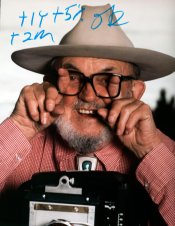
And a side/sight of Adam's I didn't know :D, from here:
DK-Ansel-glasses_LF.jpg

Ansel Adams TIME Cover & "The Cover That Missed", 1979
cover & c print, signed, unique (printed in 1984 in an edition of 25)
"The only photographer to appear on the cover of TIME, photo by me, signed by Ansel Adams, September 3, 1979. The Cover That Missed inscribed with, 'For David Hume Kennerly, The cover that Missed! Ansel Adams, NY-9-5-79' . The photograph underscores Ansel's playfulness and fine sense of humor. He had a pair of glasses with no lenses, and demonstrated them in a vivid visual fashion."
 

Shawn Dougherty

Member
Allowing Ads
Joined
Jul 22, 2004
Messages
4,129
Location
Pittsburgh
Format
Multi Format
if the question is clear tonal separation in extreme lighting conditions, pyro developers will blow the socks off the stand development. In one of his books saint Ansel had a picture of a light bulb developed in pyro developer, try to do that one on a working light bulb with Xtol:cool:

You know you can stand develop with some pyro developers, right? =)
 
Joined
Jan 21, 2003
Messages
15,715
Location
Switzerland
Format
Multi Format
Standing development is also about boosting micro contrast, and general contrast, when you're photographing low contrast scenes.
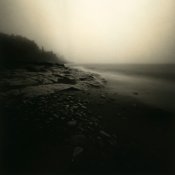
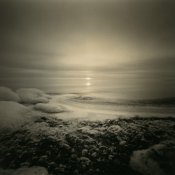
I was shooting pinhole using Kodak Plus-X film a year or so ago, and used 120 film to make 6x6 negatives. I would process them in 1+200 dilution Rodinal at 70 degrees F for 60 minutes with 10s agitation at the 30 minute mark, and a full minute of agitation at the start.

I got negatives that printed well on Grade 3 paper from scenes that were foggy and low contrast, as well as scenes that were fairly brightly lit in the middle of the day with normal contrast.
Attached prints are almost straight prints at Grade 3 (left one is Forte Polygrade and right one Fomabrom Variant).

It is a great tool for anybody to use.

- Thomas
 

Attachments

  • by_the_water_-_002_sm.jpg
    by_the_water_-_002_sm.jpg
    78.5 KB · Views: 178
  • by_the_water_-_001_sm.jpg
    by_the_water_-_001_sm.jpg
    105.2 KB · Views: 185

Marco B

Subscriber
Allowing Ads
Joined
Jan 13, 2005
Messages
2,736
Location
The Netherla
Format
Multi Format
Standing development is also about boosting micro contrast, and general contrast, when you're photographing low contrast scenes.

....

I got negatives that printed well on Grade 3 paper from scenes that were foggy and low contrast, as well as scenes that were fairly brightly lit in the middle of the day with normal contrast.

So, essentially this was a "push" development, however the stand development used to control or limit grain sizes? Less agitation, so finer grain? :confused: Do I understand you right for these specific images?
 
Joined
Jan 21, 2003
Messages
15,715
Location
Switzerland
Format
Multi Format
The negative making the print on the left was a scene of flat lighting. Very flat.
The negative making the print on the right was in normal contrast lighting if you discount the rising sun.
They were both developed for the same amount of time, believe it or not. So it evened out the contrast range between the two negatives - automatically within the process.

- Thomas

So, essentially this was a "push" development, however the stand development used to control or limit grain sizes? Less agitation, so finer grain? :confused: Do I understand you right for these specific images?
 

c6h6o3

Member
Allowing Ads
Joined
Oct 16, 2002
Messages
3,215
Format
Large Format
if the question is clear tonal separation in extreme lighting conditions, pyro developers will blow the socks off the stand development. In one of his books saint Ansel had a picture of a light bulb developed in pyro developer, try to do that one on a working light bulb with Xtol:cool:

The negative for the picture you mention was developed in Windisch Catechol, a pyro based developer. The reducing agent in this formula is pyrocatechin, which is different from the reducer in PMK, pyrogallol. Pyrocatechin is also the reducer in Pyrocat HD which many fine printers use for semi-stand or minimal agitation development.

It's not a case of stand development OR pyro development; I know many photographers who get beautiful results using stand development WITH pyro.
 

Gerald C Koch

Member
Allowing Ads
Joined
Jul 12, 2010
Messages
8,131
Location
Southern USA
Format
Multi Format
The negative for the picture you mention was developed in Windisch Catechol, a pyro based developer. The reducing agent in this formula is pyrocatechin, which is different from the reducer in PMK, pyrogallol. Pyrocatechin is also the reducer in Pyrocat HD

This is a minor point but it's rather confusing when someone uses the term pyro for pyrocatechin when must people will think of pyrogallol when they see pyro. Older literature is particularly bad in this respect. The accepted chemical names are catechol and pyrogallol. Pyrocatechin is a very old name and best left in the past.
 

Shawn Dougherty

Member
Allowing Ads
Joined
Jul 22, 2004
Messages
4,129
Location
Pittsburgh
Format
Multi Format
This is a minor point but it's rather confusing when someone uses the term pyro for pyrocatechin when must people will think of pyrogallol when they see pyro. Older literature is particularly bad in this respect. The accepted chemical names are catechol and pyrogallol. Pyrocatechin is a very old name and best left in the past.

As someone who only started foolin' with pyro in 2004... =) Things have changed. In my experience, I'd estimate that 90% or more of those I speak with who use "pyro" use some form of Pyrocat.... Even on the boards it seems to be far and away the most popular - and everyone seems to refer to it as "pyro".

Have you found differently?
 

c6h6o3

Member
Allowing Ads
Joined
Oct 16, 2002
Messages
3,215
Format
Large Format
As someone who only started foolin' with pyro in 2004... =) Things have changed. In my experience, I'd estimate that 90% or more of those I speak with who use "pyro" use some form of Pyrocat.... Even on the boards it seems to be far and away the most popular - and everyone seems to refer to it as "pyro".

Have you found differently?

I started using PMK about 20 years ago. At that time 'pyro' meant pyrogallol. That's what Adams referred to as pyro in The Negative and other books. If he developed a negative in catechol and used it as an example he would call it that and not 'pyro'. About 10 years ago I started using ABC pyro, which is also pyrogallol based. I've never associated the word 'pyro' with catechol or even Sandy's Pyrocat.

I think the recent association of 'pyro' with catechol in its many guises is purely the result of Sandy King's choice of name for the groundbreaking developer he invented.

Gerald: I will henceforth excise the word 'pyrocatechin' from my vocabulary. I place that misnomer in the same class as calling a substance as alkaline as pyrogallol 'pyrogallic acid', which some vendors still do.
 
Joined
Jan 21, 2003
Messages
15,715
Location
Switzerland
Format
Multi Format
I am basically on a single developer regime, but recently bought a bottle of Rodinal just to try some standing development again. Call me crazy.
I'll be sticking to a single developer at least 95% of the time. :smile:

- Thomas

I'll have to try that stuff some day. After all, it was good enough for Brett Weston.
 

Dan Henderson

Member
Allowing Ads
Joined
Feb 6, 2005
Messages
1,880
Location
Blue Ridge,
Format
4x5 Format
Like Shawn (hi Shawn, it was good to meet you last weekend) I am relatively new to pyro type developers. But even before using it I associated the word "pyro" with pyrogallol developers such as PMK. It seems to me that "pyrocat" (small p) would be a good word to associate with pyrocatechol type developers, like Pyrocat or Dixactol.
 

2F/2F

Member
Allowing Ads
Joined
Apr 29, 2008
Messages
8,031
Location
Los Angeles,
Format
Multi Format
I would check out the book "The Darkroom Cookbook" by Steve Anchell (and by "check out," I also mean that it may be available at a library near you). There are five useful paragraphs on stand development that will do more for you than piecing together tidbits from the Internet as your first introduction to the technique. One paragraph is introductory, one is on advantages, one is on disadvantages, and two that explain the basics of how to employ the technique.
 

sanking

Member
Allowing Ads
Joined
Mar 26, 2003
Messages
5,437
Location
Greenville,
Format
Large Format
I think the recent association of 'pyro' with catechol in its many guises is purely the result of Sandy King's choice of name for the groundbreaking developer he invented.

Gerald: I will henceforth excise the word 'pyrocatechin' from my vocabulary. I place that misnomer in the same class as calling a substance as alkaline as pyrogallol 'pyrogallic acid', which some vendors still do.

Pyrocatechin is rarely used these days for catechol, but pyrocatechol is a perfectly good modern equivalent, and in some respects has more use in the scientific literature.

When I developed the Pyrocat formula I used the name Pyro in it because whether you call the chemical pyrocatechin, pyrocatechol, or just catechol it does the same thing in development as pyrogallol, i.e. it stains and tans when used in solutions low in sulfite.

I would also note that in The Film Developing Cookbook, Anchell and Troop treat both pyrogallol and pyrocatechin in the same chapter, Tanning Developers.

That said, I find it perfectly reasonable to use the term "pyro developer" to refer to either pyrogallol or pyrocatechol.

Sandy
 

chaptastic

Member
Allowing Ads
Joined
Jun 3, 2010
Messages
2
Location
Atlanta, Ga
Format
35mm RF
I would check out the book "The Darkroom Cookbook" by Steve Anchell (and by "check out," I also mean that it may be available at a library near you). There are five useful paragraphs on stand development that will do more for you than piecing together tidbits from the Internet as your first introduction to the technique. One paragraph is introductory, one is on advantages, one is on disadvantages, and two that explain the basics of how to employ the technique.

Could you possibly provide a page reference (or section)? I'm interested in trying stand development but can't seem to find this passage in the book. Thanks!
 

Lee L

Member
Joined
Nov 17, 2004
Messages
3,287
Format
Multi Format
Could you possibly provide a page reference (or section)? I'm interested in trying stand development but can't seem to find this passage in the book. Thanks!
Stand development is covered in the 3rd edition, pages 39-40.

The 2nd edition only has one paragraph for agitation, mentioning 10 seconds/minute and continuous shuffling for sheet film in trays.

If you don't have the 3rd edition, you won't find stand development mentioned.

Lee
 
Photrio.com contains affiliate links to products. We may receive a commission for purchases made through these links.
To read our full affiliate disclosure statement please click Here.

PHOTRIO PARTNERS EQUALLY FUNDING OUR COMMUNITY:


Ilford ADOX Freestyle Photographic Stearman Press Weldon Color Lab Blue Moon Camera & Machine
Top Bottom