• Welcome to Photrio!
    Registration is fast and free. Join today to unlock search, see fewer ads, and access all forum features.
    Click here to sign up

Stand Development

A coal wagon

A
A coal wagon

  • 0
  • 0
  • 4
Morning Birdie

D
Morning Birdie

  • 0
  • 0
  • 13

Forum statistics

Threads
203,141
Messages
2,850,462
Members
101,692
Latest member
eviosl
Recent bookmarks
2

Anscojohn

Subscriber
Allowing Ads
Joined
Dec 31, 2006
Messages
2,704
Format
Medium Format
Since the late 1950s I have been souping film; had a great darkroom mentor in college in the early 1960s; worked thereafter with a couple of old lab rats who had been working in the trade since the 1930s and 1940s. I remember a mention of stand development in Sussman's book, The Amateur Photographer, I think referencing paraphenaline diamine. And yet a day barely goes by that I do not read of a mention of stand development on Apug. Have I been missing something in the last fifty years? Has stand development gained some kind of cachet? What gives?
 
Has stand development gained some kind of cachet? What gives?
It's gained wider recognition and acceptance as a tool for getting particular characteristics from certain film and developer combinations. It's been around for a very long time.

Read up on the APUG postings. I'd recommend posts by Steve Sherman, Sandy King, and df cardwell for a good grasp of the potential of stand or semi-stand development techniques.

Lee
 
It's gained wider recognition and acceptance as a tool for getting particular characteristics from certain film and developer combinations. It's been around for a very long time.

******
Hi Lee,
I know it's been around for a long time; I am just wondering what seems to have brought it back "all of a sudden," as a technique--- if the number of references I see on Apug are an indication.
 
Hi Lee,
I know it's been around for a long time; I am just wondering what seems to have brought it back "all of a sudden," as a technique--- if the number of references I see on Apug are an indication.
It honestly doesn't appear that way to me. It's mentioned prominently in my 1981 copy of Adams' "The Negative", and I've known others to mention it occasionally over time. I first became aware of it over 30 years ago. I think you've just hit a spot (APUG) where there is a critical mass of people with enough experience meeting a large number of people who are curious or interested in trying it out to solve specific problems or attain specific qualities, so it gets talked about more here.

See (there was a url link here which no longer exists)
and (there was a url link here which no longer exists) for what I think are accurate takes on why it's been more or less "visible" as a technique over time.

Lee
 
Thanks, Lee, for the additional info and the links.
 
Since the late 1950s I have been souping film; had a great darkroom mentor in college in the early 1960s; worked thereafter with a couple of old lab rats who had been working in the trade since the 1930s and 1940s. I remember a mention of stand development in Sussman's book, The Amateur Photographer, I think referencing paraphenaline diamine. And yet a day barely goes by that I do not read of a mention of stand development on Apug. Have I been missing something in the last fifty years? Has stand development gained some kind of cachet? What gives?

I've tried it with Rodinal and various films, with the best results coming from Plus-X. This was shooting with Rolleiflex TLRs. I haven't gotten around to trying it in LF, which is proposed to give the best results.

However, from the results I did get, it's not with the hour's time of waiting to me, as the end product gave only slightly more shadow detail.
 
Can you do stand development with Diafine?

Daniel.

I do not think so, as I've heard it makes no difference past 3min in each solution. Will be trying some myself soon, had to push Neopan 400 to 1600 (MF not 135).
 
However, from the results I did get, it's not with the hour's time of waiting to me, as the end product gave only slightly more shadow detail.[/QUOTE]

*******

I can understand what some people might consider the worth of stand development for adjacency effects and the like. I have yet to meet, face to face, anyone who has ever used stand develpment.
 
I can understand what some people might consider the worth of stand development for adjacency effects and the like. I have yet to meet, face to face, anyone who has ever used stand develpment.

You need to get out more.:D
 
Anscojohn: Here is one that deals with Glycin developer:
(there was a url link here which no longer exists)

Which I hope try in very near future, Just to see how it works :
 
One thing you don't hear as much about now is water bath film process. Which I think is another approach to the same end. I have never done stand development but I have done water bath.
 
One thing you don't hear as much about now is water bath film process. Which I think is another approach to the same end. I have never done stand development but I have done water bath.
*****
Yes. I have done water bath as well to try to control very extreme contrasts. But my impression, over the years, is that is was the extreme adacency=--Eberhard effects, etc, which were the raison d etre for stand development, not taming contrast.

I do not know how to express properly my attitude about what I perceive to be a sudden upsurge of interest in what had become (when I first began souping film fifty years ago) an archaic approach to standard photography.

In another context, I feel that I encounter here, also, the newbies's tendency to begin "pushing Adox KB-14 to ASA (or ISO) 1600,":rolleyes: or some such thing.

I know we all do it when new in the darkroom or in an attempt to retrieve an exposure error; or for desperate exposure situations when ANY image was better than no image at all. I kind of feel (and I may be dead wrong) that stand development has some kind of aura or cachet totally undeserving of the amount space devoted to it.

I admit to being a dinosaur who "should get out more":smile:, but thems me thoughts and I be stickin' tooem."
 
John - perhaps this thread will better illustrate the wonderful by products of stand or reduced agitation development.

(there was a url link here which no longer exists)

Check out Steve Shermans photo - I have seen it in person, and I was with him when he took it. The mid tone contrast is striking - even more so when you consider the flat lighting conditions in which it was taken. See Gainer's reply on page 2 of this thread as well. And keep in mind, a scan barely does this image justice. There are many many ways to develop and print, reduced agitation is but one of them - but it is a dramatic technique to say the least.
Tim
 
I kind of feel (and I may be dead wrong) that stand development has some kind of aura or cachet totally undeserving of the amount space devoted to it.

Well, I might be a victim of hype. What I do know is that you have developed film more than a decade longer than I have been alive…

I find that stand, or in my case semi-stand development, is a useful technique. It is not the only way I develop film, but I use it almost exclusively when developing sheet film since my Combi Plan tank takes quite a long time to fill and empty. Semi-stand development gives me stable and repeatable results that I find hard to obtain with normal to short development times in this tank.

However, this utilitarian reason is not my main motivation for using semi-stand development. It is a valuable creative tool. It makes it possible to tame high contrast scenes while retaining good micro contrast, and it is a good technique in order to produce punchy negatives with good micro contrast when photographing flat scenes. Needless to say it is quite effective for normal contrast scenes as well.

Nevertheless, it is hard to replicate some of the results that can be obtained with normal agitation. To me both techniques are valuable and I would say complementary to each other.
 
Minimal Agitation is a better term, I think, than 'standing development', for it describes how it has been used over the past 30 or so years: using agitation as a variable control instead of a constant.

It is a practical technique that has become more accepted in the internet era, I suspect, because the claque of doctrinal photochemistry 'experts' who controlled what was published in print have have been replaced by good photographers who make good pictures instead of merely regurgitating convention.

Theorizing over photochemistry is a remarkable waste of time, for Ideological purity can't make a good photograph. When Sandy or Steve make an exquisite photograph which could not have been made without adjusting the amount of agitation, the technique is validated.
 
I'm relatively new to LF and developing my own film. I always wondered how to get that "look" of rich striking tonality. With Steve Sherman's excellent guidance, I'm a believer in the merits of SS- A bit of a PIA, but worth it.

Tim
 
Wirelessly posted (BlackBerry 8300: BlackBerry8300/4.5.0.55 Profile/MIDP-2.0 Configuration/CLDC-1.1 VendorID/102)

I use stand developing and minimal agitation (semi-stand) to control contrast. I do not use it as a substitute for normal developing as some do, but I use it mostly when push-processing and therefore needing to control contrast. I prefer to work with high speed films such as Tri-X and TMY-2 at 1600 ASA or so instead of using super high-speed films such as TMZ or Delta 3200. I find that I can get much better grain pushing the other films, and the only thing I have to do then is control contrast. I find that stand and semi-stand really help with this. I use this technique with Rodinal and with TMAX developer. My next goal is to try HC-110 as described by Adams in The Negative.

Actually that's where I got the idea of using minimal agitation to control contrast, from Ansel Adams.
 
However, from the results I did get, it's not with the hour's time of waiting to me, as the end product gave only slightly more shadow detail.

*******

I can understand what some people might consider the worth of stand development for adjacency effects and the like. I have yet to meet, face to face, anyone who has ever used stand develpment.[/QUOTE]
I took interest in semi stand when I found the need to handle the extreme subject brightness ranges encountered indoors in old buildings and hotels. In these cases the hour or less was worth it to me. I now have a great tool at hand I did not have before. I have not used the method for over a year but for controlling N-7, I have no other tool. To boot I was able to use the film at rated speed! Check out Steve Sherman's methods!
 
Stand or semi-stand is just a name for minimal agitation.
Bromide drag is/was the main consideration for me not to try it but I have to admit it works very well specially with rodinal 1+100 or 1+200
Until I tried it in the good ol'APX100 during bball season (put developer, agitate, go watch the game, come back in half time, agitate, come back at the end of the game, fix, wash)

The main advantage to is the prevention of blooming highlights while getting some shadow detail when exposures were dodgy or the contrast was very high.
I do not think it replaces normal developer but it can be fun.

Can you do stand development with Diafine?

Daniel.
Diafine is a divided developer which is a compeltely different category but serves a similar purpose
 
Last edited by a moderator:
We've heard the truism that you expose for the shadows
and expose for the highlights. That is true as far as it goes,
but it is only a truism, generally true but not completely accurate.

Since few of us are developing a dozen rolls of film every day, shot under studio conditions,
we are able to go a little further with our craftsmanship than to look at the time and temperature
chart on the darkroom wall.

If we allow the possibility of variable agitation,
from constant agitation to intermittent agitation,
every fifth minute or so,
we get a new mantra:

"Expose for the shadows,
develop for the midtones,
and agitate for the highlights."

For my own work, such at it is,
I recognize the situations when
I need to make strong choices in exposure and development,
and have worked out good answers for these particular problems.

An example would be using 220 film for portraiture.

My only choice for film is TXP,
the last of the wonderful Kodak films intended for shooting portraits
in traditional, flat, studio lighting. It compresses the shadows,
and adds separation to the high values, so faces are given attention
while the setting is diminished.

But I like to shoot in the light I find by windows, and 'found' settings
and rarely shoot in a studio anymore. For me, TXP simply makes highlights too bright when the sun is strong, and if there is a stray bit of sunshine, it makes a real problem. I SHOULD be shooting TMY or Tri-X. But if I want to shoot 220... I need to use TXP.

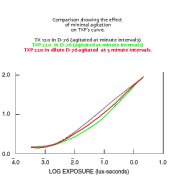
If I choose a developer like XTOL or D-76, dilute it to lengthen the development time, and agitate the film for 10 seconds every 5th minute, the 'belly' of the TXP curve diminishes, and TXP becomes almost like TX.

I still have to watch the highlights,
but it is much easier to use in the field. To work this 'magic, I have to re-balance the normal exposure and development with the minimum agitation safely possible; but this is what craftsmanship is all about.

Here is an illustration showing a normal TX curve, a normal TXP curve,
and the results of minimal agitation with dilute D76. XTOL works even better.
NOTE: it might not seem to be a big difference, but if it frees you from burning and freaking dodging for the rest of your life, it can't be all bad, can it ?

 

Attachments

  • TX:TXP Minimal Agitation D76.jpg
    TX:TXP Minimal Agitation D76.jpg
    105.7 KB · Views: 186
DF, very interesting! I just shot some TXP of some old barns near me on a bright, sunny day with lots of contrast; just to be different, of course, and I wanted to use 220. I didn't get killer, award-winning negs, but they are quite printable. I was spot-metering at EI 320.

What dilutions, times, EI's and metering technique would you use in this situation with TXP and D-76 for your stand devving?
 
according to what I have read here then I guess I have done SS development many times by just backing way off the agitation in my normal process when I know I have high contrast. In fact using a dilute developer like Beutlers and agitating just 5 seconds a minute would be pretty close to that.

My problem with minimal agitation with Rodinal 1-100 or Beutlers on 120 film is odd plus density marks on the film and sometimes bubble marks on the edges.

The two images I put in the gallery last night were Beutlers process and 5 seconds a minute agitation.
Dennis
 
Beutlers, interestingly enough, is a suggested 'standing developer' suggested by Agfa in the early 1920s, diluting its basic metol-carbonate developer. Rodinal 1+100 is also a long time classic.

The reason I limit my 'resting cycles' to 5 minutes (Sandy King tends to use 3 minutes, I think) is that I don't run into the density problems, and other artifacts. With different film and developer combinations, I've succeeded with 10 minutes cycles, sometimes only to 7 minutes. But never at 5 minutes. Five minute cycles give me all the goodness, and eliminates the risk. Obviously, you need to increase the development time when you agitate less. I judge my negatives by midtone values,
and a good starting point is to reduce the developer concentration by 50%, and increase the time by 50%. But all film and developer combinations differ, and you can't predict the exact time.

(there is a tremendous difference between agitating film 5 seconds per minute, and 10 seconds every fifth minute.)

That said, compared to longer resting times, there is IMHO little to be gained by resting longer.

The purpose of higher than normal dilutions is to increase the development times, thereby increasing the effect of the minimal agitation. With Rodinal, there is nothing to be gained by going beyond 1+50. The magic comes from the reduced agitation, not the dilution. Dilution ONLY slows the process.

I have only used steel reels since 1968. I have heard some folks have problems with various types of plastic reels. I have heard that there some plastic reels that ARE good for minimal agitation. I have NO suggestions for using plastic reels.

I also advocate filling the tank with developer before adding the reels. I haven't EVER had a problem in 40 years, developing with steel reels, and adding the the solution beforehand.
 
Photrio.com contains affiliate links to products. We may receive a commission for purchases made through these links.
To read our full affiliate disclosure statement please click Here.

PHOTRIO PARTNERS EQUALLY FUNDING OUR COMMUNITY:


Ilford ADOX Freestyle Photographic Stearman Press Weldon Color Lab Blue Moon Camera & Machine
Top Bottom