

• Welcome to Photrio!
    Registration is fast and free. Join today to unlock search, see fewer ads, and access all forum features.
    Click here to sign up

Stand Development

Somewhere...

D
Somewhere...

  • 2
  • 1
  • 69
Iriana

H
Iriana

  • 6
  • 1
  • 129

Recent Classifieds

Forum statistics

Threads
202,740
Messages
2,844,938
Members
101,494
Latest member
FlyingDutchman
Recent bookmarks
0
So called stand development seems to be the refuge for those who shy away from giving film conventional development because they can't, won't, or don't want to learn how to burn in highlights while enjoying a full spread of shadow tones and mid tones.

And why is it called stand development when only half the system, the film, is standing while the developer molecules are free to flow and diffuse at will? Maybe real stand development should be like the old Bimat process where the developer is a gel and no liquid phase is present.
 
So called stand development seems to be the refuge for those who shy away from giving film conventional development because they can't, won't, or don't want to learn how to burn in highlights while enjoying a full spread of shadow tones and mid tones.

And why is it called stand development when only half the system, the film, is standing while the developer molecules are free to flow and diffuse at will? Maybe real stand development should be like the old Bimat process where the developer is a gel and no liquid phase is present.
Always was curious: Was the Bimat system ever used on anything else than autonomous spacecraft?
It would be just the ticket for easy home development I think.
 
Why do I have to waste time during printing, waste expensive paper “to burn” in highlights, when I can simply modify aggetation method, so my highlights don’t build up too quickly ? That’s what stand development does; it allows the silver grain to reduce slowly, which makes it small. Try continually shaking your film developing tank constantly for your slotted time like a mixing a martini; shaken/ not stirred. And compare film under enlargement. And tell me what you see compared against film developed as “stand”. ??? Optimizing masking, of highlight grain in pyro developer, semi stand development for control density of highlights, optimizing mid tone expansion, is for some a sound strategy, and is easy printing! I don’t get the fuss with “the haters” out there
 
Why do I have to waste time during printing, waste expensive paper “to burn” in highlights, when I can simply modify aggetation method, so my highlights don’t build up too quickly ? That’s what stand development does; it allows the silver grain to reduce slowly, which makes it small. And compare film under enlargement. And tell me what you see compared against film developed as “stand”. ??? Optimizing masking, of highlight grain in pyro developer, semi stand development for control density of highlights, optimizing mid tone expansion, is for some a sound strategy, and is easy printing! I don’t get the fuss with “the haters” out there

I agree, greg. My worry, never having done it is that not only is there no consensus on it there isn't even any middle ground. The more I read and the more videos I look at there appears to be those for whom full stand has created no issues at all then there are those (probably the majority who recognise the issue of bromide drag) but who rightly point out that a form of semi-stand works and it would seem that those users do achieve the benefits without the drawbacks

I have yet to find the "holy grail" which is what is the minimum agitation required to reach the objectives of smallest grain. Has anyone ever done an experiment for 135 film in which they find out how small a grain can be achieved with stand/semi-stand for comparison with that grain produced by say D76 and "normal" agitation" across a range of films from 50 - 400 and likewise for 120 film?

Until I see such a study or even a balanced debate on it then like a lot of other matters it would seem that the only way is to try it

Unfortunately like a lot of other matters "film and printing " there are only two sides, one of whom is called White and is the implacable enemy of the one called Black. The "Middle Ground" party, if it ever existed, was crushed years ago

pentaxuser
 
Worth a read:

https://gitbucket.tundraware.com/tundra/Stand-Development

The article doesn't mention grain size but says a lot about contrast. What I found interesting is that a tiny amount of agitation makes a big difference to contrast compared to pure stand developing. I have agitated fairly minimally for years and i think it's one reason my negatives have become easier to print, and have avoided trying stand development because of the risk of unevenness.
 
Last edited:
Why do I have to waste time during printing, waste expensive paper “to burn” in highlights, when I can simply modify aggetation method, so my highlights don’t build up too quickly ? That’s what stand development does; it allows the silver grain to reduce slowly, which makes it small. Try continually shaking your film developing tank constantly for your slotted time like a mixing a martini; shaken/ not stirred. And compare film under enlargement. And tell me what you see compared against film developed as “stand”. ??? Optimizing masking, of highlight grain in pyro developer, semi stand development for control density of highlights, optimizing mid tone expansion, is for some a sound strategy, and is easy printing! I don’t get the fuss with “the haters” out there
I don't like what stand does to mid-tones, and I'm happy burning highlights.
And I care the most (usually) about the mid-tones.
As the saying goes, YMMV.
 
Why do I have to waste time during printing, waste expensive paper “to burn” in highlights, when I can simply modify aggetation method, so my highlights don’t build up too quickly ? That’s what stand development does; it allows the silver grain to reduce slowly, which makes it small. Try continually shaking your film developing tank constantly for your slotted time like a mixing a martini; shaken/ not stirred. And compare film under enlargement. And tell me what you see compared against film developed as “stand”. ??? Optimizing masking, of highlight grain in pyro developer, semi stand development for control density of highlights, optimizing mid tone expansion, is for some a sound strategy, and is easy printing! I don’t get the fuss with “the haters” out there

You wont need to burn in highlights if you expose and develop correctly for the lighting ratio in the image you are recording. Stand development is not required.
 
It is much better for your heart and overall health than sitting development, much like a standing desk for your computer.
 
Andrew O'Neill makes excellent use of enhanced edge effects. When those are combined with his Carbon Transfer work, it is impressive.
One of the ways to increase the 'edge effect' is with the carbon printing process itself. Carbon prints can have significant raised relief, with the blacks being thicker than the whites. Imagine the diagram in post #15 was mapping the height difference of the emulsion between two tonalities as an interesting edge effect, and how the affects how we see the image.

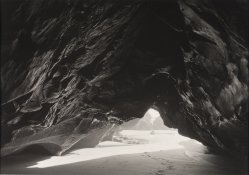
I have no reason to use stand development -- dang, I am always having to expand the SBR on the negative. The only time I have used anything less than 'normal' development was back in the mid-90s because I read at least 13 stops with my Pentax spot meter in the scene below...I think it was about 10% less than normal. 5x7 carbon print
 

Attachments

  • SeaCave5x7.jpg
    SeaCave5x7.jpg
    361.9 KB · Views: 91
Last edited:
I don't like what stand does to mid-tones, and I'm happy burning highlights.
And I care the most (usually) about the mid-tones.
As the saying goes, YMMV.
Wow a balanced comment on this super controversial subject, Matt, as tends to be your modus operandi. A rare gem indeed in this B&W world :smile:

Due to the imposed covid -19 isolation I have had the time to trawl through a lot of YouTube videos which was a source I had never bothered with previously and this includes ones on stand/ semi-stand development and other topics and what I have noticed is that the same "usual suspects" seem to turn up on a lot of them in the comments/ questions section with the same negative comments on anyone demonstrating something that is not part of their shibboleths

Indeed I suspect that in some cases their objective is purely to be a naysayer on everything. Of course the comments section on videos is not designed for a lengthy debate where matters are examined in a balanced fashion but this is not the case with our infrastructure

I feel I have developed a "nose" for such comments to which I refer above in videos or on forums now but 12-15 years ago as a newcomer to the site and photography I certainly did not have such a "nose" and tended to accept without question what was said without being able to read between the lines so to speak but if we hope to be seen as a beacon for balance and the provision of wisdom and truth for newcomers then this has to be our aim, doesn't it?

On the other hand that may not be the function of Photrio or not any longer and that's fine by me as long as we realise its negative effect on those potential new members who are looking for balanced information but may not be finding what they need in the form of anything resembling helpful guidance

pentaxuser
 
I'd be curious to shoot two rolls side by side, exactly the same, one with stand development, one without, and seeing the extent to which a difference could be distinguished. My guess is the difference isn't as significant as discussed. I usually stick to agitating normally, although I'm lazy by nature and do like the idea of just dumping in my developer and leaving my film to sit for an hour until its ready for me.
 
Sorry, pentaxuser, but especially in the case of a beginner, good information is a lot more useful than “balanced” information..
The problem is that good information can be that which the respondent imparts and in many case a lot of what the respondent imparts is different from that which another respondent imparts. At times this leaves the questioner with no answer at all, especially when different respondents do not in fact "talk to one another" for the benefit of the questioner

Very quickly the questioner gets forgotten about in the ensuing "gunfight" and winning is what counts. Not ideal

pentaxuser
 
Well, not that I’m recommending it (I wouldn’t), but there isn’t much about stand development that inherently compresses contrast. It expands contrast just fine.
But I do not want my highlights held back at all.
 
I'd be curious to shoot two rolls side by side, exactly the same, one with stand development, one without, and seeing the extent to which a difference could be distinguished. .

Good point and one I was trying to refer to in my # 32. We are enabled by information which can be demonstrated. Videos by the likes of Greg Davis about the real difference between Kodak type film agitation and Ilford type spring to mind

pentaxuser
 
That takes real talent.

Either that or its thread standing where you let threads develop to completion before indulging in some needless agitation to see if you can create any more edge effects. More likely it will just create more drag tho.
 
I'd be curious to shoot two rolls side by side, exactly the same, one with stand development, one without, and seeing the extent to which a difference could be distinguished. My guess is the difference isn't as significant as discussed. I usually stick to agitating normally, although I'm lazy by nature and do like the idea of just dumping in my developer and leaving my film to sit for an hour until its ready for me.

You're in luck! I have done this, with HP5+. I don't have the prints any more, so you'll have to be satisfied with my half-baked recollections.

The shot had some deep shadow, some open shade, and some full sun. The stand developed film (Rodinal 1+150, which I found produced contrast very close to normal development) had noticeably denser shadows, and slightly flatter highlights. The change in highlights was not what I wanted; I like bright highlights, and I will increase agitation if a given film isn't delivering on that front. However, the boost in shadow detail was potentially very useful. The grain was no different, and neither was the sharpness.

I don't recall seeing bromide drag in that test, but I've seen it on other films where I used stand development. That's the main reason I don't use it any more. I'd probably only consider it if I had a subject with a huge SBR.
 
Either that or its thread standing where you let threads develop to completion before indulging in some needless agitation to see if you can create any more edge effects. More likely it will just create more drag tho.

You may want to burn in some of those highlights.
 
Don’t worry. It doesn’t do that. Still not suggesting it though.
So I will get the same highlights I do with an active developer with constant agitation for about twice the 'normal' amount of development for scenes of a SBR of about 5 or 6 stop range to get a DR of about 2.8?
 
You're in luck! I have done this, with HP5+. I don't have the prints any more, so you'll have to be satisfied with my half-baked recollections.

The shot had some deep shadow, some open shade, and some full sun. The stand developed film (Rodinal 1+150, which I found produced contrast very close to normal development) had noticeably denser shadows, and slightly flatter highlights. The change in highlights was not what I wanted; I like bright highlights, and I will increase agitation if a given film isn't delivering on that front. However, the boost in shadow detail was potentially very useful. The grain was no different, and neither was the sharpness.

I don't recall seeing bromide drag in that test, but I've seen it on other films where I used stand development. That's the main reason I don't use it any more. I'd probably only consider it if I had a subject with a huge SBR.


Thanks. Can you recall what was your agitation regime when you saw bromide drag on other films. It may be that some films are more prone to bromide drag but if this were to be the case then I cannot work out what it might be about that film type or those film types if it were more than one that might cause this?

Only by attempting to establish from actual user experience such as here or in videos might it be possible to lay a few guidelines about the minimum agitation to avoid bromide drag.

pentaxuser
 
I just used semi-stand development, last night, on film from a graphmatic holder that was lost for 15 years, that I found saturday when I was cleaning stuff from my garage. Having no clue what was on the film, my priority was on getting a printable image.

Contrast did not seem to be sacrificed.

Film was Tri-x, shot from a Super Graphic. Developed in Rodinal 1:200 with 30 sec agitation at the beginning and 30 seconds at the 1 hour mark.

https://www.flickr.com/photos/187380343@N05/51015072721/in/dateposted-public/

Another salvage of an unknown negative, here... Tech Pan 4x5 film

https://www.flickr.com/photos/187380343@N05/50870533083/in/dateposted-public/
[\IMG]
 
Last edited:
Photrio.com contains affiliate links to products. We may receive a commission for purchases made through these links.
To read our full affiliate disclosure statement please click Here.

PHOTRIO PARTNERS EQUALLY FUNDING OUR COMMUNITY:


Ilford ADOX Freestyle Photographic Stearman Press Weldon Color Lab Blue Moon Camera & Machine
Top Bottom