
-
Welcome to Photrio!Registration is fast and free. Join today to unlock search, see fewer ads, and access all forum features.Click here to sign up
You are using an out of date browser. It may not display this or other websites correctly.
You should upgrade or use an alternative browser.
You should upgrade or use an alternative browser.
Stand development times for HP5+ in Rodinal?
-
A
- Thread starter kchoquette
- Start date
Recent Classifieds
-
Free Jobo Sheet Film Loader 2508 No Guides
- Started by Roger Thoms
-
Want to Buy 12x20 Film and Film holder
- Started by stray227
-
Free NuArc Vacuum Frame
- Started by Roger Thoms
-
For Sale Copal Press no.1 shutter (CLA'd)
- Started by OAPOli
-
For Sale Bronica ETR 2.8/50 lens cells
- Started by OAPOli
Forum statistics


[Edit: This is the photograph being discussed below... (there was a url link here which no longer exists).]
Hi Michael,
Oh dear lord no, never personally offended. That's what open discussion is all about. If I had a dollar for every time I've been good faith wrong in my life I wouldn't still be working a day job.
Generally speaking, assertions of "better" or "worse" cannot be logically made without baseline comparisons. And as anyone with any scientific exposure knows, absolute assertions can never be made, only implied. A Law is only a Law because no one has yet figured out how to disprove it.
That said, my observations are admittedly anecdotal. I have not run any baseline-controlled sets of densiometric experiments to determine verifiable cause and effect. Or degree of effect. But neither can common sense and empirical experience be disqualified as indictors of trend.
In the case of this negative, I actually exposed three identical copies that evening. (After having already paid the price of a visit by law enforcement to make sure I wasn't a terrorist in sheep's clothing, I wasn't about to come back again if I didn't have to. Bert has read more on this in the included BPX letter.)
One negative was developed according to my normal regimen. The background registered sufficiently. But the sign face may as well have been a solid block of silver. There was no way my enlarger light was going to penetrate it.
The second negative was developed semi-stand in Adonal/Rodinal. Initially this was in fear of the dreaded bromide artifacts. They didn't show, and the sign face was much less dense, as measured by my densitometer. The background was still acceptable since its necessary minimum base exposure was assured.
The third negativethe one used to make Bert's BPX printwas an attempt to take it as far as I could, just to make sure the grass wasn't greener on the other side. Surprisingly, it was. A still acceptable background. No bromide gremlins. (Perhaps due to the motionless horizontal orientation of the negative in the tray?) And a further significant reduction in the density of the sign face.
This reduction pulled the overall contrast down to a level that I could get away with a 3x burn that doesn't show by reflected light. Although (close your ears Bert, you're not supposed to hear this), if you hold the print up to a bright light from behind, the burning is readily apparent. That's one reason I routinely dry mount all of my BPX submissions.
So although the observations were anecdotal and not scientifically rigorous, neither were they useless. They followed empirically defined common sense expectations, arrived at via prior experience. And the process resulted in the most easily printable negative for the effect I was trying to achieve.
(I should note that I did also try a gentle paper pre-flash, again looking for that greener other side. But it only seemed to flatten the brilliance I was hoping for, so I abandoned that approach.)
So according to the proper application of scientific methodology, no, I cannot categorically state that minimal agitation reduces negative contrast. I have not followed the proper rigorous steps to credibly make that assertion.
However, neither can I simply ignore the results of the three developed negatives. It would be equally foolish to do so, because empirical results do also count. Nothing in nature happens in a vacuum.
You know, Einstein was one of the first great theoretical scientists. But he was also a strong empiricist, believing that regardless of what the numbers predicted, you had to be able to demonstrate and observe the assertion in the real world before it could be considered truly valid.

Ken
Hi Michael,
Oh dear lord no, never personally offended. That's what open discussion is all about. If I had a dollar for every time I've been good faith wrong in my life I wouldn't still be working a day job.
Generally speaking, assertions of "better" or "worse" cannot be logically made without baseline comparisons. And as anyone with any scientific exposure knows, absolute assertions can never be made, only implied. A Law is only a Law because no one has yet figured out how to disprove it.
That said, my observations are admittedly anecdotal. I have not run any baseline-controlled sets of densiometric experiments to determine verifiable cause and effect. Or degree of effect. But neither can common sense and empirical experience be disqualified as indictors of trend.
In the case of this negative, I actually exposed three identical copies that evening. (After having already paid the price of a visit by law enforcement to make sure I wasn't a terrorist in sheep's clothing, I wasn't about to come back again if I didn't have to. Bert has read more on this in the included BPX letter.)
One negative was developed according to my normal regimen. The background registered sufficiently. But the sign face may as well have been a solid block of silver. There was no way my enlarger light was going to penetrate it.
The second negative was developed semi-stand in Adonal/Rodinal. Initially this was in fear of the dreaded bromide artifacts. They didn't show, and the sign face was much less dense, as measured by my densitometer. The background was still acceptable since its necessary minimum base exposure was assured.
The third negativethe one used to make Bert's BPX printwas an attempt to take it as far as I could, just to make sure the grass wasn't greener on the other side. Surprisingly, it was. A still acceptable background. No bromide gremlins. (Perhaps due to the motionless horizontal orientation of the negative in the tray?) And a further significant reduction in the density of the sign face.
This reduction pulled the overall contrast down to a level that I could get away with a 3x burn that doesn't show by reflected light. Although (close your ears Bert, you're not supposed to hear this), if you hold the print up to a bright light from behind, the burning is readily apparent. That's one reason I routinely dry mount all of my BPX submissions.
So although the observations were anecdotal and not scientifically rigorous, neither were they useless. They followed empirically defined common sense expectations, arrived at via prior experience. And the process resulted in the most easily printable negative for the effect I was trying to achieve.
(I should note that I did also try a gentle paper pre-flash, again looking for that greener other side. But it only seemed to flatten the brilliance I was hoping for, so I abandoned that approach.)
So according to the proper application of scientific methodology, no, I cannot categorically state that minimal agitation reduces negative contrast. I have not followed the proper rigorous steps to credibly make that assertion.
However, neither can I simply ignore the results of the three developed negatives. It would be equally foolish to do so, because empirical results do also count. Nothing in nature happens in a vacuum.
You know, Einstein was one of the first great theoretical scientists. But he was also a strong empiricist, believing that regardless of what the numbers predicted, you had to be able to demonstrate and observe the assertion in the real world before it could be considered truly valid.
Ken
Last edited by a moderator:
Ken, while I'm neutral on the subject in general, can you prove anything you've said? That's the problem. I'm not defending NB23, I'm simply asking how anyone who uses the technique actually knows what is happening vs what they think is happening. I can buy the edge effect argument in theory. The problem lies in the statements people make regarding contrast control and film speed. I still have not seen one shred of evidence, data or print-wise to support any of the claims people make. I'm all for people using whatever technique they like - but when you make a statement such as "....minimal agitation, this photograph would not have been possible", that's where I have to disagree.
Hopefully you won't be personally offended by this. It has nothing to do with your photography or the techniques you choose to apply. I don't discriminate when it comes to this kind of thing. Plenty of big names (virtually all of them, except the ones who never wrote technical books, articles etc.) have been guilty of the same sort of violations - so you're in good company
I use stand but don't make any claims it is merely easy if you have different films stick them in a multi tank set the alarm for 60. Never had problems in 50+ years
Rodinal lasts for 25 years in part used bottle or mine did.
You get flat midtones and the dynamic range is not as good as with POTA.
If I've underexposed I use microphen or ID68 with a post borax bath, but I've not detected any differences with the Rodinal stand, apart from contrast. You would need to do a step wedge and look for 1/3 stop...
Lots of people say if you agitate you get more grain this is likely as agitation will increase developer activity and Stone says he detected considerable difference. But I like grain so Im not worried.
pentaxuser
Member
Not sure anyone has noticed but we seem to have lost the OP who initiated the thread way back while only mid-way through page 2 and we are on page 6 now
Maybe he has solved his problem and we won't hear from him again on this thread which might be a pity as I'd like to ask a question which seems obvious to me but I don't think has been asked.
He gets better grain from Tri-X than HP5+ at what appears to be box speed and what grain he has with Tri-X then disappears at 2 stops more which is great.
So, OP can I ask why you have decided to struggle with HP5+ ?
pentaxuser
Maybe he has solved his problem and we won't hear from him again on this thread which might be a pity as I'd like to ask a question which seems obvious to me but I don't think has been asked.
He gets better grain from Tri-X than HP5+ at what appears to be box speed and what grain he has with Tri-X then disappears at 2 stops more which is great.
So, OP can I ask why you have decided to struggle with HP5+ ?
pentaxuser
Thinking further on this, Michael...
Do you have data that, either inductively or deductively, contra-indicates the Ashen Lady results? Because if you do, and especially if it's deductive in nature, that would imply that either I incorrectly observed or misinterpreted the empirical facts, or there are other variables at work in the required set beyond those of which we are currently aware. And in either case my own assumptions may need to be adjusted accordingly.
Reduced/minimal agitation has been used in one form or another since darned near the beginning. It's even included in the early Agfa Rodinal instruction sheets as an option for glass plates, and I believe paper as well.
Stand, semi-stand, water bath, whatever one calls it, the variations on the principle have been used for generations by photographers who really did perceive a visible difference. St. Ansel wouldn't have gone to all the trouble of water bathing all of those negatives if he couldn't see a difference. And his eye for tone far exceeds mine.
He even water bathed Moonrise, didn't he? From Examples: The Making of 40 Photographs:
So this is an appeal to careful empiricism as a valid alternative approach to the goal line. Because again, nothing in nature happens in a vacuum.
Ken
Do you have data that, either inductively or deductively, contra-indicates the Ashen Lady results? Because if you do, and especially if it's deductive in nature, that would imply that either I incorrectly observed or misinterpreted the empirical facts, or there are other variables at work in the required set beyond those of which we are currently aware. And in either case my own assumptions may need to be adjusted accordingly.
Reduced/minimal agitation has been used in one form or another since darned near the beginning. It's even included in the early Agfa Rodinal instruction sheets as an option for glass plates, and I believe paper as well.
Stand, semi-stand, water bath, whatever one calls it, the variations on the principle have been used for generations by photographers who really did perceive a visible difference. St. Ansel wouldn't have gone to all the trouble of water bathing all of those negatives if he couldn't see a difference. And his eye for tone far exceeds mine.
He even water bathed Moonrise, didn't he? From Examples: The Making of 40 Photographs:
"Using the Exposure Formula, I placed this luminance on Zone VII; 60 c/ft2 therefore fell on Zone V, and the exposure with the filter factor o 3x was about 1 second at f/32 with ASA 64 film. I had no idea what the value of the foreground was, but I hoped it barely fell within the exposure scale. Not wanting to take chances, I indicated a water-bath development for the negative."
So this is an appeal to careful empiricism as a valid alternative approach to the goal line. Because again, nothing in nature happens in a vacuum.
Ken
Last edited by a moderator:

I just wrote a whole bunch and it disappeared. But what I basically said is that I've done this test before using Foma100 (a really grainy film) with Rodinal, to see the difference, and increasing grain was not high at all, and the increase in shadow detail and decrease in highlight was obvious.
If I have the time I will post something but if I don't then I probably won't get to it for a while I have lots of family things going on.
But I actually did take three pictures of the same flower, developed one as a stand development, develop the other as a regular inversion, and the third one I have actually not developed but it's going to be rotary.
If I have the time I will post something but if I don't then I probably won't get to it for a while I have lots of family things going on.
But I actually did take three pictures of the same flower, developed one as a stand development, develop the other as a regular inversion, and the third one I have actually not developed but it's going to be rotary.
- removed account8
- Deleted
My understanding of generalized minimal agitation technique is that it depends on differential developer activity as a function of exposure.
Meaning, in the absence of refreshed developer higher exposure areas will exhaust quicker, while lower exposure areas will exhaust slower. Essentially, less fresh developer is available for longer periods over higher exposure areas. As if those areas were being differentially (and proportionally) less agitated.
This is the effect both stand and water bath rely upon. Only the application mechanism differs.
Stand keeps the exposures continually in contact with developer solution with little or no agitation. Water bath flips back-and-forth between developer immersion and a no agitation plain water immersion, using the developer that has soaked into the emulsion itself, in exchange for significantly more agitation between each flip.
I believe that AA applied ten cycles (flips) for Moonrise using D-23? Could be wrong about that, though.
But in both cases it's a form of minimal agitation that results in differential building of negative density.
Is my understanding incorrect?
Ken
Meaning, in the absence of refreshed developer higher exposure areas will exhaust quicker, while lower exposure areas will exhaust slower. Essentially, less fresh developer is available for longer periods over higher exposure areas. As if those areas were being differentially (and proportionally) less agitated.
This is the effect both stand and water bath rely upon. Only the application mechanism differs.
Stand keeps the exposures continually in contact with developer solution with little or no agitation. Water bath flips back-and-forth between developer immersion and a no agitation plain water immersion, using the developer that has soaked into the emulsion itself, in exchange for significantly more agitation between each flip.
I believe that AA applied ten cycles (flips) for Moonrise using D-23? Could be wrong about that, though.
But in both cases it's a form of minimal agitation that results in differential building of negative density.
Is my understanding incorrect?
Ken
Last edited by a moderator:

This article is as close as I've seen to the stand vs normal agitation issue being addressed well, and it doesn't address grain as I remember. (there was a url link here which no longer exists)
The essence of reduced agitation methods is to create a more S shaped curve. Flatter shadow tones, flatter highlights, while keeping normal mid tones.
One of the challenges the article addresses is that the EI if pegged to where the mid tones are "normal" that isn't going to be at box speed. It doesn't have the same relationship between zone V and .1 density as normal ZS adherents are used to; the toe gets real long.
Yes there may be more shadow detail available to print but it's still down on the toe, yes .1 comes at a faster speed but so what? To take full advantage of stand developing 2-3 stops of extra exposure may be needed to place mid-tones and highlights in the best spot for printing.
Without that extra exposure the curves in that article suggest to me that for normal or reduced exposure, stand development acts a lot like a simple pull or minus development.
Finding your personal sweet spot, as D F Cardwell did would take some testing.
The essence of reduced agitation methods is to create a more S shaped curve. Flatter shadow tones, flatter highlights, while keeping normal mid tones.
One of the challenges the article addresses is that the EI if pegged to where the mid tones are "normal" that isn't going to be at box speed. It doesn't have the same relationship between zone V and .1 density as normal ZS adherents are used to; the toe gets real long.
Yes there may be more shadow detail available to print but it's still down on the toe, yes .1 comes at a faster speed but so what? To take full advantage of stand developing 2-3 stops of extra exposure may be needed to place mid-tones and highlights in the best spot for printing.
Without that extra exposure the curves in that article suggest to me that for normal or reduced exposure, stand development acts a lot like a simple pull or minus development.
Finding your personal sweet spot, as D F Cardwell did would take some testing.
Last edited by a moderator:
- removed account8
- Deleted

He even water bathed Moonrise, didn't he? From Examples: The Making of 40 Photographs:
"Using the Exposure Formula, I placed this luminance on Zone VII; 60 c/ft2 therefore fell on Zone V, and the exposure with the filter factor o 3x was about 1 second at f/32 with ASA 64 film. I had no idea what the value of the foreground was, but I hoped it barely fell within the exposure scale. Not wanting to take chances, I indicated a water-bath development for the negative."Ken
Ah, now that's a book worth reading ...
Ansel Adams explains how he made his negatives/prints and tells a nice story as well.
Bert from Holland
http://thetoadmen.blogspot.nl
Just saw this and thought it could be relevant.
(there was a url link here which no longer exists)
(there was a url link here which no longer exists)
HiStone
You are trying to confuse us with experimental results again?
Noel
Haha!!!

baachitraka
Member
I have used Rodinal(1+100) stand for an hour at 17°C for Rollei RPX 400 negative exposed using Holga 120GFN on bright sunny day.
Results were pretty good and used Grade 3 for printing and required 1/4th of the stop to burn the sky.
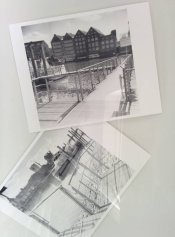
Results were pretty good and used Grade 3 for printing and required 1/4th of the stop to burn the sky.
baachitraka
Member
On that day incident reading on open shade read EV 15 but camera was limited to 1/100th of a second either @f/8 or @f/11.
Stand development kept highlights very well, but I may not use it as a general purpose development scheme.
Stand development kept highlights very well, but I may not use it as a general purpose development scheme.
| Photrio.com contains affiliate links to products. We may receive a commission for purchases made through these links. To read our full affiliate disclosure statement please click Here. |
PHOTRIO PARTNERS EQUALLY FUNDING OUR COMMUNITY:  |