

• Welcome to Photrio!
    Registration is fast and free. Join today to unlock search, see fewer ads, and access all forum features.
    Click here to sign up

Stain to Silver Ratio in Pyro Negatives

a sidebar

H
a sidebar

  • Tel
  • Feb 3, 2026
  • 0
  • 0
  • 32
On The Mound

A
On The Mound

  • 1
  • 3
  • 63

Forum statistics

Threads
202,141
Messages
2,835,725
Members
101,134
Latest member
georgeR9
Recent bookmarks
0

Nicholas Lindan

Advertiser
Advertiser
Joined
Sep 2, 2006
Messages
4,316
Location
Cleveland, Ohio
Format
Multi Format
The ratio of stain to silver in pyro negatives may not be constant, contrary to assumption.

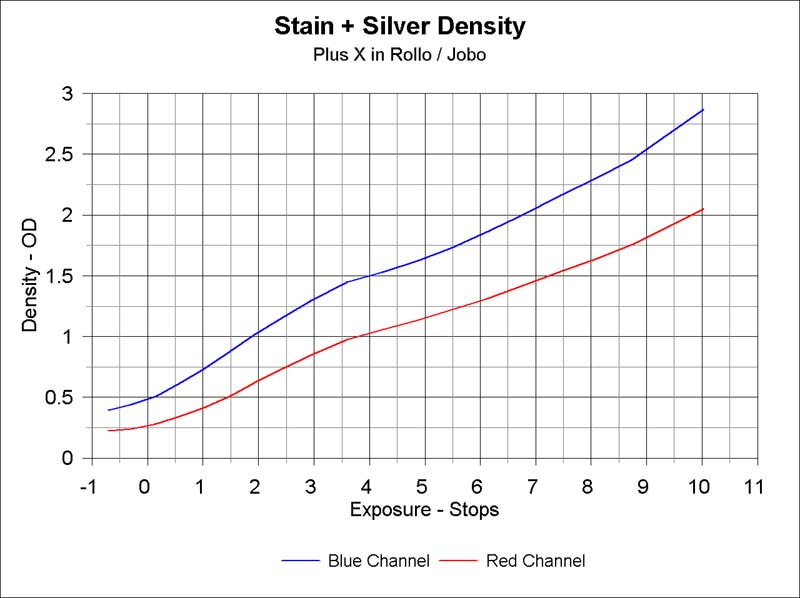
A typical density plot for a pyro negative is shown below:
rollossd.jpg

Plus-X sheet film, projected 21 step tablet, Rollo Pyro 8 minutes, Jobo tank & spiral reel, Unicolor reversing motor base, Noritsu DM-201 densitometer.

The red channel sees little of the stain, the blue a lot. At first glance the stain density looks proportional to the silver non-stain density.

[The plot shows some interesting anomalies from being developed on the old Jobo 4x5 sheet film spiral reels. The curve shows a premature toe, an uplift where one would expect a shoulder and a large carbuncle in the middle. The increased density is due to increased development caused by greater agitation due to turbulence at the edges as they cut through the pool of developer in the tank. One edge of the film is at steps 1-3 (shoulder of the curve) and 19-21 (toe), the other edge at steps 9-11 & 11-13 (peak at 3.5 stops exposure). In spite of this the two curves run in tandem.]

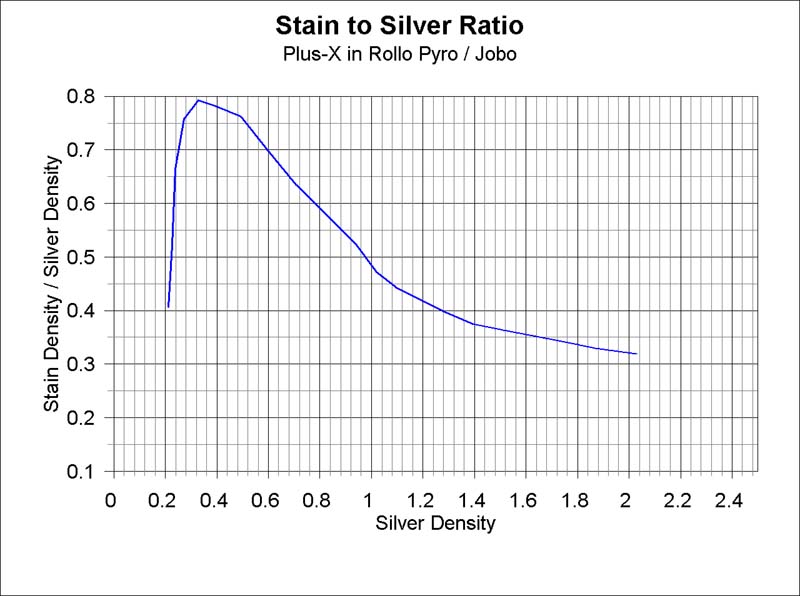
However, a closer reading of densities and calculation of the ratio of stain to silver, using the procedure detailed at the end of the post, reveals a different story.
rollos2s.jpg


A closer look at the first plot shows the same ratio variation - as a few minutes with a calculator will show.

I don't know the reason for the variation.

The Experimental Procedure

  1. Plus-X sheet film was exposed to a projected step tablet
  2. The film was developed in Rollo Pyro in a Jobo tank / spiral reel on a reversing Unicolor motor base
  3. Densities were measured with a Noritsu DM-201 color densitometer
  4. Silver was bleached away with ferricyanide
  5. Densities of the resulting stain-only negative were again measured
  6. Silver density was calculated by subtracting the stain densities measured in step 5 from the stain plus silver densities of step 3
  7. Stain to silver ratio was determined by dividing the blue channel stain measurements from step 5 by the visual channel silver densities calculated in step 6 - these are the values plotted as a function of the silver density from step 6. The same shape of curve arises if one has exposure as the horizontal axis.
 
Last edited by a moderator:

Jim Noel

Member
Allowing Ads
Joined
Mar 6, 2005
Messages
2,261
Format
Large Format
What you have done is likely correct for the developer you used.
However, it is inappropriate to group all pyro based developers. The two primary pyro developers, Pyrocatechol and pyrogallol, stain differently and each different formula for these has a variance in response.
 
OP
OP
Nicholas Lindan

Nicholas Lindan

Advertiser
Advertiser
Joined
Sep 2, 2006
Messages
4,316
Location
Cleveland, Ohio
Format
Multi Format
On a philosophical note...

It has been said that people can be grouped as either simplifiers or complicators. The world needs both, though carried to extremes either can get exasperating.

I have noticed that people drawn to pyro are of the complicating bent.

Those who use D-76 1:1 are simplifiers.
 
Last edited by a moderator:

Vaughn

Subscriber
Allowing Ads
Joined
Dec 13, 2006
Messages
10,291
Location
Humboldt Co.
Format
Large Format
So the question is, am I a simplified complicator, or a complicated simplifier...hmmmmmmm :D
 

brucemuir

Member
Allowing Ads
Joined
Dec 25, 2007
Messages
2,228
Location
Metro DC are
Format
Multi Format
It has been said that people can be grouped as either simplifiers or complicators. The world needs both, though carried to extremes either can get exasperating.

I have noticed that people drawn to pyro are of the complicating bent.

Those who use D-76 1:1 1-shot are simplifiers.
You are complicating things...or is it simplifying by generalization?

I use both.
:smile:
 

Photo Engineer

Subscriber
Allowing Ads
Joined
Apr 19, 2005
Messages
29,018
Location
Rochester, NY
Format
Multi Format
It does not matter what Nicholas is! He has carried out a very meaningful experiment and presented it to us clearly so that everyone can understand the data. The problem is that many people will miss the implication of this. Combined with his previous post, this data shows that there are some very complex issues that impact a print made with any paper using a pyro negative such as the one shown above.

Thanks Nicholas for a very interesting piece of data.

PE
 

Keith Tapscott.

Member
Allowing Ads
Joined
Jun 11, 2005
Messages
1,846
Location
Plymouth. UK
Format
Multi Format
It has been said that people can be grouped as either simplifiers or complicators. The world needs both, though carried to extremes either can get exasperating.

I have noticed that people drawn to pyro are of the complicating bent.

Those who use D-76 1:1 are simplifiers.
What does that make D-23 users? :laugh:
 
OP
OP
Nicholas Lindan

Nicholas Lindan

Advertiser
Advertiser
Joined
Sep 2, 2006
Messages
4,316
Location
Cleveland, Ohio
Format
Multi Format
Those who use D-76 1:1 are simplifiers.
You are complicating things...or is it simplifying by generalization?
I use both.
So the question is, am I a simplified complicator, or a complicated simplifier
What does that make D-23 users?
How about D76 straight?

This is all getting very complicated...
 

John Bond

Member
Allowing Ads
Joined
May 23, 2006
Messages
47
Format
Medium Format
It seems the total of silver grain and pyro stain may be different than the sum of its parts. Could it be that what some think is a filtering effect from the stain is actually the result of a nonlinear combination of silver to stain creating a different characteristic curve than if the two combined in a more linear way?
 

Photo Engineer

Subscriber
Allowing Ads
Joined
Apr 19, 2005
Messages
29,018
Location
Rochester, NY
Format
Multi Format
I doubt if the combination is non-linear. Nothing we have seen here would indicate that, but see the other post by Nicholas for more useful information.

PE
 
OP
OP
Nicholas Lindan

Nicholas Lindan

Advertiser
Advertiser
Joined
Sep 2, 2006
Messages
4,316
Location
Cleveland, Ohio
Format
Multi Format
the result of a nonlinear combination of silver to stain creating a different characteristic curve than if the two combined in a more linear way?

The optical densities of two compounds add in a linear fashion. This is a very, very, very fundamental property. One would have as much luck arguing that Force does not equal mass times acceleration for some magic compound. Oh, hell, I have a good friend who believes in anti-gravity, space aliens and regularly talks to ghosts. Belay that last point.

Anyway...

The stain is stuck to the gelatin and not to the silver. It isn't properly referred to as stain but as tanning - as in leather.

It is reasonable to assume that under the alkaline conditions of tanning development, the quinoid oxygen atoms of the oxidized developer become strong proton acceptors from amino groups of the protein, and the polymerization in situ of the primary oxidation products to polyfunctional substances of higher molecular weight serves to crosslink the polypeptide chains. (*)

C. E. Kenneth Mees, The Theory of the Photographic Process, Revised ed. (New York: Macmillan, 1962) 584​

Well, that about obfuscates that point to death.

(*) In English this time:

Under alkaline conditions pyrogallol molecules, after they have been oxidized by the act of developing silver, stick to the protein in gelatine. They also stick to each other forming long chains that join protein molecules together.​

Hence the relief patterns you sometimes see on pyro negatives where the emulsion shrinks in areas of high optical density.

More gelatin relief is one reason old-style films with unhardened thick emulsions are preferred for pyro. The thin well-hardened emulsions of modern films show little to no relief.
 
Last edited by a moderator:

Photo Engineer

Subscriber
Allowing Ads
Joined
Apr 19, 2005
Messages
29,018
Location
Rochester, NY
Format
Multi Format
In simpler words yet, oxidized pyrogallol in alkali acts just like formaldehyde and hardens gelatin!

Nicholas;

To further obfuscate things, but not in THIS case, sometimes materials with color, when combined, do not add in a linear fashion due to very rare chemical interactions. In this case, things are straightforward though. They do add linearly as you say.

PE
 
OP
OP
Nicholas Lindan

Nicholas Lindan

Advertiser
Advertiser
Joined
Sep 2, 2006
Messages
4,316
Location
Cleveland, Ohio
Format
Multi Format
sometimes materials with color, when combined, do not add in a linear fashion due to very rare chemical interactions.

Actually that does happen in this case: the density of oxidized pyro and the density of gelatin don't add linearly as they are polymerized into a tangled mess with its own optical properties.

Oxidized pyro on its own won't have the same absorbance spectra as pyro stain (though it may be close enough for practical purposes; my personal spectrophotometer is in bits in the basement so I can't comment further).
 
Last edited by a moderator:

Photo Engineer

Subscriber
Allowing Ads
Joined
Apr 19, 2005
Messages
29,018
Location
Rochester, NY
Format
Multi Format
I believe that this effect is so tiny it is not a part of the equation. Generally, with most chemicals, the effect is greater with the formation of crystals or hydrogen bonding or a number of other factors not even worth mentioning.

PE
 

Kirk Keyes

Member
Allowing Ads
Joined
Jun 17, 2004
Messages
3,234
Location
Portland, OR
Format
4x5 Format
Under alkaline conditions pyrogallol molecules, after they have been oxidized by the act of developing silver, stick to the protein in gelatine. They also stick to each other forming long chains that join protein molecules together

My understanding was that the oxidized pyro-molecule (whether it is pyrogallol or pyrocatechol) cross-links adjacent parts of the gelatin molecule. This cross-linking can occur between two molecules of gelatin, or parts within the same gelatin molecule.
 

Kirk Keyes

Member
Allowing Ads
Joined
Jun 17, 2004
Messages
3,234
Location
Portland, OR
Format
4x5 Format
Perhaps it shows that the tanning requires a little bit of development to get the stain formation going, then as the amount of development increases the oxidized pyro is able to take advantage of the large excess of nearby gelatin to more efficiently from stain. As more development continues, the large excess of available gelatin for stain formation decreases as it is crosslinked during the formation of the stain. And when there is a large amount of development, the stain continues to consume available crosslinking positions and the formation of stain decreases.

There is probably some steric hindering occuring as the gelatin becomes increasingly crosslinked.
 

Kirk Keyes

Member
Allowing Ads
Joined
Jun 17, 2004
Messages
3,234
Location
Portland, OR
Format
4x5 Format
A typical density plot for a pyro negative is shown below:

rollossd.jpg
It's funny - I have a Noritsu DM-201 and I get a hump in the middle of my curves just like this for all my films/developers - staining or not... I figured it had to do with the Noritsu...
 
Last edited by a moderator:

Photo Engineer

Subscriber
Allowing Ads
Joined
Apr 19, 2005
Messages
29,018
Location
Rochester, NY
Format
Multi Format
Kirk and Nicholas, you are both right but are using different words.

The important thing here is that the quinone form of the oxidized developer crosslinks gelatin and becomes colorless! It loses the double bonds that create color. The excess quinone and the hydroquinone form usually form a quinhydrone which is highly colored. In fact, the parent compound, quinhydrone itself, was used to make green ink! So the excess oxidized developer that does not form crosslinks with gelatin is what is the color former in this case. The color itself is a function of the ratio of quinone to quinhydrone that is left in the coating and if it varies, then the color varies with this ratio. I see no evidence of variation in the samples posted so far, therefore it must be constant throughout the coating.

PE
 

pawlowski6132

Member
Allowing Ads
Joined
Sep 29, 2009
Messages
47
Location
South Bend
Format
8x10 Format
Guys, in all honesty, although I find these types of discussions about pyro interesting, I always find a gap between them and any practical implications or potential impacts for me in the Darkroom. Can someone dumb this down for me and help close the gap???
 
OP
OP
Nicholas Lindan

Nicholas Lindan

Advertiser
Advertiser
Joined
Sep 2, 2006
Messages
4,316
Location
Cleveland, Ohio
Format
Multi Format
I always find a gap between [these discussions] and any practical implications or potential impacts for me in the Darkroom. Can someone dumb this down for me and help close the gap???

I don't know of any practical purpose for any of this information as regards day-to-day darkroom work.

It is of interest to me as I was looking for ways to simplify the calibration procedures for the Pyro Enlarging Meter. I didn't find any - it seems the present calibration, which makes no assumptions about the stain, will have to stay.

As the the experiments seem to contradict the commonly accepted 'lore of pyro' I thought them interesting and posted the results.
 
Last edited by a moderator:
Photrio.com contains affiliate links to products. We may receive a commission for purchases made through these links.
To read our full affiliate disclosure statement please click Here.

PHOTRIO PARTNERS EQUALLY FUNDING OUR COMMUNITY:


Ilford ADOX Freestyle Photographic Stearman Press Weldon Color Lab Blue Moon Camera & Machine
Top Bottom
