• Welcome to Photrio!
    Registration is fast and free. Join today to unlock search, see fewer ads, and access all forum features.
    Click here to sign up

Sprocket holes: Yes or no?

Forum statistics

Threads
203,120
Messages
2,850,073
Members
101,679
Latest member
thatguysitanio
Recent bookmarks
1

Markok765

Member
Allowing Ads
Joined
Apr 26, 2006
Messages
2,262
Location
Ontario, Can
Format
Medium Format
Do you print the sprocket holes in your photos? I do, because it shows the photo is 35mm and from film.
 
I find that the sprocket holes have a strong effect of shattering expectation. In other words, they are not subtle in any way. When looking at the photo, practically the first thing you see is the sprocket holes. The holes have an effect of 'breaking the wall', perhaps reminding you that you are looking at a photograph, and collapsing the scene from imagination-space onto the paper. I find it similar to a 4th wall break in a motion picture. This effect isn't necessarily bad but I certainly wouldn't print everything like that.


sl_film.jpg

Possibly even more visually violent than 35mm printed with unexposed sprocket holes, is film in which the hole area including sprocket holes is exposed.

2865573409_ce8f4193a4.jpg
 
Printing the sprocket holes and rebate is pretty much a cliche, in my opinion. I'm not so sure what the purpose is other than to prove that it's not from a digital camera.
 
nope marko
i don't use a filed down arbusian negative carrier,
i crop the black clean off.
plenty of numeric-ians ps in the rebate, sprocket holes,
black border &C onto their fauxtos so what's the point?
 
I hardly ever shoot 35, but I'd only include the sprocket holes if they added something to the image. I have yet to see any examples where it does add to the image.
 
If the image is crap, no amount of sprocket holes will help.
And if the image is good, added extraneous "stuff" won't do anything but bring it down.

The only reason to print sprocket holes or similar peripheral distractions is as "proof" that the image came from 35mm film or such. Maybe for courtroom usage?

For fine art usage, such stuff is unattractive, distracting, out of scale and jarring to look at - a waste of the viewer's attention. It's technical self pleasuring for photo geeks. Don't do it.

From the viewer's point of view, who cares what camera it came from? Sure, I care for myself, as a maker of images, but I'm not going to inflict that technical blather on others.
 
It is a sort of a frame for the image.

If you are curious about whether the sprocket holes might enhance a particular image, print it both ways, and then decide.

Generally, I think they detract from a good image, and don't enhance a mediocre one.

Matt
 
Only on contact print pages as the frame numbers are actually useful there.
 
My self I think that sprocket holes make the photo look as though you are too cheap to buy a proper negative holder. They add very little to a photo except to advertise the type of film that you use. So in other words "Not a chance in my prints"
 
only with my holga which i have tweaked to u se 35mm film.

sometimes i may print the rebate, but not often. There are times when it works well, but not often
 
But sadly, you can probably get a Photoshop plugin to add that border to a digi-image! :rolleyes:

DaveT

Yep, even the Hasselblad notches can and has been faked. :sad:
Kind regards
 
But sadly, you can probably get a Photoshop plugin to add that border to a digi-image! :rolleyes:

DaveT

Indeed. I've seen a digi-pic in a 4x5 Velvia frame which still had the EXIF info from the camera it was taken on, and an over-saturated colour pic with a sprocket-hole border. The "film"? Acros apparently :rolleyes:
 
Showing the sprocket holes can work very well in the right circumstances. The Rule is not to show them (as obvious from some of the replies). It is an important rule , and as artists we need to know the rules in order to know when to break them.

Printing multiple frames at the same time is one instance that sprocket holes can become a valuable part of the image. And when it is important to the image to be identified as a photograph, sprocket holes can work.

Such devices are not just limited to photography. Lithographers have often matted their prints to include the impression marks of the stone around the image, watercolor painters show the torn (not cut) edge of their paper. One could even argue that some of these "marks" have become (or always have been) part of the image, such as the brush marks of an oil painting.

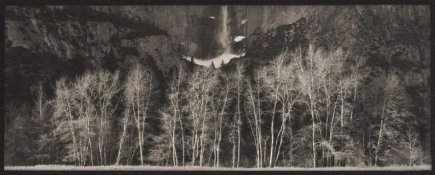
I include the film rebate in my LF platinum/palladium prints. Others such as Richard Avedon have also used the rebate to form part of the image ( http://en.wikipedia.org/wiki/Richard_Avedon ). In one of my images, the widening of the rebate was distracting, so I removed it by scratching it off the neg...The print is below...the area scratched off is in the lower right.

Vaughn
 

Attachments

  • Last Valley Light, Yosemite Falls.jpg
    Last Valley Light, Yosemite Falls.jpg
    86 KB · Views: 207
I find that the sprocket holes have a strong effect of shattering expectation. In other words, they are not subtle in any way. When looking at the photo, practically the first thing you see is the sprocket holes. The holes have an effect of 'breaking the wall', perhaps reminding you that you are looking at a photograph, and collapsing the scene from imagination-space onto the paper. I find it similar to a 4th wall break in a motion picture. This effect isn't necessarily bad but I certainly wouldn't print everything like that.


sl_film.jpg

Possibly even more visually violent than 35mm printed with unexposed sprocket holes, is film in which the hole area including sprocket holes is exposed.

2865573409_ce8f4193a4.jpg

Ah, a somewhat intelligent answer to a subjective question, full of analysis and free of opinion stated as fact (as were several other responses)! It sounds like you might have actually been subjected to an honest-to-god academic photo critique at least a few times in your life. Is this really the Internet? :D
 
I agree with a great many people here - no sprocket holes, and if you think it 'proves' that it's film and not digital, believe me it doesn't - I've seen lots of weirdos who attach digital sprocket holes to their digital photos...you know, because they're so cool.

We're photographers because we're masters of composition - if you sprocket hole your work you're throwing that off. Yes, I have done it in the past...maybe once...as a gimmick.
 
I'm always surprised at how many are so against sprocket holes. I personally like a black border around my photos, but oftentimes the neatly cropped black border is too... neat. Not that I advocate full blown sprocket holes and rebates, but a bit rougher of a border I think can be aesthetically pleasing.
 
I remember a period in the 70s when some included the "black border", to prove full frame cropping, but never the sprocket holes.
To me, it seemed more like a fashion statement than photography.
 
Sounds like Five on One Hand, Half of Ten on the other...

paulie
 
Photrio.com contains affiliate links to products. We may receive a commission for purchases made through these links.
To read our full affiliate disclosure statement please click Here.

PHOTRIO PARTNERS EQUALLY FUNDING OUR COMMUNITY:



Ilford ADOX Freestyle Photographic Stearman Press Weldon Color Lab Blue Moon Camera & Machine
Top Bottom