
• Welcome to Photrio!
    Registration is fast and free. Join today to unlock search, see fewer ads, and access all forum features.
    Click here to sign up

Spotting Advice

Recent Classifieds

Forum statistics

Threads
202,065
Messages
2,834,564
Members
101,094
Latest member
not_cal
Recent bookmarks
0

zsas

Member
Allowing Ads
Joined
May 12, 2011
Messages
1,955
Location
Chicago, IL
Format
35mm RF
I have an unopened Spotone 5 and 6, a nice brush, print below needing spotting is toned in gold (has a hint of blue-black), MGIV matte, is this the wrong Spotone (5 and 6)?

I think I need Spotone 1 for cold bluish prints, that correct? My Phil Davis book seems to indicate Spotone #1 is for cold-bluish, #2 is for warm-brownish and #3 is for neutral black. Then what are 0, 4, 5 and 6?
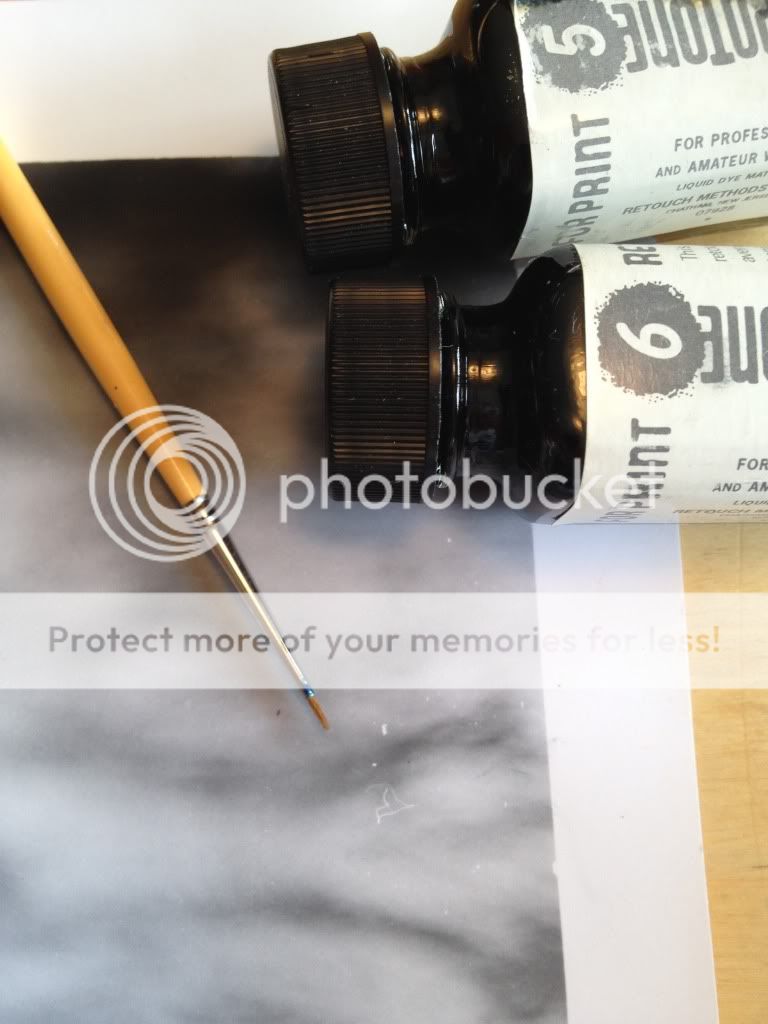
photo-66.jpg


Now the problem, Spotone seems no more. I don't see anything for blue-black prints as a leaf through my Freestyle catalog, any advice?

Thanks!
 

removed account4

Subscriber
Allowing Ads
Joined
Jun 21, 2003
Messages
29,832
Format
Hybrid
hi andy

an old timer i know used to use water color paint ..
but YYMV :wink:

john
 

Jim Jones

Member
Allowing Ads
Joined
Jan 16, 2006
Messages
3,740
Location
Chillicothe MO
Format
Multi Format
I've used Dr. P. H. Martin's inks Dead Link Removed, available at art or crafts stores.
 
OP
OP
zsas

zsas

Member
Allowing Ads
Joined
May 12, 2011
Messages
1,955
Location
Chicago, IL
Format
35mm RF
Thanks all for the advice, just found a bottle and another half bottle of Spotone #1 on CL for less than a pack of gum! Woohoooo! Even has the instruction guide which I didn't have!
 

jordanstarr

Member
Allowing Ads
Joined
Apr 30, 2007
Messages
781
Location
Ontario
Format
Multi Format
The numbers are the density of the black. Those blacks you have are neutral. They come with olive, selenium brown, etc. tints as well and will clearly indicate it on the bottle. If you are doing straight prints, what you have is fine. But something you should consider is taking a little bit out and putting it in a water bottle lid or similar (like a painter's palette) and allow it to dry. The dry black stuff is pure black and is as dense as it can be (so if you need to spot an absolute black, just use a bit of water and dab it. Use more water for lighter shades.

I have a painters pallette with Black, Blue-black, brown-black, selenium black...all dried to nothing with a small thing of water beside me. I have a strip of paper to use as a test and you can hold it up to the print to see if the shades match before spotting. Just my personal method rather than having 8 bottles of neutral black shades #1-8. I have a pretty good feel for water density/mixture is best for the spot, so it works best for me.

You can use spot-one #1 for cold-bluish, but you can also ad some blue if needed to match the tone of your print. Because all paper, developer, developer dilutions, toning dilution and time in the toner are all different for each printer, it's hard to say "use this for that". You need to experiment and match the tones yourself sometimes.
 

AgCl4ever

Member
Allowing Ads
Joined
Feb 24, 2006
Messages
65
Location
Toronto, Canada
Format
35mm RF
I have found Peerless aniline dyes to be a good replacement for now-gone Spotone. They come in a book of dye saturated blotters - clip off a tiny piece, add it to a small puddle of water on a white dish, let it dry, and then pick up some dye on a damp brush. Lots of colors are included in the book, so you can mix just about any color you need for spotting - or, for hand coloring.
 

ROL

Member
Allowing Ads
Joined
Oct 27, 2005
Messages
795
Location
California
Format
Multi Format
Then what are 0, 4, 5 and 6?

Good question. I bought a complete set of on closeout several years ago, $1 apiece. The dyes are:

#1 – Blue Black
#2 – Selenium
#3 – Neutral (Black)
#O – Olive
#S – Sepia
#B – Brown

Never heard of #4, #5, #6. Look at their description and color coding on the label. Oddly the scan of your 5 & 6 seem to carry the same visual as the neutral #3.

Now the problem, Spotone seems no more.

My original set of dyes, #1 – #3, will last a lifetime. I've only ever had need for #3, selenium toned w/o color shift. Get a $1 plastic palette from a hobby or art store, dab a drop on palette, let it dry, then re–wet your spotting brush to pick up small amounts of the dye. Your original drop will last practically forever. If ya got 'em, cherish 'em.

I don't see anything for blue-black prints as a leaf through my Freestyle catalog, any advice?

#1 – Blue Black or combined with #3. Try it out on white paper and then a scratch print first to see if you like it. Make sure you let it dry before judging color.

I wouldn't think that resting the bottles and brush on your print is necessarily a good idea.
 
Last edited by a moderator:

Bill Burk

Subscriber
Allowing Ads
Joined
Feb 9, 2010
Messages
9,479
Format
4x5 Format
I think the #5 and #6 may be recent formulations for Multigrade papers. Maybe you already have what you need.

Just this weekend I saw a few bottles of clear "L" Spotone which I didn't look closely but I assume is lacquer.
 
OP
OP
zsas

zsas

Member
Allowing Ads
Joined
May 12, 2011
Messages
1,955
Location
Chicago, IL
Format
35mm RF
Thanks all! That 5 and 6 I have maybe they came from a parallel universe, the only mention to 4,5,6 was in some other forum where someone said the 5 was neutral (I had a #4 that was broken and thee that bottle out). None of the bottles say anything either, I was given these so that explains my ignorance of what I have if you wonder.

I just brushed some 5 and 6 undiluted onto some scrap FB paper and it looks "black". I am going to get my #1 later this week so should be good, will cut it with my 5/6 if it is too blue. We shall see, my wife paints with the kids every weekend, I am glad I can join them now with my own "painting", I guess I am more of a Seurat kind of painter:smile:

ROL ha! Yes I prob should have not put my inks/brush on the print like above, I crammed in one frame so I photograph the illusive 5 and 6's.

I did find a picture of the set you describe above, not like what I seem to have been given:
http://1.bp.blogspot.com/_lnbYoAP--7k/Rv5wEu2eaEI/AAAAAAAAAy8/SXQV9Q6h1IQ/s1600-h/spotone3.JPG

Thanks so much all for advice!! Can't wait! I spotted in college a bit and found it very peaceful and engaging!
 

Andrew Moxom

Member
Allowing Ads
Joined
Feb 2, 2007
Messages
4,888
Location
Keeping the
Format
Multi Format
Andy, i have the 6 pack of spotone..... I use the neutral,and sepia mixed and sometimes neutral.... And i never use a brush... I use a cocktail stick, wetted at one end. I shake up the two bottles, and take the lids off and turn them over. I dip the stick into both lids, and test it on a scrap piece of card till i get the shade i need. Then i spot the print. The pointed end of the stick is really easy to use and less clumsy than a brush. You can gradually stipple an area to build up density.
 

Blighty

Member
Allowing Ads
Joined
Oct 11, 2004
Messages
914
Location
Lancaster, N
Format
Multi Format
Andy, i have the 6 pack of spotone..... I use the neutral,and sepia mixed and sometimes neutral.... And i never use a brush... I use a cocktail stick, wetted at one end. I shake up the two bottles, and take the lids off and turn them over. I dip the stick into both lids, and test it on a scrap piece of card till i get the shade i need. Then i spot the print. The pointed end of the stick is really easy to use and less clumsy than a brush. You can gradually stipple an area to build up density.
What a fantastically simple idea. I'm using a 00 brush and even that's too big for the very smallest spots. I'm going to try your method.
 
OP
OP
zsas

zsas

Member
Allowing Ads
Joined
May 12, 2011
Messages
1,955
Location
Chicago, IL
Format
35mm RF
Andy, i have the 6 pack of spotone..... I use the neutral,and sepia mixed and sometimes neutral.... And i never use a brush... I use a cocktail stick, wetted at one end. I shake up the two bottles, and take the lids off and turn them over. I dip the stick into both lids, and test it on a scrap piece of card till i get the shade i need. Then i spot the print. The pointed end of the stick is really easy to use and less clumsy than a brush. You can gradually stipple an area to build up density.

Andy - Great method! I tried the traditional way (ie $7 French spotting brush) and just couldn't get it work, then used a plain toothpick (1 box of 250, $0.60), and it worked like a charm! I love the Andrew Maxxom Spotting
Technique (AMST)!
 

M. Lointain

Member
Allowing Ads
Joined
Jun 1, 2011
Messages
143
Format
Multi Format
Unless the color of your print is way off of a black (like sepia for example) you can just use the neutral black and you will never see the difference unless it is a large area.
 

piu58

Member
Allowing Ads
Joined
May 29, 2006
Messages
1,545
Location
Leipzig, Germany
Format
Medium Format
> But something you should consider is taking a little bit out and putting it in a water bottle lid or similar (like a painter's palette) and allow it to dry. The dry black stuff is pure black and is as dense as it can be (so if you need to spot an absolute black, just use a bit of water and dab it. Use more water for lighter shades.


That ist the way I do it. I use a piece of white porecelain to let Spotone dry. The porcelain helps to see the right water dilution / shade of gray.
 

Bill Burk

Subscriber
Allowing Ads
Joined
Feb 9, 2010
Messages
9,479
Format
4x5 Format
I am homing in on the color by spotting on a test strip. Well, actually I use the test strip as a blotter and to check the shade before deciding what spot to hit on the print. But after the test strip is spattered with spots... You can really see the color of the Spotone vs Print. Still too blue. True, as Uwe Pilz says you'll never notice the difference on a normally spotted print. But you know there is a difference.
 

kevs

Member
Allowing Ads
Joined
Aug 21, 2006
Messages
711
Location
North of Pangolin
Format
Multi Format
The way I've learnt spotting is to use extremely dilute dye to build up the tone; I find this method works well. I've used Dylon clothing dyes in the past to good effect for spotting prints - just like the proper stuff it goes into the gelatin. Watercolour paint just sits on the gelatin surface, is very visible on glossy papers and iirc rubs off quite easily. YMMV.

Someone will now tell me that Dylon isn't archival or eats gelatin... :D

Cheers,
kevs
 

Bob Carnie

Subscriber
Allowing Ads
Joined
Apr 18, 2004
Messages
7,735
Location
toronto
Format
Med. Format RF
I have spotted all my career and you may be surprised at how I was taught.

I use a #3 Windsor newton brush which by most posts is very large. The idea with spotting is to charge the brush with ink that is the density or slightly darker than the areas you want to work on.

The tip of the brush should come to a very defined point and not be frayed, as you spot you basically drop from the interior of the brush small amounts of ink to the tip of the brush.
This spot of dye is left into the lighter area of the spot you are working on... by moving around this area and putting in different density's or colours into the space you are creating a rosetta or stocastic rendering of the surrounding area.. The trick is to build up density and colour until the spot dissolves into the background.
Interesting is that black areas are more difficult to spot than neutral grey, you would think the opposite.

#00 brushes or as I call them nose hair brushes are completely useless .. I teach all my staff to use a bigger brush.... big is better they say.
For colour work the blue and brown dyes in combination are really easy to work with.
Sliding a density across an scratch or line is a no no.

Your job as a spotter is to be a camoflage expert and fool the viewer to not seeing your work.
 

Bill Burk

Subscriber
Allowing Ads
Joined
Feb 9, 2010
Messages
9,479
Format
4x5 Format
I use a 20x0 brush which is different than Bob's advice and it's not a toothpick. Both good tips worth trying next time.

I get that the brush needs to be "wet" or else you only get "one spot" out of each visit to the palette.

I'd been using a coffee filter as a blotter. It was driving me crazy because one quick swipe and the brush is entirely bone-dry. Then I hit upon something that was right next to the Q-tips in the cabinet. Light-day pads.

Cut into small rectangular shapes to keep from being busted or grossed out.

When the brush swipes across, you get the shape on the tip and crud is cleaned off. But it doesn't dry the brush out.
 

piu58

Member
Allowing Ads
Joined
May 29, 2006
Messages
1,545
Location
Leipzig, Germany
Format
Medium Format
I have two brushes, a 000 and a 00000 (the finest I could find). I use mostly 00000. But I add irregular rendering
 

M. Lointain

Member
Allowing Ads
Joined
Jun 1, 2011
Messages
143
Format
Multi Format
I do it the way Bob does too. Use a big brush. It definitely helps with the tedium of it since it is easy to cover a print without recharging. The brush has to be a good one though. I like Rafael brushes myself.
 

Bob Carnie

Subscriber
Allowing Ads
Joined
Apr 18, 2004
Messages
7,735
Location
toronto
Format
Med. Format RF
With care a good quality brush should last for years.. I started on Windsor Newtons and really like the quality.
I do it the way Bob does too. Use a big brush. It definitely helps with the tedium of it since it is easy to cover a print without recharging. The brush has to be a good one though. I like Rafael brushes myself.
 

tkamiya

Member
Allowing Ads
Joined
Oct 3, 2009
Messages
4,284
Location
Central Flor
Format
Multi Format
Bob,

You use spotting dye that is slightly DARKER THAN THE IMAGE AREA? Will you tell us how you do this and build up to the surrounding area to blend in??

I use mostly 3/0 brush. I have a 6/0 also but I find it mostly useless. I wonder if choice of brush size has something to do with the print size? I print up to 11x14 and never larger. Size of dust and spec aren't that big.
 

Bob Carnie

Subscriber
Allowing Ads
Joined
Apr 18, 2004
Messages
7,735
Location
toronto
Format
Med. Format RF
I charge the brush and sample tones on the white rebate until I have the tone I reguire.

Also the whole nut of spotting IMHO is the point of the brush ...the point is what creates the drop of tone, the size of print has no bearing to spotting, you need the bigger brush to hold the ink.. this is what some refer to as Charging The Brush with Ink.

I also use my spit to keep the point and as well a bit wet... but now its sounding gross, so I will stop.


Bob,

You use spotting dye that is slightly DARKER THAN THE IMAGE AREA? Will you tell us how you do this and build up to the surrounding area to blend in??

I use mostly 3/0 brush. I have a 6/0 also but I find it mostly useless. I wonder if choice of brush size has something to do with the print size? I print up to 11x14 and never larger. Size of dust and spec aren't that big.
 

Mahler_one

Member
Allowing Ads
Joined
Oct 26, 2002
Messages
1,155
Interesting discussion, and I thank everyone. However, how do you remove the applied dye from the print if you've found that the color applied is "incorrect"? How can the spotting dye be removed without leaving a mark of some sort?
 

tkamiya

Member
Allowing Ads
Joined
Oct 3, 2009
Messages
4,284
Location
Central Flor
Format
Multi Format
You can just rewash the print. If you are using regular photographic dye made for this purpose, it will simply wash off....
 
Photrio.com contains affiliate links to products. We may receive a commission for purchases made through these links.
To read our full affiliate disclosure statement please click Here.

PHOTRIO PARTNERS EQUALLY FUNDING OUR COMMUNITY:


Ilford ADOX Freestyle Photographic Stearman Press Weldon Color Lab Blue Moon Camera & Machine
Top Bottom
