• Welcome to Photrio!
    Registration is fast and free. Join today to unlock search, see fewer ads, and access all forum features.
    Click here to sign up

spoon measurement

Recent Classifieds

Forum statistics

Threads
201,902
Messages
2,831,887
Members
101,014
Latest member
photomaximo
Recent bookmarks
0

David Lyga

Member
Allowing Ads
Joined
Nov 25, 2007
Messages
3,445
Location
Philadelphia
Format
35mm
Does anyone know where to find a chart, online, for spoon measurement? Years ago I found one but currently I have had no luck. This, of course, is for volumetric, rather than mass, amounts. Don't want to get into a controversy about how 'inaccurate' such is (there are pros and cons). I know that Anchell's Darkroom Cookbook has one, but I do not have the book. Thank you. - David Lyga
 

snapguy

Member
Allowing Ads
Joined
Jan 1, 2014
Messages
1,287
Location
California d
Format
35mm
Oh my

Boy, the Internet is all over the map on this one. I did find Biblical-era measurements but the only thing I found I could understand on spoons is that a teaspoon is .50 fluid ounces. Good luck. I don't do apps but there should be one on this. I think.
 

Gerald C Koch

Member
Allowing Ads
Joined
Jul 12, 2010
Messages
8,131
Location
Southern USA
Format
Multi Format
Haven't seen much being written about spoon measurement of chemicals in quit some time. Digital scales have become so reasonable that I think most people weight things out.
 

Kyle M.

Member
Allowing Ads
Joined
Aug 19, 2013
Messages
558
Location
The Firelands
Format
Large Format
Regardless of how inaccurate it is I've been using a teaspoon to measure Rodinal for quite awhile now. A teaspoon is supposed to be approximately 4.9ml, I just round it up to 5ml and everything has been going good so far. I develop everything in rodinal 1+50 so for 1 roll of 35mm film in a Paterson tank thats 250ml total which is 5ml or 1 teaspoon of Rodinal.
 

tkamiya

Member
Allowing Ads
Joined
Oct 3, 2009
Messages
4,284
Location
Central Flor
Format
Multi Format
David,

I've read somewhere that there is really no universally agreed upon definition for teaspoon and tablespoon. I've also read it varies greatly from a brand to a brand of spoons. That said, it is commonly known in US that, teaspoon is 5ml or 5cc, tablespoon is 3 times that at 15ml or 15cc.
 

Truzi

Member
Joined
Mar 18, 2012
Messages
2,685
Format
Multi Format
This probably isn't the kind of answer you want, but why not get a set of measuring spoons and a small graduated cylinder. At least you'll know for your own situation, though it won't help if you are trying to work from someone else's measurements.

You could try some wine-making sites, like:
winemaking.jackkeller.net
It's a long-shot, but you may find something on it.
 

snapguy

Member
Allowing Ads
Joined
Jan 1, 2014
Messages
1,287
Location
California d
Format
35mm
all sorts

There are all sorts of dispensers for small amounts of liquids at your local drug store (Walgreens, etc.) I have a Medicine Dropper and Spoon designed to measure out one or two tablespoons of medication. I guess infants need small doses of medicine so you will find them in the baby department.
 

Xmas

Member
Allowing Ads
Joined
Sep 4, 2006
Messages
6,398
Location
UK
Format
35mm RF
Lots of our (UK)over the counter liquid medications come with little measuring cylinder 2.5 to 30 Mls range stuck over tamper proof cap.

Noel
 
OP
OP
David Lyga

David Lyga

Member
Allowing Ads
Joined
Nov 25, 2007
Messages
3,445
Location
Philadelphia
Format
35mm
David,

I've read somewhere that there is really no universally agreed upon definition for teaspoon and tablespoon. I've also read it varies greatly from a brand to a brand of spoons. That said, it is commonly known in US that, teaspoon is 5ml or 5cc, tablespoon is 3 times that at 15ml or 15cc.

I should have elucidated: Long ago I graduated to a graduated cylinder. I merely mentioned 'spoons' because that is all that most know about when it comes to volumetric measurements of raw photo chemicals. I already KNOW that a teaspoon (at least in theory) represents 5ml and a tablespoon represents 15ml.

What I wanted was the g/ml factors for stuff like metol (I think 0.7) and hydroquinone (I think 0.6). There ARE some chemicals that, like water, equate cubic area with mass, such as potassium ferricyanide (i.e., one ml weighs one gram).

It amazed me to find NOTHING on the Internet about this. I merely wanted a conversion table, like in Anchell's Darkroom Cookbook. And, yes, 'Oh My', I also saw the Biblical measurement site also. - David Lyga
 

Wayne

Member
Allowing Ads
Joined
Jul 8, 2005
Messages
3,622
Location
USA
Format
Large Format
If you post which chems you are looking for I can post the conversions from the Cookbook
 

removed account4

Subscriber
Allowing Ads
Joined
Jun 21, 2003
Messages
29,832
Format
Hybrid
if / when you find the conversion
can you post it back to this thread?
maybe the moderators can make it a sticky
since there are lots of people who tsp rather than weigh things out...
 
OP
OP
David Lyga

David Lyga

Member
Allowing Ads
Joined
Nov 25, 2007
Messages
3,445
Location
Philadelphia
Format
35mm
Thank you, Wayne. I have the following for these. I wish to CONFIRM the gram/ml factors:

metol = 0.7
hydroquinone = 0.6
sodium sulfite, anhydrate = 1.5
potassium bromide = 1.5
sodium thiosulfite, anhydrate = 1
sodium thiosulfite, pentahydrate = 1
NB: at first it might seem odd that both the penta and anhy of sodium thiosulfite have identical factors, but remember: you need 50% more VOLUME of the penta to make the same strength fixer as the anhydrous)


Yes, jnanian, I could NOT BELIEVE that I could not find it on the Internet. To me, this is utterly impossible given the interest to date. With the WHOLE WORLD on the Internet, this lack is not merely depressing, but unfathomable. (Sorry to wax with such emotion, but WORDS are my 'emoticons', not tawdry symbols.) - David Lyga

And for benefit of the others: possibly these also: (I am largely guessing here and want CONFIRMATION):

glycin = 0.35
borax = 0.9
boric acid powder = 0.9
sodium hydroxide = 0.9
sodium metabisulfite = 1.2
Kodalk = 1.1
phenidone A = 0.45
sodium carbonate, anhy = 0.5
sodium carbonate, mono (washing soda) = 1.17

Also, for further benefit: I REGULARLY divide proprietary powder developers and other powder combinations, (even though I could be hung for doing so). I have NEVER had a problem. NEVER. And I have been doing this for years. If there are any mathemeticians out there I think that they will admit that the Standard Deviation for this is VERY confined. Statistically, especially if the powder is shaken up before measuring volumetrically, the deviation from the theoretical norm (i.e., the actual formula) is very low. Thus, I offer the following volumetric numbers for the milliliters of powder contained within each package:

D-76 gallon size: 290ml (I would imagine that Ilford's ID-11 has the same dry volume)
D-76 replenisher gallon size: 390ml
Dektol gallon size: 465ml
Microdol-X gallon size: 370ml
Kodak Fixer with hardener gallon size: 600ml
Kodak Hypo Clearing Agent gallon size: 330ml (I would also like to know if this powder can substitute for developer preserver, as it is almost entirely sodium sulfite)
Kodak D-11 gallon size: 385ml
Kodak D-19 gallon size: 480ml
Polydol gallon size: 300ml
Polydol replenisher gallon size: 410ml
DK-50 part A gallon size: 24ml
DK-50 part B gallon size: 96ml
DK-50 replenisher part A gallon size: 74ml
DK-50 replenisher part B gallon size: 185ml
Ilford Microphen A US gallon size: 40ml
Ilford Microphen B US gallon size: 280ml
Kodak Selectol Soft gallon size: 180ml

I know that many of these are discontinued, but some people might still have a package or can. If your manufacturer sizes differ from one US Gallon (i.e., like if the size is for one quart or one liter), simply remember that a US Gallon has 3785ml of liquid. - David Lyga
 
Last edited by a moderator:

alanrockwood

Member
Allowing Ads
Joined
Oct 11, 2006
Messages
2,195
Format
Multi Format
I am both surprised and pleased that no one has yet posted something like "don't use volume measurements for photo chemicals". The general issue has come up in a few discussions here, and they have usually degenerated into unproductive sniping on either side.
 

pdeeh

Member
Allowing Ads
Joined
Jun 8, 2012
Messages
4,770
Location
UK
Format
Multi Format
Just to make sure the thread is complete, I'll just add that

You must never use volumetric measurements for photographic chemicals.
 
Last edited by a moderator:

Kirks518

Member
Allowing Ads
Joined
Oct 5, 2013
Messages
1,494
Location
Flori-DUH
Format
Multi Format
Honestly, I'm not sure I'm understanding the question, but as I wouldn't have an answer, that's irrelevant. :smile:

D-76 gallon size: 290ml (I would imagine that Ilford's ID-11 has the same dry volume)


But I have a question. If one wanted to use D-76 as a one-shot, and let's say they're using a tank that takes 300ml per 35mm roll, would they then use 23ml (22.985ml)? That's also assuming my math is correct?
 

MartinP

Member
Allowing Ads
Joined
Jun 23, 2007
Messages
1,569
Location
Netherlands
Format
Medium Format
Presumably the variations in volume due to humidity and compacting of the crystals/powder are so small as to be insignificant? Possibly some things vary more than others, so I was just curious what materials are "good enough" when measured volumetrically.
 

Jim Noel

Member
Allowing Ads
Joined
Mar 6, 2005
Messages
2,261
Format
Large Format
I have measured packaged dry chemicals with spoons for 30-35 years and never had a problem.
Examples:
D-76 1+1 = 2 TBS + 15 oz water
I have worked these out for each of the dry chemicals I use through a process of measuring them out. It doesn't take much time or knowledge to do so.
 

albada

Member
Allowing Ads
Joined
Apr 10, 2008
Messages
2,177
Location
Escondido, C
Format
35mm RF
Thank you, Wayne. I have the following for these. I wish to CONFIRM the gram/ml factors:
sodium sulfite, anhydrate = 1.5
(big snip)
- David Lyga

I have the following measurements for sodium sulfite. In both cases, the sulfite was shaken down, causing it to settle to a higher density:
Purchased from Photographer's Formulary (in USA): 1.5
Purchased from silverprint.com in the UK: 1.7

Mark Overton
 

Gerald C Koch

Member
Allowing Ads
Joined
Jul 12, 2010
Messages
8,131
Location
Southern USA
Format
Multi Format
I have the following measurements for sodium sulfite. In both cases, the sulfite was shaken down, causing it to settle to a higher density:
Purchased from Photographer's Formulary (in USA): 1.5
Purchased from silverprint.com in the UK: 1.7

Mark Overton

These data point out the problem with measuring by volume. Since sodium sulfite is usually used in large amounts in BW developers any error for this chemical is not really significant. However it would pose a problem for color developers where it is used in very small amounts.

If you use volume measurement to mix up a developer like D-76 you will get a perfectly workable developer. This assumes that you don't make any errors in the process. However what you get is not quite D-76. IIRC Dr. Henry in his book "Controls in Black and White Photography" discusses the effect of errors in compounding developers. Anyone contemplating using this method should read that portion of his book.
 
OP
OP
David Lyga

David Lyga

Member
Allowing Ads
Joined
Nov 25, 2007
Messages
3,445
Location
Philadelphia
Format
35mm
I am both surprised and pleased that no one has yet posted something like "don't use volume measurements for photo chemicals". The general issue has come up in a few discussions here, and they have usually degenerated into unproductive sniping on either side.

That is why I uttered the caveat at the beginning: that I did not wish to be drawn into such nonsense and defamation.

And Kirks518: your math is correct, in that 23ml does indeed equate to making 300ml of FULL STRENGTH D-76, but I am far and away more frugal than that! In fact, I HIGHLY dilute my developers (not for storage, but for immediate use). For a LITER of working solution D-76 I would use only 12ml (!) of powder. But, I first make a stock solution so that I can make only as much working solution as I wish. To make the stock solution (which stores well as long as it is airtight), I mix the 12ml of D-76 in only 100ml of water and add 0.5ml of sodium carbonate, anhydrous to that 100ml. This is my stock solution. To make a working solution, dilute 1+9. Again, this stock solution of 100ml, stores very well (I use tiny 50ml liquor bottles) as it is MORE concentrated than Kodak's stock solution for D-76.

For use (I use about 80F ambient) I dilute that stock solution 1+9 and process something like Ilford PAN F+ for FOUR minutes, Tri-X for about 10 minutes. If you wish to work colder, consider the Fahrenheit factor (for development time change) to be 1.05. In other words, on a calculator, enter 1.05, then multiply by the 4 minutes and press 'equal' for as many degrees Fahr as you wish to lower the temp. You will get the new, increased, development time. For the opposite, to INCREASE temp (from a lower one), enter the 4 minute development time, then divide by your current development time in minutes and press 'equal' for as many times as needed to reflect the degree F change. Remember always to use decimals: 5 and one half minutes is entered as 5.5 and 7 and one quarter minutes is entered as 7.25.

Of course, you can modify the amount of carbonate you add to the stock solution. But do not go overboard or you will end up with paper developer!

DO NOT use higher dilutions than mine or you will get into trouble. Mine is about 6.5X. That is a LOT, but it works well. Consider that to be a practical limit. Use carbonate to adjust the development time to be what you deem most appropriate. - David Lyga

 
Last edited by a moderator:

RPC

Member
Joined
Sep 7, 2006
Messages
1,633
Format
Multi Format
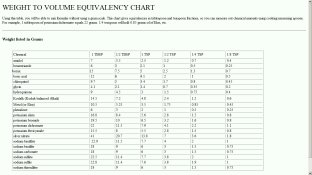
Does this help?
 

Attachments

  • weight to volume equivalancy chart.jpg
    weight to volume equivalancy chart.jpg
    219.5 KB · Views: 116

nworth

Member
Allowing Ads
Joined
Aug 27, 2005
Messages
2,228
Location
Los Alamos,
Format
Multi Format
I haven't seen any on line, but Anchell, "The Darkroom Cookbook", has quite a list. A few of the more common:

Amidol - 2.33 g/tsp (3.5 per half tbsp)
Hydroquinone - 3 g/tsp
Metol - 3.5 g/tsp
Phenidone - 2 g/tsp
Potassium bromide - 6.4 g/tsp (1.6 per quarter tsp)
Sodium bisulfite (anh) 6 g/ ts[
Sodium carbonate (mono) 6 g/tsp
Sodium metaborate - 4.5 g/tsp
Sodium thiosulfate - 6 g/tsp (18 g/tbsp)
Sodium sulfite (anh) 7.6 g/tsp

These are, of course, approximate. But approximate is good enough for a lot of things, like fixers, and for things where precise or reproducible results are not essential.
 
Photrio.com contains affiliate links to products. We may receive a commission for purchases made through these links.
To read our full affiliate disclosure statement please click Here.

PHOTRIO PARTNERS EQUALLY FUNDING OUR COMMUNITY:


Ilford ADOX Freestyle Photographic Stearman Press Weldon Color Lab Blue Moon Camera & Machine
Top Bottom