
• Welcome to Photrio!
    Registration is fast and free. Join today to unlock search, see fewer ads, and access all forum features.
    Click here to sign up

Speed increasing ascorbate/carbonate developer

Sacred

A
Sacred

  • 0
  • 0
  • 11
San Miguel Arcangel

H
San Miguel Arcangel

  • 0
  • 0
  • 25

Recent Classifieds

Forum statistics

Threads
201,958
Messages
2,832,692
Members
101,031
Latest member
charotarguy
Recent bookmarks
0

Alan Johnson

Subscriber
Allowing Ads
Joined
Nov 16, 2004
Messages
3,381
This is based on my previous finding that a developer with high ascorbate and carbonate lasts a long time exposed to air in a half full bottle.My theory is that all the air only oxidizes a small proportion of the ascorbate and the high carbonate means the acid so produced does not cause a significant pH drop.
I call the developer "3W" after the 3 witches in Shakespeare's Macbeth.

3W developer
Water.......................................850ml
Dimezone-S..(stir till dissolved)........1g
Sodium Sulfite..............................20g
Ascorbic Acid (Vitamin C)...............20g
Sodium Carbonate anhydrous.........40g
filter through cotton wool.
Water to........................................1L
pH~9.8
Develop about 10% less than for Xtol 1+0

I have not measured the speed increase compared to D-76 accurately but the attached pics on APX 100 exposed at EI=200 (average metering) show there is an increase.
Phenidone may be used in place of Dimezone-S but the developer may then be less resistant to hydrolysis if it is left unused for a long time.
Previously Gainer formulated various ascorbate developers but unlike them the present brew contains sulfite to uncover latent image specks and provide an increase in EI.
Thanks for comment.

 

Attachments

  • 3W 1.jpg
    3W 1.jpg
    1.1 MB · Views: 182
  • 3W 2.jpg
    3W 2.jpg
    863.1 KB · Views: 186
  • 3W 3.jpg
    3W 3.jpg
    1.2 MB · Views: 172

Rudeofus

Member
Joined
Aug 13, 2009
Messages
5,119
Location
EU
Format
Medium Format
The development time is interesting, as I would have expected a formula with that much Dimezone and Carbonate at that high a pH to work much faster than XTOL. It seems closer to a print developer in formulation but without a restrainer.

+1 to that. I'm very surprised to see such a long dev time for that much Phenidone plus strong secondary dev plus pH close to 10 ...

And I'm also surprised to see that 40 g/l Sodium Carbonate plus 20 g/l Ascorbic Acid gave you pH 9.8 ....
 

Rudeofus

Member
Joined
Aug 13, 2009
Messages
5,119
Location
EU
Format
Medium Format
Initially I would have thought pH should be lower. But given Ascorbic Acids high molecular weight I may be wrong.

What still amazes me is the dev time Alan claims to need. E6 FD with 1 g/l Phenidone, 20 g/l HQMS and pH 9.5 develops Tri-X in less than a minute. When I developed Tri-X for 5 minutes at 30°C (which should equal 10-15 minutes at RT) with E6 FD diluted 1+1, I got a four stop push judging from the characteristic curve. And yes, such intense overdevelopment will raise shadow detail.
 

pdeeh

Member
Allowing Ads
Joined
Jun 8, 2012
Messages
4,770
Location
UK
Format
Multi Format
Interesting.
I played with an Metol/Ascorbic Acid developer (ratio Metol 1:4 Ascorbic Acid) a few months ago, using Sodium Carbonate as the alkali, (although the original formula called for metaborate) and got some rather good results, excellent tone and sharpness, and nowhere near as much grain as I see in the attachments above. The formula was I believe a Kodak "lab developer" used for testing emulsions. it was pretty "hot" though, development times were stupidly short. I never pursued trying to tame it as I'm no chemist, just a fiddler.
 
OP
OP

Alan Johnson

Subscriber
Allowing Ads
Joined
Nov 16, 2004
Messages
3,381
I forgot to mention that the developer is hoped to be re-useable but rather than wait it is convenient to write it up in bite-size chunks.I hope to report future results on the same glass bottle of W3.
The ratio ascorbate:dimezone-s is within limits suggested by Gainer, dimezone-s is a bit heavier than phenidone per mole:
http://unblinkingeye.com/Articles/Synergism/synergism.html

I too expected a shorter development time.I have no densitometer but the contrast looks slightly less than what I get with Xtol and was a surprise and hard to explain.
Perhaps dimezone-s is adsorbed on silver bromide crystals and once it covers the surface adding more does not make much difference. This aspect of chemistry is not my thing.
Measuring the pH again gave 9.8, meter calibrated 6.9, 9.2 and checked afterwards with 5g/L Na2CO3 measured pH=11.1. I'm not entirely happy with this cheap meter.

The pics were taken with an orange filter and I had to increase the contrast after scanning to get blacks. I doubt there is anything particularly unusual about the tonality of W3.

Yes it is grainy and unless this is wanted Xtol pushing would probably be better. There are occasions where it is convenient to shoot 100 box speed film at EI=200.
 

BradS

Member
Allowing Ads
Joined
Sep 28, 2004
Messages
8,130
Location
Soulsbyville, California
Format
35mm
The results seem very good to me. I like the tonality....but, I think the effect due to the orange filter is the much larger than any effect due to the developer.

I am very curious about the fog levels. Based upon my experiments with similar concoctions (yes, Gainer influenced many of us), I would expect considerable fog.
What do you observe with respect to fog levels compared to D76?
 

nworth

Member
Allowing Ads
Joined
Aug 27, 2005
Messages
2,228
Location
Los Alamos,
Format
Multi Format
It is, indeed, a very grainy developer. Some may be interested in it just for that reason. I'm not real fond of its rather brooding tonality, but that may be an exposure issue.
 

BradS

Member
Allowing Ads
Joined
Sep 28, 2004
Messages
8,130
Location
Soulsbyville, California
Format
35mm
Hi Brad,
Hope you can get an idea of the fog levels with D-76d EI=100 and W3 EI=200 from the attached pics on a lightbox.

Interesting....and about what I expected. There is noticibly more fog than with D76 but, it does seem manageable. It might be interesting to see what effect the addition of some benzotriazole (spelling?) or KBr has on the fog level.
Thanks for the scan and the thread.
 

Gerald C Koch

Member
Allowing Ads
Joined
Jul 12, 2010
Messages
8,131
Location
Southern USA
Format
Multi Format
The ratio of dimzone to ascorbate that I have seen is usually 1 to 40 or even higher. All the phenidone derivatives tend to produce fog in highly alkaline solutions without a restrainer. For any super-additive combination there is an optimum ratio for the two developing agents. This ratio is dependent on the composition of the developing. You must take into account the sulfite content. alkalinity, restrainer, etc. Formulating a developer is NOT an easy task. Mason discusses this and shows a graph of effective speed versus the ratio of the developing agents. The curve is U-shaped showing that an optimum ratio exists.
 
Last edited by a moderator:
OP
OP

Alan Johnson

Subscriber
Allowing Ads
Joined
Nov 16, 2004
Messages
3,381
Thanks for the suggestions re KBr/Benzotriazole and Dimezone-S.
But first, to see if the developer has a reasonable shelf life,I am keeping 700 ml of it in a sealed glass bottle with 350 ml airspace and hope to monitor its activity.
 
OP
OP

Alan Johnson

Subscriber
Allowing Ads
Joined
Nov 16, 2004
Messages
3,381
Michael,
Thanks for those ideas.
I think there are some relatively simple things not known (or not published) about ascorbate developers and worth looking at,though it is a slow process.
(1) In absence of sulfite oxidation gives an orange compound which may be dehydrosacorbate and first indications with another developer made from p-aminophenol and ascorbate are that the pH tends to drift lower.
(2) In presence of sulfite,as in the present W3 developer, I expect oxidation to give a yellow compound, relatively colorless, and it is of interest to find out if the pH still drifts lower or if the sulfite stabilises it.
For years people have said "Oh ascorbate developer working solution does't keep throw it out after a day"
I'm not convinced that this is always true but it has to be found by experiment.
 
OP
OP

Alan Johnson

Subscriber
Allowing Ads
Joined
Nov 16, 2004
Messages
3,381
I am concerned with the case of many days/weeks exposure of developer to air in a part full container where the Fenton/ordinary oxidation of ascorbate is probably complete.
The final products of the Fenton reaction are possibly oxalic and threonic acids:
Dead Link Removed
The color of threonic acid is probably beige:
http://www.hmdb.ca/system/metabolites/msds/000/000/849/original/HMDB00943.pdf?1358463319
I just note this for reference,not claiming this is what happens to oxidized ascorbate.
 

ntenny

Subscriber
Allowing Ads
Joined
Mar 5, 2008
Messages
2,521
Location
Portland, OR, USA
Format
Multi Format
For shelf life, it might be interesting to try to develop a version in an organic base, a la PC-Glycol/PC-TEA/HC-110. Keep the ratios of active ingredients, with some reduction in the carbonate to compensate for the base, and mix in however much glycol or TEA it takes to dissolve them, then dilute at time of use...

I just did a little bit of googling and found a thread on APUG from 2006, in which a guy named Alan Johnson had a nice discussion with Pat Gainer about adding sulfite to PC-TEA. So you're probably way ahead of me on this line of thought already. :smile:

-NT
 

Rudeofus

Member
Joined
Aug 13, 2009
Messages
5,119
Location
EU
Format
Medium Format
Out of sheer curiosity I tested this developer with a test clip contact exposed through a Stouffer wedge. I have not scanned in the clip, but from looking at it I'd say that with 5 Minutes development at 30°C the clip is seriously overdeveloped. We have every reason to believe that the alleged speed increase is an effect of this overdevelopment.

Alan, can you confirm that you used anhydrous form of Sodium Sulfite and Sodium Carbonate for your test? I did and seem to get significantly higher b+f density than what you showed here.
 

Rudeofus

Member
Joined
Aug 13, 2009
Messages
5,119
Location
EU
Format
Medium Format

I do my test charts at 30°C in order to speed up testing. Yes, if 7 minutes at 20°C is indeed the correct processing time for Xtol stock and Tri-X, then I should repeat this test either with 6 minutes at 20°C or 2 minutes at 30°C. But looking at the contrast of this neg, I think the threefold increase in dev time alone doesn't explain the huge contrast I got.
 
OP
OP

Alan Johnson

Subscriber
Allowing Ads
Joined
Nov 16, 2004
Messages
3,381
I do my test charts at 30°C in order to speed up testing. Yes, if 7 minutes at 20°C is indeed the correct processing time for Xtol stock and Tri-X, then I should repeat this test either with 6 minutes at 20°C or 2 minutes at 30°C. But looking at the contrast of this neg, I think the threefold increase in dev time alone doesn't explain the huge contrast I got.

Yes, thanks for noting.

10% less than Xtol 1+0 time is not correct for all films.

It seems about right for APX100 but some Acros I developed in W3 for this time was somewhat contrasty and overdeveloped.
I would expect about EI=80 for Acros with D-76, attached pics of a cable duct and some silver birch trees were taken at EI=125, have plenty of shadow detail overdeveloped in this way (in error).
The fact that Acros was overdeveloped does not mean that there is no speed increase with correct development. Chemically it is similar in composition to the former Paterson FX-50 but more concentrated in the working solution:
http://www.photomemorabilia.co.uk/Paterson/Chemistry/fx50testreport.pdf

Michael,
My theory is that these phenidone/ascorbate type developers kept in half full bottles usually fail because all the ascorbate is oxidized and/or the pH drops.
To get round this I use a lot of ascorbate that can cope with a lot more air and a lot of carbonate as there is a lot more acidic decomposition products to be buffered against.
Yes, if you get around to doing the test you mention it certainly would help to clear up the matter of the film EI vs some other developer.
 

Attachments

  • w3 4.jpg
    w3 4.jpg
    999 KB · Views: 105
  • W3 5.jpg
    W3 5.jpg
    1,014.2 KB · Views: 114

Rudeofus

Member
Joined
Aug 13, 2009
Messages
5,119
Location
EU
Format
Medium Format
Alan, if you look at the definition of contrast index (see page 9), which is/was also used for ISO speed determination, you see that a density of 0.1 over b+f level is used as threshold. If you look at the typical curve, there is discernible detail below b+f+0.1, and forced development will make this extra detail visible in enlarged prints.

So yes, you will gain a bit more shadow detail with push development. We should still not call this "speed increasing", because speed is defined for a specific C.I.
 
OP
OP

Alan Johnson

Subscriber
Allowing Ads
Joined
Nov 16, 2004
Messages
3,381
In view of the very short development times I have given up the attempt to use the concentrate.
Instead, a 1-shot 1+9 dilution is tried.
Provisionally, APX-100 developed 6min 20C in this gives an EI at least 160 and the grain and tonality are improved.
Results to follow.
 
OP
OP

Alan Johnson

Subscriber
Allowing Ads
Joined
Nov 16, 2004
Messages
3,381
Michael,
Thank you for doing this test,
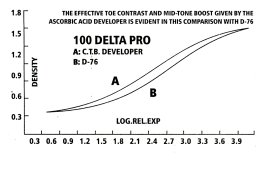
I have taken the liberty of attaching a D-log E curve from the British Journal of Photography 10 Nov 1999, article reporting work by C T Blood.

CTB Developer-working Solution:
Ascorbic Acid................1g/L
Phenidone...................0.1g/L
Sodium Metaborate......8.75g/L
pH 9.9-10
Develop Delta 100 10-11 min 20C

The writer claims Delta 100 can be exposed at EI up to 250-320 ,Pan F at EI 125-160 and Delta 400 up to EI 800.
This suggests that it might be worthwhile to test W3 at higher dilution to see if it can give anything like these results.
I will get some Delta 100 and try W3 at 1+19.
 

Attachments

  • Ascorbate Metaborate.jpg
    Ascorbate Metaborate.jpg
    242.7 KB · Views: 91
OP
OP

Alan Johnson

Subscriber
Allowing Ads
Joined
Nov 16, 2004
Messages
3,381
I used the densitometer on my Epson V700 scanner to try to match negatives as given by Delta 100 EI =100 developed 8min 20C in Xtol 1+0 , using diluted W3.
W3 1+29 developed 27 min 20C is close but still has slightly higher contrast and lower shadow density than Xtol 1+0.
So although it is speed increasing, W3 is inconvenient to use and not quite as speed increasing as Xtol.
How manufacturers managed to get a speed increase with developing times circa 10 min remains a mystery to me.
 
Photrio.com contains affiliate links to products. We may receive a commission for purchases made through these links.
To read our full affiliate disclosure statement please click Here.

PHOTRIO PARTNERS EQUALLY FUNDING OUR COMMUNITY:


Ilford ADOX Freestyle Photographic Stearman Press Weldon Color Lab Blue Moon Camera & Machine
Top Bottom