• Welcome to Photrio!
    Registration is fast and free. Join today to unlock search, see fewer ads, and access all forum features.
    Click here to sign up

Spectral sensitizing dyes

Somewhere...

D
Somewhere...

  • 5
  • 2
  • 93
Iriana

H
Iriana

  • 7
  • 1
  • 158

Recent Classifieds

Forum statistics

Threads
202,750
Messages
2,845,041
Members
101,499
Latest member
ThomasE
Recent bookmarks
1

Photo Engineer

Subscriber
Allowing Ads
Joined
Apr 19, 2005
Messages
29,017
Location
Rochester, NY
Format
Multi Format
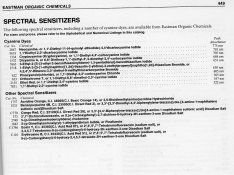
I have had so many people asking me about spectral sensitization that I have scanned the Kodak catalog from 1971, Catalog #46 listing their recommended dyes.

They are no longer available from Kodak but represent a cross section of usable dyes for emulsion work.

PE
 

Attachments

  • sensitizing dyes.jpg
    sensitizing dyes.jpg
    188.9 KB · Views: 737
Thanks, PE; that's going to be quite helpful. Its interesting that a few of the dyes in the "other" section are used as either indicators or biological marker dyes. Im interested that Congo Red is on the list; that stuff is quite inexpensive.
 
I have said before that Erythrosine is not the worlds best sensitzing dye, but it is inexpensive. I think that you will find that dyes on the 'other' list are not very good either, but that they do work.

Best of luck.

PE
 
Sellers such as this fellow, billythec on eBay intrigue me with the possibility that normally expensive & rare spectral sensitizing dyes might show up for cheap.

He has a number of dyes from Eastman Organics, search "eastman", in addition to just a ton of other stuff. I haven't done it yet, but someone should cross-check the above list against his inventory.
 
I searched about 1/2 of those pages and found no sensitizing dyes. Also, some of the prices are quite good but others are out of sight. Please note that factory sealed bottles are marked as sealed, but others presumably have been opened.

PE
 
Thanks PE. Sorry if I sent you on a wild goose chase. That guy has a 10lb. bag of Potassium Dichromate though, if you'd like... :wink:

I think I'd consider that a "life-time supply"
 
And Don't forget PE's Suggestion of SDA 3057 and SDE3008.For red and green senitivity,respectively. The SDE3057, is kinda tricky, but works.SDE is straight forward. And WELCOME to the World of handling chemicals and mixers with only IR to see by!
Bill
 
Wild Bill, have you successfully made some panchro emulsions? Would love to hear some details!
 
Holmburger,
I have made some emulsions which are sensitive to red,green and blue. I have made no atempt yet to balance the sensitivity, so that the three sensitivites are equal. My choice of sensitizing vdyes is following PE's recomendation. He has a post on a thread that goes back more than a year. Basicly There is a red dye that is sensitive to green light and a red dye that turns cyan in the pressence of iodine. I add 10mg of KI/mole of Ag, let it stir for 15 minutes then add 150mg dye. The emulsion turns cyan. The dye is called SDA3057, but I forgot the name of the supplier. It is in my notes and in PE's original post. But I cannot remember, off hand. These dyes are in methanol in my fridg. The green sensitive dye is added at 100mg/mole Ag. It is called SDE3008. It is a red - magenta dye and remains that color in the emulsion. The optimum concentration of SDA 3057 will depend on your grain size. But PE has explained all this in his post, better than I can. The dyes are pricey! $150/gram + a "curtosy fee". Basicly, you must spit a batch of blue-sensitive (no dyes) emulsion into 3 parts. One part contains no dy One contains the SDE3008, the other the SDA3008. Then you combine the 3 parts in equal amounts. Taking a shot of a KODAK color chart in openshade, outdoors, indicates that this vaproach is fairly balanced already.
I worke in total darkness, wearing a Generation 1 Night Vision monacle. These go for about $250 on ebay. Being a monacle,depth perception is screwy. I have poured many emulsions on the floor, trying to hit the glass plate. But now I use Meyer rods. This is the easiest way (for me) to coat plates. You can get these for about $30, brand new.
I hope this helps, but do search for PE's post on this subject.
Bill

 
Obviously, I made a mistake, I meant so say that 1/3 contains SDA3057; 1/3 contains/SDE3008; one third no dye.
 
Thanks for the depiction wildbill.

Not knowing much about emulsion making yet, I'm surprised to hear that 3-separate emulsions are mixed. I guess I thought (somewhat naively) that the sensitizing nature would be applied equally to each grain. That is, a single theoretical grain would become sensitive to the full spectrum, as opposed to 3 grains from separate emulsions each "taking care of" a portion of the spectrum.
 
There are a variety of methods to achieve pan sensitization. Bill described a method I posted quite a while back for making Pan Matrix Film, but you can also get a panchromatic dye to do the job. Placing 3 dyes on one grain (or even 2) is rather difficult though.

PE
 
PE, this is the method you mentioned to me about a year ago to make Pan sensitive dry glass plates?

MB
 
PE,
Can you give some examples of panchromatic dyes ?
I actualy tried,with one emulsion,adding both SDA3057(at 150mg/M Ag) and SDE3008(at 50mg/M Ag). It looked pritty good, as judged by a shot of the Kodak color chart. I went back to splitting batches though. Just to be on the safe side. Also, when using a split beam camera, I can actualy use a differntly sensitized emulsion behinde each of the color filters. I like that for several reasons.
Bill
 
Bill;

When you add 2 dyes to 1 emulsion, the more tightly adsorbed one can kick the other dye off the grain and you lose sensitivity in one region of the spectrum. That is why I suggest mixing 2 differently sensitized emulsions.

As for a pan dye, well that is the problem. I have not yet found one commercially. We had them at EK. There is a problem with these too. Their spectral distribution may not match the spectrum you wish to capture, and it may vary from emulsion to emulsion. That is another reason I prefer the blending method. Of course this is only a problem with B&W materials. I've been fortunate that all of my work with spectral sensitization was in color where it was mandatory that a minimum of 3 emulsions be used. The B&W work was purely "theoretical" in meetings and such reviewing the work of the B&W people.

PE
 
(there was a url link here which no longer exists)

Here is a very interesting discussion from about 5 years ago.

I still haven't found the thread that everyone seems to be alluding to.
 
I tried last night to find the elusive post,and could not. But it dose exist somewhere on this forum, of that I ame sure,
Bill
 
Anything been done with anthocyanins?
 
These are very weak dyes and may have been used. IDK for sure. Anthrocyanines are also used but are weak and higher in molecular weight so you get less bang for the buck. Phthalocyanines or Merocyanines are often used. Look at Brooker's Merocyanine as an example. Leslie Brooker was the founder of the dye lab at EK and his work points directions for dye usage. Today, all dyes at EK are numbered using the Brooker system and so we have B-11774 and etc....

PE
 
A thought occurred to me.. can we just recycle the dyes that get washed out of a commercial film in a pre-wash?
 
The rinse water could be extracted with organic solvent using a separatory funnel. Look up the EPA liquid-liquid extraction. Still sounds like a lot of work...
 
Photrio.com contains affiliate links to products. We may receive a commission for purchases made through these links.
To read our full affiliate disclosure statement please click Here.

PHOTRIO PARTNERS EQUALLY FUNDING OUR COMMUNITY:


Ilford ADOX Freestyle Photographic Stearman Press Weldon Color Lab Blue Moon Camera & Machine
Top Bottom