• Welcome to Photrio!
    Registration is fast and free. Join today to unlock search, see fewer ads, and access all forum features.
    Click here to sign up

Sour Grapes as Standard Equipment?

Recent Classifieds

Forum statistics

Threads
203,592
Messages
2,856,874
Members
101,917
Latest member
Swarls
Recent bookmarks
0
ROI ?
Cheers
Søren
 
ROI ?
Cheers
Søren

Return on investment. In this instance meaning worth more when sold than when purchased.

I would think that if a million people, who wouldn't normally have had a chance to see the original, are given the chance to see it due to the museum's purchase than it will have returned an excellent value.
 
Aha. Thanks
 
If not sour grapes, then at least something akin, such as "Wouldn't it be nice to have enough of daddy's money not to have to work for a living?"

I can't help wondering how many other photographers might have achieved greatness if they had been free to do whatever they damn' well wanted, without financial constraints.

I don't include myself, but I have met others who could have done very nicely, thank you, with this sort of start to their photographic careers.

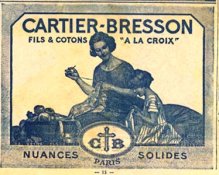
Other ads on the same page (Mon Ouvrage for April 1st [honestly] 1926) include bicycles, patent medicines, dolls' cars, and at least three varieties of patent body hair remover.

Cheers,

R.
 

Attachments

  • C-B.JPG
    C-B.JPG
    36.5 KB · Views: 119
Last edited by a moderator:
Return on investment. In this instance meaning worth more when sold than when purchased.

I would think that if a million people, who wouldn't normally have had a chance to see the original, are given the chance to see it due to the museum's purchase than it will have returned an excellent value.

Actually, I was targeting ROI more at the 10 million dollar athelete. We all like to do the inherent "school teacher v. jock" comparison but the fact is that the jocks make all that dough because they are key to their employers making even more ridiculous sums of money. Is the the 10mil going to someone worthy of it? Not for me to say. Is it a good economic investment? Broadly speaking, absolutely.
 
True, but the payment has to be made and we the tax payer have to make it. This includes the sport franchise of which most are receiving ever larger tax payer subsidies.

I am referring to money well spent. If you want ARod on your favorite team you'll be fine with the price. My team (was) the DIA (Detroit Institute of Art) and I want them to have the best players, even if the player’s career may be short, and I am fine with the price.

There is also a trickle down effect. Not necessarily in money, but in acceptance.
 
True, but the payment has to be made and we the tax payer have to make it.

This is why I referred in an earlier post to an inclusive or participatory arts policy rather than 'winner takes all'. If he can get $1M from a private buyer spending their own money, that's one thing. Getting $1M of taxpayers' money spent by a committee is another entirely. My own view -- and I freely accept that there are others, also defensible -- is that the same $1M would be better invested in more, lower-priced works of art to be seen by more people -- or on bursaries designed to get others out and making pictures, rather than being 'consumers of art'.

Cheers,

R.
 
Since this is all in the abstract...
...and 1 million will make available to this community an image that may inspire and elucidate with regard to photography as art an entire community. Or the revenue generated by this purchase could fund the activities you've mentioned.

The argument you make is true, but could be applied to all museum purchases. If the decisions to buy art are to be done democratically (by all), I suspect the outcome will be no more satisfactory and will create a completely unmanageable approach; if it is to be done by a larger representation then you've only scaled the current problem.

If the money is to be used to buy many less expensive works (which I don't see as an ether or proposition) who is to decide what is worthy?

We could stop buying art all together create a huge investment fund and use the interest to improve the state of the humanities and those who practice it. A lovely utopian thought.
 
Why is it automatically assumed that the museum used taxpayer funds to purchase this work?

I don't know the ownership structure in Oz, but here in the U.S. most museums are run by private, not-for-profit organizations. They raise funds from a variety of sources including contributions, "suggested" admission fees, donations of art works and usually some small fraction of public monies.

Further, most well-established museums regularly rotate their collections through deascessions(?(i.e. sales of works no longer considered important to the collection) and ascessions with the former funding much of the purchase of the latter.

And so what if public money was used to acquire this work? It means that the public acquired an asset which should rise in value over time and even permit, through its eventual deascession(?), the procurement of other work(s).
 
The argument you make is true, but could be applied to all museum purchases...

Well, I did say that there were other valid arguments, and you've made them eloquently. My only real point was that most people don't think about the policies behind arts spending. Some decry it all as bad (the philistine/Nazi view of 'the government wasting our money'). Others, it seems, see no need for any debate on the idea of a committee spending a million dollars of someone else's money, as long as it's a photograph (how would some of them reacted had it been digi?).

Cheers,

R.
 
Why is it automatically assumed that the museum used taxpayer funds to purchase this work?

I don't know the ownership structure in Oz, but here in the U.S. most museums are run by private, not-for-profit organizations. They raise funds from a variety of sources including contributions, "suggested" admission fees, donations of art works and usually some small fraction of public monies.

Further, most well-established museums regularly rotate their collections through deascessions(?(i.e. sales of works no longer considered important to the collection) and ascessions with the former funding much of the purchase of the latter.

And so what if public money was used to acquire this work? It means that the public acquired an asset which should rise in value over time and even permit, through its eventual deascession(?), the procurement of other work(s).


These are good points.
 
My only real point was that most people don't think about the policies behind arts spending.

how would some of them reacted had it been digi?

Assuming the money was public money (good point George), and a large portion of the populace was oblivious, is it the fault of the museum or should the populace wake up and see where their money is going?

I don't confuse the purpose of this site with the greater world around us. I suspect and hope others here do the same. If the image in question was digital it would not be posted here (for long).

I want all museums and public institutions that deal in the arts to be well funded and generous with their assistance. This would include stone carvings through digital creations, as it is they are not. I, as with most, can only supply a limited focus to what they are doing, I need to be able to trust them and, in this instance, I think they have done well.
 
Last edited by a moderator:
Well I decided to do some digging around regarding just how the money for this $1,000,000 photograph came to be in the purse of my local government gallery, National Gallery of Victoria (NGV).

It appears that the gallery had wished to purchase a Wall work for some time. There is one other in the country at the Art Gallery of Western Australia. NGV deputy director Tony Ellwood said the gallery bought Untangling with money from the NGV Foundation while Wall's prices were still affordable.

I chased around to find out about this, "NGV Foundation", apparently it is made up of various organisations and individuals who donate, or bequests to the Gallery.

The source of this information comes from the original newspaper article from last December.

http://www.ngv.vic.gov.au/ngvfoundation/

The above link will take anyone to the NGV Foundation home page.

It appears that my money hasn't been used after all, doesn't change my view of the picture though.

Interestingly, every painting, piece of pottery or whatever in the gallery, if it has been purchased from one of the three parts of the NGV Foundation, always has this information on the description attached to, or near the piece of work being shown. This picture doesn't have this information at all, which is why I thought it had been purchased outright by the gallery.

Mick.
 
Photrio.com contains affiliate links to products. We may receive a commission for purchases made through these links.
To read our full affiliate disclosure statement please click Here.

PHOTRIO PARTNERS EQUALLY FUNDING OUR COMMUNITY:



Ilford ADOX Freestyle Photographic Stearman Press Weldon Color Lab Blue Moon Camera & Machine
Top Bottom