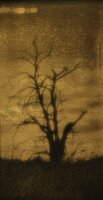
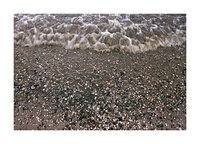
Hi Parker, that's a beautiful portrait. Fitting the Pictorialism period around 1900. Something I like to try myself.
I never preflashed before. Can you tell me how you did this with DPP?
Thanks.
Several people have posted on flashing this paper, so I just followed their advice. In short, you want to treat it just like flashing any silver paper, use a small amount of white light and expose it to just below the threshold.
I believe when I made that portrait I had taken to over flashing, meaning exposing it slightly beyond the threshold, making the darkest shadows not pure black. That made it easier to control. Combined with selenium toning it really gave a nice, albumen-like feel.
I'll try to find my notebook and post more specific details. I had metered it so I could reproduce it with any light source and timer.
I've rated it at ISO 1.6 in shade and ISO 3 in bright sun. There's no "right" answer, it depends on developer, dilution, temperature, etc. But that'll get you in the ballpark.
~Joe
PS: As the data sheet indicates, the paper is intrinsically high in contrast, and not panchromatic. I find the tones easier to manage in low-contrast light, such as shaded daylight, typically at around ISO 1.6. In bright sun the highlights can blow easily, so I tend to down-rate the ISO to around 3 - 6 range. Controlling the light is essential to good results tonally, hence why studio lighting can produce great results when managed properly.
How does the emulsion reverse itself? I've read somewhere that it's based on Ilford Cibachrome technology. Someone more informed than I will chime in, hopefully.
As far as the technology goes, I have it on good authority that the reason there was a delay in reintroducing the emulsion because a single vital ingredient was unavailable in sufficient quantity.
Fortunately, Harman's dastardly scientists have now cloned enough copies of Tinkerbell to enable the requisite amounts of Faerie Dust to be harvested from her/their wings to add to the kettles.
Unfortunately, this does mean that vast numbers of Tinkerbells are now confined in the secret underground bunkers at Mobberley, in conditions that would shame a chicken ranch.
Don't remember the name as I used it in the 60's. It was not Panalure but designed specifically for making prints from color slides. The paper had a panchromatic B&W emulsion coated on stiff plastic stock. Thinking back now it used a conventional reversal development system. I remember using sodium hydrosulfite as the fogging developing agent.
How does the emulsion reverse itself? I've read somewhere that it's based on Ilford Cibachrome technology. Someone more informed than I will chime in, hopefully.
Apparently it uses a standard black and white paper developing process and not a reversal process, so I guess it must reverse itself as you say somehow.
Apparently it uses a standard black and white paper developing process and not a reversal process, so I guess it must reverse itself as you say somehow.
I found out today from my local film and paper supply place that the Ilford Direct positive paper will also be available in limited quantities in 11x14, 16x20 and in 20",40" and 50" wide rolls.
"Peter, Yes, I use R3 on paper and it works very well.
It does not work well with Ilford's Direct Positive paper, but I have a formula that does work with that paper. If I have time in the next few weeks I will try to fine tune it and show the results, and provide the details."
Posted by New55:
"Direct positive paper requires a different monobath. The Paterson Orbital sort of works, but not well. 1 minute exposure, f8, 300mm. R7 BC"
"Which direct positive paper did you use?"
"Efke"
Photrio.com contains affiliate links to products. We may receive a commission for purchases made through these links. To read our full affiliate disclosure statement please click Here.