
Hi All,
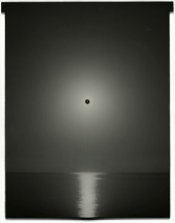
Lately I've been playing around with pseudo (sabbatier) solarization of paper negatives in the darkroom (shoot negative -> re-expose during development) to get a sort-of direct positive with all the crazy and wonderful effects the process creates. I want to try a 'true' solarization now, similar to the work of Chris McCaw, in-camera with a long exposure. I understand the basic principle, an extreme overexposure will actually produce a 'positive' image. I'm trying to wrap my head around some of the physics of this and I need some pointers in terms of the actual process. From my understanding, what's going on is that the density curve becomes a bell curve with overexposure, leading to a decrease in density where exposure is higher (reversing the image). If this is the case -- why does the sun remain/turn black? I understand that often times the paper actually gets burnt, is the 'black sun' just the emulsion scorching and turning black because of that or is it blackness from density? What's the darkroom process like for this 'reversal'? I'm under the impression that the image comes straight out on the paper, like an alt print-out process, but honestly I have no clue. Would I develop-stop-fix as normal? What kind of exposure times should I be starting with (outdoor, daylight)?
Apologies for how little I know about what's going on here, If any of my assumptions or background understanding are wrong, please correct me! Information about this is preciously rare online. I know that I can do the standard, ansel adams black sun solarization with a paper negative and then contact print it, but my intention isn't to just take a bunch of pictures of the sun, I'm moreso interested in the direct reversal that takes place . I want to make unique, positive images in-camera of any subject with this process (though I do have at least one specific black sun image in mind).
Should I be concerned about setting my camera on fire?
Thanks!
Lately I've been playing around with pseudo (sabbatier) solarization of paper negatives in the darkroom (shoot negative -> re-expose during development) to get a sort-of direct positive with all the crazy and wonderful effects the process creates. I want to try a 'true' solarization now, similar to the work of Chris McCaw, in-camera with a long exposure. I understand the basic principle, an extreme overexposure will actually produce a 'positive' image. I'm trying to wrap my head around some of the physics of this and I need some pointers in terms of the actual process. From my understanding, what's going on is that the density curve becomes a bell curve with overexposure, leading to a decrease in density where exposure is higher (reversing the image). If this is the case -- why does the sun remain/turn black? I understand that often times the paper actually gets burnt, is the 'black sun' just the emulsion scorching and turning black because of that or is it blackness from density? What's the darkroom process like for this 'reversal'? I'm under the impression that the image comes straight out on the paper, like an alt print-out process, but honestly I have no clue. Would I develop-stop-fix as normal? What kind of exposure times should I be starting with (outdoor, daylight)?
Apologies for how little I know about what's going on here, If any of my assumptions or background understanding are wrong, please correct me! Information about this is preciously rare online. I know that I can do the standard, ansel adams black sun solarization with a paper negative and then contact print it, but my intention isn't to just take a bunch of pictures of the sun, I'm moreso interested in the direct reversal that takes place . I want to make unique, positive images in-camera of any subject with this process (though I do have at least one specific black sun image in mind).
Should I be concerned about setting my camera on fire?
Thanks!