
• Welcome to Photrio!
    Registration is fast and free. Join today to unlock search, see fewer ads, and access all forum features.
    Click here to sign up

Solarized Negatives

The Chicken

A
The Chicken

  • 3
  • 4
  • 80
Amour - Paris

A
Amour - Paris

  • 1
  • 0
  • 83

Recent Classifieds

Forum statistics

Threads
203,241
Messages
2,851,921
Members
101,743
Latest member
Pablino
Recent bookmarks
0

GrantR

Member
Allowing Ads
Joined
Aug 19, 2008
Messages
58
Location
Columbia, SC
Format
Multi Format
This is going to be interesting...

I had a roll of Efke25 that I was shooting at night at a party, at some point, the back of the camera fell off because of the stupid engineering of the company that made the camera (i.e. the camera strap is connected to the locking mechanism), and I quickly put the back back on.
Now, I don't think that was part of the problem, but I mention it just in case.
I was also drunk when I took these pictures....the exposure was all over the place, so I decided to blow the dust off my PaRodinal and try some standing development. The developer smelled awful, very similar to the color developer used in E6 processing, but I diluted it anyway 1:100, and threw it in the tank and let it process for 30 minutes...then I forgot about it.
I found it an hour and a half later and quickly stopped and fixed it, when I pulled it out it looked like it was improperly fixed and had a layer of bronze all over. Now, the fix is almost brand new--I mixed it up yesterday and have maybe run 4 rolls of film through it. The developer was homemade AND very old and it was incredibly over developed....but where did this bronzing come from?

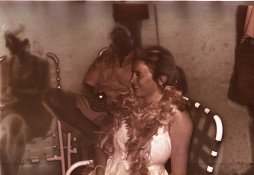
I've attached a scan of one of the negatives to show the odd solarization.
 

Attachments

  • IMG_0001.jpg
    IMG_0001.jpg
    981.1 KB · Views: 427
I know Efke has a soft emulsion, not sure about when and how, but are you sure there was no physical stress to the film during development?
 
It sure looks like solarisation (or more properly the Sabat(t)ier effect) to me. There are Mackie lines on sharp-edged objects and everything. No idea where the bronzing came from, but maybe that's an effect of the old developer.

Personally, I think the results look terrific. If I were you, I'd be tempted to see if I can replicate it.

-NT
 
Grant, Do it again.... nice!
 
Solarization (or Sabattier) is an effect that is normally done by reexposing film (or paper) during the development phase of processing. It could be the result of the back falling off the camera prior to dvelopment(doubtful) or most likely caused by spoilt chemie. Whatever the cause, the result is worthy, and hopefully repeatable.
 
As of this moment, there are photographers all over the world scrounging around in their darkrooms for that long-lost bottle of homemade Rodinal.

Peter Gomena
 
How can it be solarisation if the negs weren't exposed to light during development?
Exposure before development just makes fogging. This must be a product of exposure whilst partially developed - whether that's due to accidentally flashing the tank somehow or due to chemical fogging from something in your homebrew developer.
 
How can it be solarisation if the negs weren't exposed to light during development?
Exposure before development just makes fogging.

I don't think that's necessarily true, is it? Here's what I'm thinking:

Each grain only cares about whether it got enough light to activate it before it was reduced in development. Pre-exposure, whether you call it "pre-exposure" or "oops", just delivers some of that light more or less uniformly, before development starts; flashing in the developer does the same thing, but only to the grains that haven't been reduced yet.

In shadow areas, there are a lot of these unreduced, because most of the grains aren't activated and aren't getting reduced; so the shadows tend to get lighter (otherwise known as "fogging" if you didn't want it to happen). In the highlights, the earlier in development the exposure happens, the more of them there are; if the exposure happened very early in the development, or (as in the original poster's case) before any development at all, there are a lot of those too, and the highlight values will also be elevated---so they blow out, or if the amount of light is enough, they experience solarisation and turn back into shadows. If I'm not misunderstanding how solarisation and pre-exposure work, I think that's a possible explanation of what happened here.

That said...while I find this chain of events sort of plausible, I can't explain why the people in the background seem to have reversed, but the white chair rail in the foreground and the four specular highlights in the background haven't. On the other hand, I don't know what the original distribution of light really looked like, and maybe the extra exposure was uneven and affected some areas of the negative but not others.

-NT
 
Photrio.com contains affiliate links to products. We may receive a commission for purchases made through these links.
To read our full affiliate disclosure statement please click Here.

PHOTRIO PARTNERS EQUALLY FUNDING OUR COMMUNITY:


Ilford ADOX Freestyle Photographic Stearman Press Weldon Color Lab Blue Moon Camera & Machine
Top Bottom
