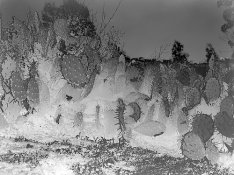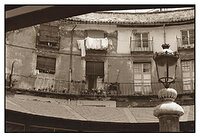

I've been playing with solarisation (of film, not paper), using the simple expedient of switching on the room light for a couple of seconds while a sheet of film is in the tray. The results don't stink (example attached), but the edge effects aren't very strong---in some cases I just get a reversal of the expected image, with a lot of base fog and some lowering of contrast.
Supposedly, solarisation works best with something close to a straight-metol developer. You don't use MQ developers, I gather, because of the superadditivity---development runs too fast in certain parts of the curve and that interferes with the effects of solarisation. But I'm using HC-110, which isn't an MQ developer, it's mostly hydroquinone. The other developers I have on hand are Diafine (where I have no idea what the developing agent(s) might be) and the raw materials for Caffenol.
So, am I wasting my time trying to make interesting solarisations in HC-110, or does the absence of metol prevent the superadditivity problem (in which case I just need to keep experimenting and see what works)?
Using the Diafine instead would be a bit of a pain (there's not much tray space in my darkroom, and I'd be afraid of contaminating the A solution in the dark), but if there's reason to think the results would be interesting, I can manage to give it a go.
Caffenol, I suppose I'll try out for this purpose eventually, but it's slow; even Caffenol C times are kind of long for sitting around in total darkness.
Thoughts, suggestions, brickbats...?
Thanks
-NT
Supposedly, solarisation works best with something close to a straight-metol developer. You don't use MQ developers, I gather, because of the superadditivity---development runs too fast in certain parts of the curve and that interferes with the effects of solarisation. But I'm using HC-110, which isn't an MQ developer, it's mostly hydroquinone. The other developers I have on hand are Diafine (where I have no idea what the developing agent(s) might be) and the raw materials for Caffenol.
So, am I wasting my time trying to make interesting solarisations in HC-110, or does the absence of metol prevent the superadditivity problem (in which case I just need to keep experimenting and see what works)?
Using the Diafine instead would be a bit of a pain (there's not much tray space in my darkroom, and I'd be afraid of contaminating the A solution in the dark), but if there's reason to think the results would be interesting, I can manage to give it a go.
Caffenol, I suppose I'll try out for this purpose eventually, but it's slow; even Caffenol C times are kind of long for sitting around in total darkness.
Thoughts, suggestions, brickbats...?
Thanks
-NT