
• Welcome to Photrio!
    Registration is fast and free. Join today to unlock search, see fewer ads, and access all forum features.
    Click here to sign up

Solarisation with hydroquinone? (or other stuff)

Recent Classifieds

Forum statistics

Threads
201,747
Messages
2,829,504
Members
100,924
Latest member
hilly
Recent bookmarks
0

ntenny

Subscriber
Allowing Ads
Joined
Mar 5, 2008
Messages
2,513
Location
Portland, OR, USA
Format
Multi Format
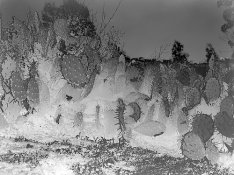
I've been playing with solarisation (of film, not paper), using the simple expedient of switching on the room light for a couple of seconds while a sheet of film is in the tray. The results don't stink (example attached), but the edge effects aren't very strong---in some cases I just get a reversal of the expected image, with a lot of base fog and some lowering of contrast.

Supposedly, solarisation works best with something close to a straight-metol developer. You don't use MQ developers, I gather, because of the superadditivity---development runs too fast in certain parts of the curve and that interferes with the effects of solarisation. But I'm using HC-110, which isn't an MQ developer, it's mostly hydroquinone. The other developers I have on hand are Diafine (where I have no idea what the developing agent(s) might be) and the raw materials for Caffenol.

So, am I wasting my time trying to make interesting solarisations in HC-110, or does the absence of metol prevent the superadditivity problem (in which case I just need to keep experimenting and see what works)?

Using the Diafine instead would be a bit of a pain (there's not much tray space in my darkroom, and I'd be afraid of contaminating the A solution in the dark), but if there's reason to think the results would be interesting, I can manage to give it a go.

Caffenol, I suppose I'll try out for this purpose eventually, but it's slow; even Caffenol C times are kind of long for sitting around in total darkness.

Thoughts, suggestions, brickbats...?

Thanks

-NT
 

Attachments

  • 2310459698_d70a889fe5.jpg
    2310459698_d70a889fe5.jpg
    116.5 KB · Views: 171

Jim Noel

Member
Allowing Ads
Joined
Mar 6, 2005
Messages
2,261
Format
Large Format
True solarization of film was done with extreme over- exposure in the camera, not in the development.

There used to be a developer called Solarol on the market which produced a "false" solarization effect. You may be able to find some with an inquiry on here, or on the auction site. I don't know if anyone has published an analytically based formula or not.
 

jim appleyard

Subscriber
Allowing Ads
Joined
Nov 21, 2004
Messages
2,421
Location
glens falls, ny USA
Format
Multi Format
IIRC, Sabattier and solarization are two different things, but often confused with one another.

Last time I got a Porters catalog, Solarol was in it.
 
OP
OP

ntenny

Subscriber
Allowing Ads
Joined
Mar 5, 2008
Messages
2,513
Location
Portland, OR, USA
Format
Multi Format
The effect you are seeing is called the Sabattier effect.

Yeah, I know, but Sabatier stole the credit for it, so I hesitate to give it his name. Granted, it's not the same as in-camera solarisation per se, but people do seem to call it that since Man Ray.

It works with any developer.

You sure? My sources say otherwise---notably http://www.cchem.berkeley.edu/wljeme/Chapt5.html, with a section called "Why Do Metol-Hydroquinone Developers Solarize Relatively Poorly?"

-NT
 

Photo Engineer

Subscriber
Allowing Ads
Joined
Apr 19, 2005
Messages
29,018
Location
Rochester, NY
Format
Multi Format
Well, as pointed out in that URL, the author says that the effect is very dependant on paper. Then he describes how much Brovira and Kodabromide differ, but they actually are very similar formulas! All I can say is that the effect has been shown to work with just about all papers and just about all developers.

I think that the problem is that a given developer without metol and one with both metol and HQ would be optimized in a toally different fashion and therefore might give the results shown. I've even done it with color to very good effect.

The thing is here too, that the Sabattier effect is very dependant on the re-exposing light intensity and the time at which it is given, and that varies with paper and with developer as well. The author may not have investigated these parameters.

I find exactly what he has regarding fog, but reducing time and moving the re-exposure to a later point in develpment lowers fog dramatically thereby somewhat refuting what he states. It is merely a matter of 'wasting' a lot of paper and time in the DR to optimize your conditions.

PE
 

AgX

Member
Allowing Ads
Joined
Apr 5, 2007
Messages
29,972
Location
Germany
Format
Multi Format
Yeah, I know, but Sabatier stole the credit for it, so I hesitate to give it his name.


That's quite an accusation. Could you please substantiate it.

As far as my information goes he (Sabattier) published his findings in 1860 in the Bulletins de Societe Francaise Phographique and since then that photographic effect was generally named after him.
 
OP
OP

ntenny

Subscriber
Allowing Ads
Joined
Mar 5, 2008
Messages
2,513
Location
Portland, OR, USA
Format
Multi Format
That's quite an accusation. Could you please substantiate it.

As far as my information goes he (Sabattier) published his findings in 1860 in the Bulletins de Societe Francaise Phographique and since then that photographic effect was generally named after him.

http://www.cchem.berkeley.edu/wljeme/Chapt1.html, first section. The author (a William L. Jolly of the UC Berkeley chem department) cites his sources; one of them is the introduction to Sabatier's (or Sabattier's---the spelling seems to be inconsistent) original 1860 paper in Cosmos, where the Societe's recording secretary points to an earlier description of the same effect.

I haven't done the research to check it at first hand, though; I'm taking Jolly's citations at their word, and certainly someone along the chain of evidence could be wrong.
 

AgX

Member
Allowing Ads
Joined
Apr 5, 2007
Messages
29,972
Location
Germany
Format
Multi Format
Thanks! That is an interesting link.

Sabat(t)ier himself is not very well known, his name only shows up in those technical textbooks in connection with that effect, and even to find that french paper cited, I had to look through quite a lot of them to find a single bibliographical hint.
 

Photo Engineer

Subscriber
Allowing Ads
Joined
Apr 19, 2005
Messages
29,018
Location
Rochester, NY
Format
Multi Format
It is common for a name to be associated with an effect if one shows diligence in pursuit of the effect. Therefore, Sabat(t)ier seems to have perhaps co-invented this effect at almost the same time as another individual, but the other individual dismissed it as being useless, whereas Sabattier showed it to be a useful attractive art form. Therefore, he got the credit!

I have heard the same story from several sources about the early days of this work. It may or may not be true, but Sabattier has stuck. Today, people still confuse Solarization with Sabattier, but this does not make them right. They take place in different places and use a different mechanism.

PE
 

Bob Carnie

Subscriber
Allowing Ads
Joined
Apr 18, 2004
Messages
7,735
Location
toronto
Format
Med. Format RF
I have been working with Mr Jollys methods for 10 years now and his articles on this printing method are excellent, well thought out and easily followed.
Personally I am using the two developer method directly onto prints and have done little to no work on the negative stage.* the second developer is saturated with postassium bromide and the thinking is the grain structure of the flashed development is different then the one with no flash therefore creating a certain split .
At this moment I am starting to print five years work, 30 x40 inch Ilford MG4 with the double developer and I am tri toning the prints in Bleach Sepia, Gold and selenium, the series is called Heavy Metal and I credit Mr Jollys excellent articles as the source of all my information.
I hate to call these solarizations as Ron and I have had many rebuttles to each other on my use of this term for what I do. But as the articles do point out they are solarizations but I don't care to argue the point as I just am happy with the results no matter what the real name of what I do is called.
 
OP
OP

ntenny

Subscriber
Allowing Ads
Joined
Mar 5, 2008
Messages
2,513
Location
Portland, OR, USA
Format
Multi Format
It may or may not be true, but Sabattier has stuck. Today, people still confuse Solarization with Sabattier, but this does not make them right. They take place in different places and use a different mechanism.

Fair enough. Perhaps we ought to be using "psolarisation" for pseudo-solarisation, and then people who prefer the Sabat(t)ier name can call it the pSabattier effect... :smile:

-NT
 
Photrio.com contains affiliate links to products. We may receive a commission for purchases made through these links.
To read our full affiliate disclosure statement please click Here.

PHOTRIO PARTNERS EQUALLY FUNDING OUR COMMUNITY:


Ilford ADOX Freestyle Photographic Stearman Press Weldon Color Lab Blue Moon Camera & Machine
Top Bottom
