• Welcome to Photrio!
    Registration is fast and free. Join today to unlock search, see fewer ads, and access all forum features.
    Click here to sign up

Smallest/lightest weight rangefinder

Tree with Big Shadows

Tree with Big Shadows

  • 1
  • 0
  • 0
Everal Barn

A
Everal Barn

  • 0
  • 0
  • 0

Forum statistics

Threads
203,448
Messages
2,854,863
Members
101,847
Latest member
C M
Recent bookmarks
0
When I do not want to carry my Leica or my SLRs I grab my Contax T2 or lately my Konica Hexar AF. The latter not much smaller but lighter and simpler with only one fixed lens. But oh what a lens.
 
The smallest is the previously mentioned Rollei 35 but there are cameras that are only a bit larger, such as the very compact Ricoh FF-1.
 
Here is another vote for a Olympus 35RC. Auto exposure, you set the shutter speed, meter selects the aperture. Also full manual control with all shutter speeds and apertures available if battery dies or meter goes belly up.
 
The 35RC is pretty much the same as all the other compact shutter-priority rangefinders of that era. You can't really go wrong with many of them regardless of which manufacturer you choose.
 
I've found that my example of the Olympus XA has considerable light fall off in the corners. My Contax T is much better in that regard.
 
Since you are already into a Nikon SLR system, look into a Nikon FG body with series E 50mm lens. Small, light, and inexpensive. I've got some older Leica gear, but often carry an FG in less than ideal conditions so I don't have to worry about it. (Motorcycle tank bag)
 
You will find it is also a fully manual camera, a feature that many other's are deficient in.

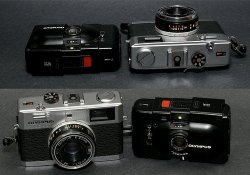
I'm talking about these type of compact rangefinders:

Olympus 35 RC
Olympus 35 SP
Minolta Hi-matic 7sII
Konica C35
Canonet QL17

etc. are all extremely similar in usage, size, and focal length. They almost all offer shutter priority as their "auto" mode but are easily used manually by just not switching to "auto."
 
A Super Paxette with a 38mm Staeble Choro on it is pretty small, pretty cheap and a nice all around, all-metal, all- manual camera. Sunny 16 and you're set. The 1/300 top shutter speed might be a problem, as might be the weight (lighter than a Leica M, but not light).

Second also the XA. That lens is really good, even if some of them fall off in the corners.

--nosmok
 
Last edited by a moderator:
You might take a gander at the Minolta Repo, or the Oly Pen EE s. Both are 1/2 frame and tiny metal jewels, more than ready to hide in a pocket until needed. Being 1/2 frame, your film seems to last forever, but that's just another bonus! Enjoy!
 
Ken, nice reply with the receipt! Also, that the XA didn't devalue... at least in '84 dollars. You've been an oly guy for a while...
 
I'm talking about these type of compact rangefinders:

Olympus 35 RC
Olympus 35 SP
Minolta Hi-matic 7sII
Konica C35
Canonet QL17

etc. are all extremely similar in usage, size, and focal length. They almost all offer shutter priority as their "auto" mode but are easily used manually by just not switching to "auto."

The C35 has no manual exposure mode. On the others, like the Hi-Matic and the QL-17, manual exposure mode is un-metered. The biggest problem with all of these is finding a working version where the battery wire was not eaten by corrosion or meter mechanics not gummy from disuse. These bodies also tended to use extensive foam in the back seals which are a PITA to replace. If cleaned, the 35RC viewfinder is amazingly bright. Ricoh had some models that are very similar to the 35RC: the 500G/GX/ME/RF series. These were also sold by Sears as the Sears RF. These are typically quite a bit less expensive than a 35RC but perform similarly.
 
FYI, here is a size comparison of the Olympus 35RC vs. XA:
4370406114_7953a42199_z.jpg
 
I've found that my example of the Olympus XA has considerable light fall off in the corners. My Contax T is much better in that regard.
I had an XA in the 80s that had real vignetting issues. I returned it to Olympus who said it was operating to specification, an official way of saying "they all do that, sir". It was a known issue, some people lived with it, others got frustrated. It's a nice camera but I found it a bit titchy.
 
buy the first one in the charity shop which looks reasonable, refoam yourself... mouse mat and rubber cement from bicycle repair kit
 
The C35 has no manual exposure mode. On the others, like the Hi-Matic and the QL-17, manual exposure mode is un-metered. The biggest problem with all of these is finding a working version where the battery wire was not eaten by corrosion or meter mechanics not gummy from disuse. These bodies also tended to use extensive foam in the back seals which are a PITA to replace. If cleaned, the 35RC viewfinder is amazingly bright. Ricoh had some models that are very similar to the 35RC: the 500G/GX/ME/RF series. These were also sold by Sears as the Sears RF. These are typically quite a bit less expensive than a 35RC but perform similarly.

While it's true that there aren't many (any?) fixed-lens rangefinders with coupled meters in manual, the other concerns here have been, in my experience, non issues. 2 Canonets (a QL17 and QL19, both G-III), a Yashica 35G, and an Olympus 35SP have all had accurate, functioning meters, clean, aligned rangefinders, and serviceable, if aging seals. To that point, I've replaced seals on a canonet and a Yashica, and while they took a measure of manual dexterity, I wouldn't call any portion of the process a PITA by any means.

Not at all saying that user maderik is wrong, but that my subjective experience with these cameras has been significantly different from his/hers.

It's also worth noting that the Oly 35SP does, strictly speaking, have metered manual...though it's not a coupled meter, which largely nullifies the benefits one imagines enjoying with metered manual mode. Basically, the meter moves a needle to an EV value in the viewfinder, then you adjust the aperture and shutter to match that EV on the lens, and you're at the proper exposure.
 
buy the first one in the charity shop which looks reasonable, refoam yourself... mouse mat and rubber cement from bicycle repair kit

You made my day :wink:

I'm refurbishing an old Nikon F3, see: (there was a url link here which no longer exists)
I recently received a nice new leatherette (blue!!) and needed "rubber cement" for it. I never heard of rubber cement and wasn't sure where to get it over here in Holland.
But hey! I know how to repair a bicycle tire (almost everyone does in Holland - bicycle country no. 1). But it never occurred to me that I could use the glue for fixing leak tires as rubber cement on my camera. How simple can it be?

So: THANK YOU !!
 
But hey! I know how to repair a bicycle tire (almost everyone does in Holland - bicycle country no. 1). But it never occurred to me that I could use the glue for fixing leak tires as rubber cement on my camera. How simple can it be?
The rubber repair solution is ok for seals as in film door:-
- cut the mouse mat with straight edges and scaple e.g. steel ruler etc.
- trial fit new trap with it dry, rework until exact fit and thickness note it will settle in a bit but black mouse mat only needs to be touching for a seal, you are trying to get the foam to self locate...
- the metal part needs to be clean, (rust would not be good...) apply glue to metal part and refit foam leave camera closed for 24 hours

The rubber wont do much damage to the seal material (ex mouse mat) people keep giving me promotional mouse mats...

A mirror bumper needs a better glue any of the tubes of instant glue should be ok...

Good luck
 
Last edited by a moderator:
Photrio.com contains affiliate links to products. We may receive a commission for purchases made through these links.
To read our full affiliate disclosure statement please click Here.

PHOTRIO PARTNERS EQUALLY FUNDING OUR COMMUNITY:



Ilford ADOX Freestyle Photographic Stearman Press Weldon Color Lab Blue Moon Camera & Machine
Top Bottom