
• Welcome to Photrio!
    Registration is fast and free. Join today to unlock search, see fewer ads, and access all forum features.
    Click here to sign up

Smallest fully mechanical rangefinder

Valencia

A
Valencia

  • 1
  • 1
  • 54
Tied to the dock

D
Tied to the dock

  • 4
  • 0
  • 93

Recent Classifieds

Forum statistics

Threads
203,092
Messages
2,849,730
Members
101,661
Latest member
Rosiemst
Recent bookmarks
0

Swordman

Member
Allowing Ads
Joined
Sep 4, 2015
Messages
82
Format
35mm
Hi,

I’m not all that knowledgable about rangefinders, so I’m hoping you guys can help. I’m wondering what the smallest fully mechanical rangefinder is. One where I can adjust the shutter speed and aperture manually. I used to have a Canonet QL17, but I sold it. Didn’t like the feel of the shutter button. The lens was amazing, though.

I’m hoping to get myself a Leica in the Summer, and I already own a Rollei 35, so don’t recommend those!
 
  • AgX
  • Deleted
Any of the mechanical auto-exposure range finders of the 60-70's are going to have long stroke high-resistance shutter releases, just as the QL17. The shutter release operates a mechanism that traps the light meter needle, brings down a set of cams to determine the needle's position and uses the information to set the aperture and shutter speed - hence the length and strength of stroke.

Even if you don't use the camera's automation the shutter stroke won't change.
 
Leidolf Lordomat It was actually conceived as Leica competitor back in the day. I'm not claming equality between the two, but I have one and I think it is a great RF from that classic era. Build is great too.
 
Last edited by a moderator:
Many thanks for all of your replies so far :smile:
 
The folding Zeiss Contina is about as small as possible, but the one I have has the rangefinder separate from focus (so you have to look at the camera to set focus). There are a number of similar folding rangefinders and non-folding ones from around the same time (early 50s) that are all mechanical. Of course, a Leica III with a collapsible Elmar 50 is also very small.
 
A Retina IIa would compete in the smallest category.
 
The Kodak Signet 35 is quite compact, plus it has a great Ektar lens. Also, the Bolsey B 22 is about the same size. The Signet has a better lens than the Bolsey.
 
I have 2 Yashica Lynx 14 one is the old version the other is the E. They are large but cheap and works very well.
 
The Braun Paxette models are small and mechanical and accept interchangeable lenses.
 
I guess a Ricoh 500G would fit the small and fully mechanical rangefinder requirement. It does offer aperture automation if feed a battery, but it doesn't need it for operating 100% manually.
As Nicolas points out, the shutter-release-travel accommodates the automation functionality, thus some resistance is to be expected. The lens is a 40mm tessar derived design, quite nice.
The aperture blades are similar to those in the Olympus XA, Minox 35 and other small cameras, that is a two blade square design which works, but isn't in made for bokeh obsessed people.
 
The smallest double mirror double lens reflex camera is the Tessina, but since the users sees the focus it does not qualify as a range finder camera.
upload_2022-1-9_9-50-3.png
 
Retina IIa
I would recommend Retina as well, quite a sleeper - surprisingly small. When I got a Retina I I had to ask myself why I always fussed over the Rollei 35 which doesn’t even cover its lens or have a dark light path. I know not an RF… so go for any of the II but beware of winding gear
 
My Retina IIc is thinner but longer than my Signet 35. Both are great but the Retina is better.
 
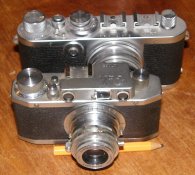
Not much is smaller than a Yamato PaX (no relation to the Paxette) but finding one that works well, or at all, is a challenge (non-RF Leica body for scale). YPax_leica.jpg
 
Voigtlander Vito II
upload_2022-1-9_11-5-44.png
 
I have a Retina IIIC big, as a folder it is easy to carry, the meter on mine is not accurate, considering I got it in 1966 not a bad run. Down size is it uses EV exposure, the shutter is linked to the aperture, many of the controls are fiddley, takes several steps to set the film counter and unlock the back. Lens is great, and there are 2 uncoupled lens that convert the 50mm to a 35 and 80mm, large and pain to use, and only a few techs will work on a Retina. Next up is a Retina S, not a folder, uses true interchangale lens from 28 to 200, the 200 is not rangefinder coupled, all of the Retina lens can be used on the Retina SLR but not all SLR lens are camed for the S. Same meter as on the Retina IIIC.

https://www.cameraquest.com/ret3s.htm
 
Looks like the Kodak Retina IIa is a winner!

Many thanks. I really appreciate everyone's input :smile:
 
Looks like the Kodak Retina IIa is a winner!

Many thanks. I really appreciate everyone's input :smile:

If you need service there's a nice fellow on the West Coast who works on these machines. Did an excellent job on my IIc.
 
Fully mechanical, coupled RF, pocketable 35mm folder:

Balda Super Jubilette
Welta Weltini (prefer the newer of the two versions)

I have a Weltini with f/2 Xenon -- excellent lens, unit focusing (vs. front element type), the RF is usable with glasses. On mine, at least, the film advance, spacing, and rewind work perfectly. A little smaller than a Retina.
 
Photrio.com contains affiliate links to products. We may receive a commission for purchases made through these links.
To read our full affiliate disclosure statement please click Here.

PHOTRIO PARTNERS EQUALLY FUNDING OUR COMMUNITY:


Ilford ADOX Freestyle Photographic Stearman Press Weldon Color Lab Blue Moon Camera & Machine
Top Bottom