

• Welcome to Photrio!
    Registration is fast and free. Join today to unlock search, see fewer ads, and access all forum features.
    Click here to sign up

Simple explanation of view camera focusing from the Art Institute of Colorado

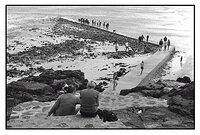
St Ives - UK

A
St Ives - UK

  • 3
  • 0
  • 75
Across the Liffey

H
Across the Liffey

  • Tel
  • Feb 25, 2026
  • 1
  • 2
  • 57

Recent Classifieds

Forum statistics

Threads
202,444
Messages
2,840,903
Members
101,333
Latest member
shanhw1978
Recent bookmarks
0

Removed Account

Member
Allowing Ads
Joined
Apr 6, 2007
Messages
907
Location
Nanaimo, Bri
Format
35mm
I've been killing time on YouTube this morning and came across a video from a photography instructor at the Art Institute of Colorado. He gives a very simple, easy to understand method of applying lens plane tilts and swings. Some explanations which get in to mathematics make my head hurt when I've got all the other factors in shooting going through my head but this video is very straightforward. It's located here.

- Justin
 
Good demo that applies to any camera.

What he didn't tell you is that on the Sinar F2 he's using, he could have also just used the swing/tilt calculator, but either method is quick to do once you get the hang of it.
 
What still confuses me is when the sides are in focus by swing, then the top and bottom are refocused with tilt, aren't the sides out of focus?

This opens the very contentious and confusing issue of "yaw." If the rail or baseboard of the camera is level, or if the camera is a "yaw-free" design like the camera in the demo, then you should be able to tilt without upsetting the swing angle. Try it out!
 
Some explanations which get in to mathematics make my head hurt

I grabbed a copy of Focusing the View Camera by Harold Merklinger before I got my camera. I skimmed through it and thought, 'ohh boy ...' I wish there were more practical examples like the linked video rather than the hard math. Thanks for the link.
 
Anything has to be better than that incomprehensible article that was recently published in View Camera--twice!!
 
I saw this video a month or so ago. It was informative. I also don't understand why tilting the camera to focus the top and bottom doesn't throw the sides out of focus. I hope the explanation has less math than the Scheimpflug rule.
 
Movements

The easy rule of thumb I follow in the field is forget the advertisements you see of cameras with extreme movements, almost never will you encounter a situation where such exaggerated movements are used.

In the field I identify the composition in three dimensional proportions, if the composition resembles a cube then the only thing to increase depth of field is F Stops. If however, the composition resembles a rectangle then swing or shift appropriate standard in the direction of the longest plane of the rectangle.

It usually becomes a combination of both but those are the principles I live by.

Cheers
 
Thanks for the link. Learning these things is a long process, and every bit of information is adding to my ability to control better my view camera.
 
Good demo that applies to any camera.

What he didn't tell you is that on the Sinar F2 he's using, he could have also just used the swing/tilt calculator, but either method is quick to do once you get the hang of it.

To learn to manipulate plane of focus by using the F2 system is like trying to learn exposure by setting your camera on program.
 
To learn to manipulate plane of focus by using the F2 system is like trying to learn exposure by setting your camera on program.

I completely agree (well, except for the fact that program exposure mode is less reliable than the Sinar calculator) that for teaching purposes, it's better to demonstrate without using the calculator.

Out of curiosity, when you're just shooting with the Sinar and not demonstrating, do you use the calculator? I used to have a Sinar F, and even though my other view cameras don't have it and I can manage without it just fine, I thought the swing/tilt calculator was a handy feature.
 
Teach students how to think about equipment and software rather than teach them how t

I completely agree (well, except for the fact that program exposure mode is less reliable than the Sinar calculator) that for teaching purposes, it's better to demonstrate without using the calculator.

Out of curiosity, when you're just shooting with the Sinar and not demonstrating, do you use the calculator? I used to have a Sinar F, and even though my other view cameras don't have it and I can manage without it just fine, I thought the swing/tilt calculator was a handy feature.

I don't, we have about 30 Sinars in the studio. But we also have (and I use) a Cambo it is geared like the P and a lot smoother. What drives me crazy about the Sinar F is the tilt has a bottom, instead of center pivot. That allows the one to hold focus while tilting but it also changes the size in the subject and the framing of the subject when doing close up work because the lens moves forward or back.

All in all, I don't even mention the tilt or swing calculator or the depth of field calculator on the Sinars although I think they are kinda cool because students today often just rent large format cameras for a particular job and I don't want to teach features that might not be available to them.

We always try (not always successfully) to teach students how to think about equipment and software rather than teach them how to use a specific type of equipment or software because both change so fast.
 
I don't, we have about 30 Sinars in the studio. But we also have (and I use) a Cambo it is geared like the P and a lot smoother. What drives me crazy about the Sinar F is the tilt has a bottom, instead of center pivot. That allows the one to hold focus while tilting but it also changes the size in the subject and the framing of the subject when doing close up work because the lens moves forward or back.

Fair enough. When I found a good deal on a P for studio work, I sold off my F.
 
Photrio.com contains affiliate links to products. We may receive a commission for purchases made through these links.
To read our full affiliate disclosure statement please click Here.

PHOTRIO PARTNERS EQUALLY FUNDING OUR COMMUNITY:


Ilford ADOX Freestyle Photographic Stearman Press Weldon Color Lab Blue Moon Camera & Machine
Top Bottom
