
- Joined
- Jan 14, 2007
- Messages
- 689
- Format
- Medium Format
Perhaps this image passes a concept of death to onlookers of this forum?


Creativity is an essential element of art
I won't speculate. But shooting the next series of saturated fall colors would be a difficult way of making something meaningful. As far as I'm concerned, it's been beaten to death. But as said above, don't let this stop you from doing it!Perhaps this image passes a concept of death to onlookers of this forum?

What koraks said.
Save and except, it is entirely appropriate to prefer materials and techniques that resonate with you and which you enjoy using. Don't avoid digital post-processing because that is something you think you "should" do. But feel free to avoid digital post-processing because you dislike doing it.
And of course, if you decide you want to discuss the how and why of digital post-processing, make sure the discussion is in the right part of Photrio
I disagree, and it has to do with the notion that I think you're confusing the concepts of art and skill. While they are related, they are conceptually distinct. Art, as far as I'm concerned, is about making something that moves people, that instills a message, emotion or notion on the onlooker. It tends to involve things like conceptual thinking, a good dose of intuition and often a lot of experimentation on behalf of the artist. What it does not, however, require is suffering. I think this is a misunderstood aspect of art and probably stems from the archetypical view that we have of the 'starving artist' that has to deal with hardship and massive challenges. In that sense, there is nothing wrong with using efficient digital tools to create a work of art. Indeed, much of the visual arts these days revolves around such tools. I wouldn't want to go as far as to disqualify because all of them are supposedly 'cheap creativity' or that relatively rapid tools were used to get to a certain end result! I really think that's a bit of a misconception on your behalf.
In this sense, you can also argue that skill is only to some extent necessary to create art. You only need to have the skill necessary to get the message across effectively. Skill in itself doesn't make art, and it's just a vehicle or tool to accomplish something. As a result, staring yourself blind on skill, and employing the most skillful approach to get something done, doesn't create art. In other words: making the same end result digitally as with film wouldn't make either one more or less artistic, while it potentially does say something (or a lot) about the skillset of the artist(s) involved.
Finally, I think your argument doesn't hold much water for another reason. You started this thread by asking if you can get saturated colors with a film not designed to do this. A quick way to get what you want would obviously be to crack open a brick of Ektar and get shooting. But if I apply your own reasoning, this would still constitute cheap art: you'd be using a speedy tool to get the job done. That the tool is a film-based one as opposed to a digital one doesn't make much of a difference conceptually.
The reason I'm picking on this is not to criticize you, personally. It's because I think you quite neatly captured in words a fundamental misconception among mostly amateur photographers (whom I'm one of, mind you!) about the relationship between art and skill or technical competence. This misconception is so deeply rooted and strongly advocated, that it seems to me that if an artist comes for advice to a place frequented mostly by amateur photographers, the advice they'll get is a lot of the time counterproductive instead of helpful. There will be lots of talk about technicalities, and rarely, if ever, does someone even pick up on the actual content of the artwork itself and the question what would be necessary to accomplish that goal. I guess I'm just warning you against falling into that trap as well. Ask yourself how bad it is if you do it the quick & dirty way. If you do it like that, you preserve much of your time and energies to work on the part of art that really matters - its message, innate emotion, or whatever it is that moves the viewer.
Don't get me wrong - I like the technicalities and to a large extent, that's what a photo forum is for. It's for talking shop, and that's fun and interesting in itself. But if you talk about art and creativity, be very wary of getting lost in the woods of technique.

I was concerned about excessive boosting of color saturation, such as +30% or even more, which is what portrait films will need when used in applications such as Fall colors.
Ektachrome E100 GX - sadly no more:
View attachment 318609
No worries, it's all good.
I think the consensus is going to be that there's no consensus on where to draw the line. Well, let me put it this way - if a consensus threatens to emerge on this, I'll be the first to attack it! I really feel that this is a matter where consensus isn't necessary and might in fact do more harm than good.
Thanks Matt. This is excellent info. You are right the portrait films tend to yield more accurate colors. My Canon 5D-III on the other hand is always too exaggerated. I guess I need to get used to my scanner that my portrait films will come out in shallow color depth. That's really not the problem. The problem is I want to shoot Fall colors with the film. Since I don't really like the digital look (colors) maybe my Fall color shots will come out fine with NC.I think you are assuming something here about the film that isn't correct.
The portrait films are quite likely to give you reasonably accurate colours, with reasonably accurate saturation. The non-portrait films will be slightly different.
If you are optically printing, the (limited) choice of printing papers will have a larger influence on the saturation of the results
If you are digitizing the results, the digitizing process will induce more change than the differences between the two types of film, and you will have to compensate for that process in any event.
Very nice.
How do you suppose this scene would turn out if shot with the current Ektachrome100?
I use to shoot alot of GX in it's day, and believe it was above & beyond what Kodak now has to offer....
Thanks Matt. This is excellent info. You are right the portrait films tend to yield more accurate colors. My Canon 5D-III on the other hand is always too exaggerated. I guess I need to get used to my scanner that my portrait films will come out in shallow color depth. That's really not the problem. The problem is I want to shoot Fall colors with the film. Since I don't really like the digital look (colors) maybe my Fall color shots will come out fine with NC.
I think you will like the current Ektachrome.
Quoting from a communication from 2018 from one of my sources about the reintroduction of Ektachrome, and some of the many changes that were either required or decided upon:
"We also adjusted the film’s sensitometric position so that the whites were whiter, and the colors more accurate."
If you are projecting the film, and would prefer a slightly warmer rendition in these sorts of circumstances, you can always use a warming filter.
 Three Oaks by atomstitcher, on Flickr
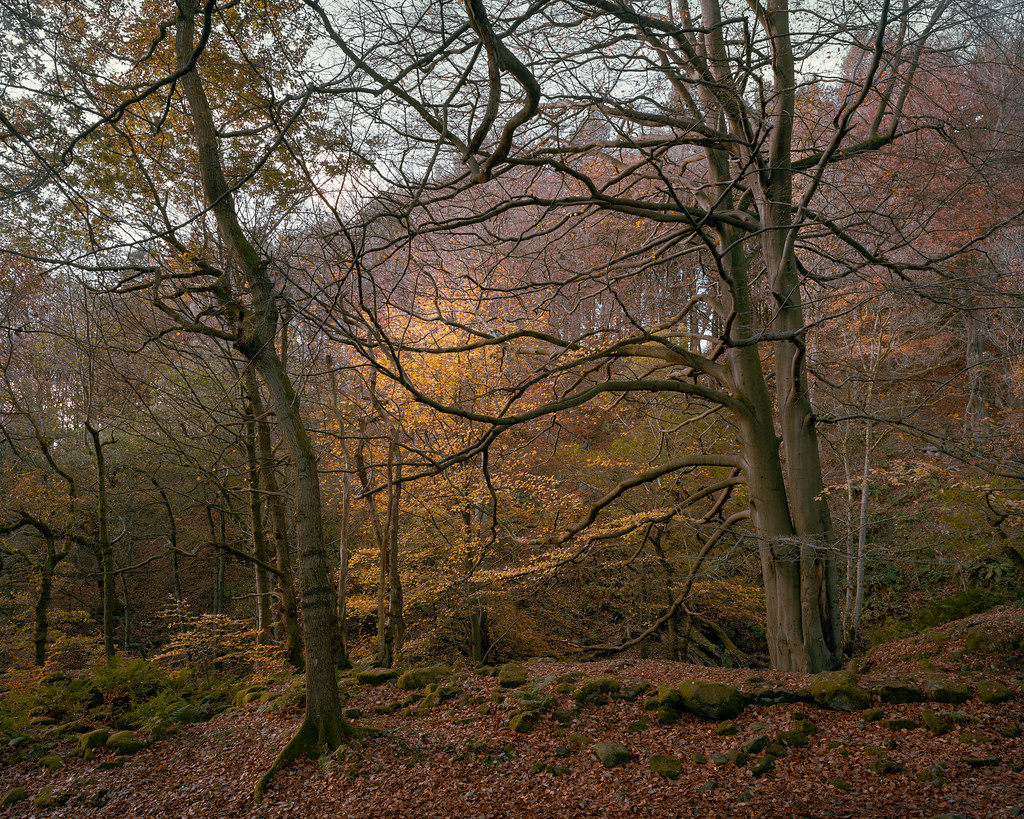 Padley View by atomstitcher, on Flickr
 Conversations by atomstitcher, on Flickr
| Photrio.com contains affiliate links to products. We may receive a commission for purchases made through these links. To read our full affiliate disclosure statement please click Here. |
PHOTRIO PARTNERS EQUALLY FUNDING OUR COMMUNITY:  |
