• Welcome to Photrio!
    Registration is fast and free. Join today to unlock search, see fewer ads, and access all forum features.
    Click here to sign up

Sharpest aperture for my Nikkor lenses?

Recent Classifieds

Forum statistics

Threads
202,908
Messages
2,847,384
Members
101,536
Latest member
anitakanase
Recent bookmarks
0

Army35mm

Member
Allowing Ads
Joined
Dec 7, 2016
Messages
125
Location
El Paso, Texas
Format
35mm
As the title states, I'm curious as to what the sharpest aperture is for my nikkor lenses.
I have the following:
28mm f2.8 ais
50mm f1.4 ais
135mm f3.5 converted ais
been trying to shoot around f8/f5.6 but I'm noticing a lot of potential blur on the outsides of my images.
 
Why don't you ask your lenses? You have them, you have a camera, you have film ...
 
Blur on the negative or on the print?

Look at the negative only.

Like you, I tend to use f/5.6 or f/8 whenever possible. The centers are usually sharpest at those apertures. You might get sharper corners at f/11, but that may not be optimal for the other parts of your image.

As Dan suggests, the best way to find out is to test your lenses.
 
The Rule of Thumb would indicate about -2EV (sometimes -3EV) from wide open

Not the same lenses, but representative:
  • Nikkor AF-S 28mm f/1.8 G best MTF is at f/4 (-2EV)
  • Nikkor AF 50mm f/1.4 D best MTF is f/4 (-3EV)
  • Micro-Nikkor AF-S 105mm f/2.8 G IF-ED VR best MTF is f/5.6 (-2EV)
 
Last edited:
Been looking to sharpen up the corners a bit. Trying to strike that balance. I'm using a very crappy Lomography smartphone scanner right now, so maybe that's why. I'll have to see about getting a negative viewer.
 
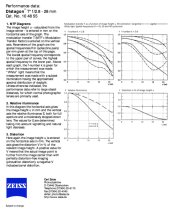
Not all 'name brand' 35mm format, wide angle, retrofocus lenses are sharp at the far area of coverage. Look at this Zeiss 28mm 2.8 MTF. In fact if you like 28mm lens on a 35mm camera, finding a good lens could take years. I used the Zeiss 28mm f2.0 (not the MTF posted) for years then switched to the Nikkor 28 f1.8, which is the best I have used to date. The manual focus Nikkor 28 F2 fared well in tests but I have never used one.
 

Attachments

  • 28 2.8.jpg
    28 2.8.jpg
    211.4 KB · Views: 111
Last edited:
Been looking to sharpen up the corners a bit. Trying to strike that balance. I'm using a very crappy Lomography smartphone scanner right now, so maybe that's why. I'll have to see about getting a negative viewer.

You cannot expect quality evaluation if your measuring device is "a very crappy Lomography smartphone scanner."
You need a GOOD film loupe.
 
While best MTF in Center are about -2EV or -3EV from wide open, the best MTF at Edges are closed down another -1EV from best Center MTF aperture.
 
While best MTF in Center are about -2EV or -3EV from wide open, the best MTF at Edges are closed down another -1EV from best Center MTF aperture.
And the difference between the two - centre or corners - will be extremely difficult to see except in the case of really large optical enlargements.
Bad scans will introduce problems of their own. Mediocre scans won't accurately reveal the quality of the negatives.
 
Hi,
There is a old rule that works fairly well for most lenses. Usually the sharpest f-stop is 2 stops down from wide open. APO, and ED optics often are best wide open or 1 stop.
In the case of your lenses you'll probably get the best results at f8 for your 28mm, f5.6 for your 50mm, and f8 for your 135mm. Of your three lenses, consider upgrading that 135mm.
 
As the title states, I'm curious as to what the sharpest aperture is for my nikkor lenses.
I have the following:
28mm f2.8 ais
50mm f1.4 ais
135mm f3.5 converted ais
been trying to shoot around f8/f5.6 but I'm noticing a lot of potential blur on the outsides of my images.

Don't know what you mean by "a lot of potential blur on he outsides of the images". Even used wide open, you should not be able to notice it with such lenses.
 
Hi,
There is a old rule that works fairly well for most lenses. Usually the sharpest f-stop is 2 stops down from wide open. APO, and ED optics often are best wide open or 1 stop.

+1

Designing a lens involves a set of compromises. At full aperture lens aberrations come to the fore as well as shallow DOF. At minimum aperture quantum effects come into play. Therefore it is usual to optimize a lens for use at minus 2 stops or so. There are exceptions. For example lenses intended for use in low light situations like the Noktons are designed to be used fully open. However the differences are not as dramatic as most people believe. If this is an important issue then get a lens test chart, good loop and some fine grain film and run your own tests. Even the best scanners add extra problems in measuring.
 
I agree with the advice given so far. I would advise using slide film in tests. All you would need to test sharpness would be a light source and a reasonably good loupe (a reversed 50 mm lens makes a handy one). With slide film your subject would be easily recognizable. It would only cost you for the roll of film and processing
 
Much depends on the ultimate use of an image. For posting online, almost any aperture on any quality lens suffices. For big enlargements from 35mm, I've found f/8 is about the smallest I can satisfactorily stop down. f/5.6 is often sharper. Large format users can and often do stop down much more.
 
Usually the trade off between depth of field and dispersion so usually around f/8 for 35mm, f/11 for MF and f/16 for 4"x5" for the sweet spots.
 
Don't know what you mean by "a lot of potential blur on he outsides of the images". Even used wide open, you should not be able to notice it with such lenses.
By potential blur, I mean I'm not sure if it's my "scanner"(Lomography smartphone scanner) or the image itself. I need to get a loupe, and I'm ordering an Epson v550 tomorrow.
 
Not sure what you mean by blur, lens aberration showing as softness in the corners? Generally speaking wide angle lenses have come on in leaps in the last twenty years, if absolute definition is vital I'd go for a modern optic. That's not to say old WA lenses were bad, but few were superlative and most were just ok. Garry Winogrand reckoned his 28mm Leica lens got much worse smaller than f8, and that's my experience of older glass. My modern Fuji lenses are excellent at any aperture except the two extremes, even on a kit zoom. However they lack the character* of old lenses.

*character = technical flaws, aka desirable imperfections.
 
I have half a mind to think it's the crappy scanner, that left side bugs me something fierce.
 
I have half a mind to think it's the crappy scanner, that left side bugs me something fierce.
Compared to the right, the whole left side is out. That suggests the scanning plane is not even. In camera film flatness issues are possible, but relatively uncommon, especially on 35mm. Sometimes happens on old bellows cameras when extending the front sucks the film out of place. Could be very bendy film beyond the scanners capacity to render in focus. Slide film is the simplest way of telling, or a negative, light box and lupe.
 
And if you don't have a lupe, use one of the lenses you have to magnify the film areas to check.
 
There seems to be an obsession with high resolution as an important goal by itself. If all of a person's photography involved only flat test charts then that would be most important. More often than not we are shooting three dimensional subjects and the need for adequate depth of field may outweigh the benefits of shooting at an aperture setting which produces the highest resolution. This has become an issue with high megapixel digital sensors. A 50MP Canon DSLR used with a 50/1.8 Canon EF lens will have its highest resolution with the lens stopped down to only f/4. If you are shooting a group of people, for example, f/4 may not provide adequate depth of field based on the distance you are shooting from. The difference with digital shooting is that you have some leeway by changing the ISO. With film shooting you could try TP/Imagelink HQ/CMS 20. That would get you fine grain and high sharpness but a very low ISO. Those film types just aren't suitable for every subject. If you are using 35mm film and need to make very large prints and are worried about the resolution of the final image, moving up to a larger format will do more good than worrying about whether your 35mm lens is set to f/5.6 or f/8.
 
crappy Lomography smartphone scanner

'Nuf said.


You don't have crappy lenses, so unless there is something mechanically wrong with them I doubt you will have crappy pictures.
 
'Nuf said.


You don't have crappy lenses, so unless there is something mechanically wrong with them I doubt you will have crappy pictures.
I answered my own question with my previous statement, and the recent photos I put in the gallery.
I need a better scanner.
 
Photrio.com contains affiliate links to products. We may receive a commission for purchases made through these links.
To read our full affiliate disclosure statement please click Here.

PHOTRIO PARTNERS EQUALLY FUNDING OUR COMMUNITY:


Ilford ADOX Freestyle Photographic Stearman Press Weldon Color Lab Blue Moon Camera & Machine
Top Bottom