• Welcome to Photrio!
    Registration is fast and free. Join today to unlock search, see fewer ads, and access all forum features.
    Click here to sign up

serial numbers nonexistent on some items?

Tompkins Square Park

A
Tompkins Square Park

  • 8
  • 0
  • 75
Siesta Time

A
Siesta Time

  • 2
  • 1
  • 57

Recent Classifieds

Forum statistics

Threads
202,859
Messages
2,846,698
Members
101,573
Latest member
IanSeehorn
Recent bookmarks
0
I have the same 1st generation AF 50mm 1.4 and it does have a serial number engraved on the aperture ring opposite the stop numbers.

 
As for what is the purpose of serial numbers? Well if a lens has changes in the optics and or barrel, difficulty may exist in identifying what the version of the actual lens is. Comparison of the serial number with a manufacturers list should definitively identify what the lens is. This was especially so with Nikon manual focus lenses which did differ even during a production run and the serial number will tell you when the changes happened after a certain number.
I don't disagree - for the market conditions that existed when the older manual focus lenses were made.
In this current world, when so few things are made to be maintained and/or repaired, I'm not so sure.
 
Here it is:
...

From what I can find, that lens is among the first-production 50/1.4 AF lenses from 1986-1991. It was made in Japan.

The serial number should be on the opposite side of the aperture scale, as mentioned in the post by Dennis above.

This is the first time I've seen a Nikkor lens with most of the ADR scale rubbed off. That lens has had a lot of use. The wear marks along the back rim of the lens and the damage to the AI ridge are interesting: it suggests a lot of contact, possibly with other lenses in a camera bag. I wouldn't be surprised if a professional photographer had used this lens for 30 years. If only that lens could tell its stories (well, I suppose it's condition does, somewhat).

One of the electronic contacts looks like it could use some help.

Anyway, not a bad buy for $10. It would be fun using it.
 
Current high-end digital cameras will be sought after more so than film cameras. As digital SLR production goes down, new prices will skyrocket like film camera prices. Old digital SLR cameras will be sought for their value and performance.

It's going to come down to how well current digital cameras age.

More things can go wrong with electronics. Capacitors fail, corrosion causes shorts, solder joints crack, and replacement batteries may not be available.

Repairs are going to end up costing more than most of the cameras are worth. That's if parts are available and you can find someone to do the repairs.
 
I would think serial numbers necessary for efficient quality control purposes. They’d help with narrowing down problem issues.
And are handy in police reports and insurance claims.
 
We sit with bated breath awaiting the serial number of this lens.
 
Even 500$-1000$ Leica external viewfinders don’t have serial numbers. Not even their 250$ lens hoods...

Also, I have noticed that these 50mm nikkor lenses have their serial numbers printed so light and small on the aperture ring. It easily gets erased over time.
 
No there is no serial number opposite the aperture scale. Maybe it was written in white ink which has since rubbed off. But there is NO engraved number. - David Lyga
 
It's there, somewhere. Try looking closely at the f/stop ring between the mount and the grip surface, all the way around. My zoom from roughly that era has the S/N on the left side, (as viewed from the back), on my 50, it's on the right. Very finely engraved as Cholliefan says. The font is about the same height as the small f/stop numbers at the back of the ring, but smaller in thickness, and black. More or less like a bold font compared to "extra light".
The engraving is too shallow to feel with your fingers (my fingers, anyway).
Hope this helps.
 
Very finely engraved, indeed. Being an early 1986-1991 lens, it definitely would have a serial number and it would be engraved rather than printed.

Considering the amount of wear on your copy of the lens, David, it may well have been worn down.

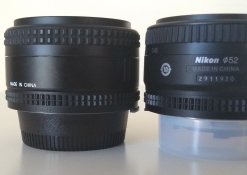
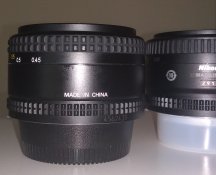
Here are two of mine, which are more modern (less than 10 years old). They still put serial numbers on them, but the one on the left is much harder to see.

IMG_20190803_142159353~2.jpg IMG_20190803_142357211~2.jpg
 
Hmm. It really depends on the lens maker. For example, Tomioka made a line of lenses to be front-mounted on #1 shutters. Most were intended for the Polaroid MP-4 system. These lenses don't have serial numbers. They also made lenses apparently identical to the MP-4 lenses to be mounted in Copal shutters, both #0 and #1. These lenses have serial numbers. They made lenses for folding Polaroid Land Cameras and for 35 mm SLRs. These have serial numbers. Go figure.

Boyer made cheap meniscus lenses for a variety of very inexpensive English and French cameras. These lenses lack serial numbers. Boyer also made more expensive lenses for enlarging and taking. Most have serial numbers. Same goes for their projection lenses. Go figure again.
 
Photrio.com contains affiliate links to products. We may receive a commission for purchases made through these links.
To read our full affiliate disclosure statement please click Here.

PHOTRIO PARTNERS EQUALLY FUNDING OUR COMMUNITY:



Ilford ADOX Freestyle Photographic Stearman Press Weldon Color Lab Blue Moon Camera & Machine
Top Bottom