
• Welcome to Photrio!
    Registration is fast and free. Join today to unlock search, see fewer ads, and access all forum features.
    Click here to sign up

Separating glued lens groups (no, seriously...)

Tree with Big Shadows

Tree with Big Shadows

  • 2
  • 0
  • 15
Everal Barn

A
Everal Barn

  • 0
  • 0
  • 17

Forum statistics

Threads
203,450
Messages
2,854,892
Members
101,848
Latest member
DLelandC
Recent bookmarks
2

M Carter

Member
Allowing Ads
Joined
Jan 23, 2013
Messages
2,149
Location
Dallas, TX
Format
Medium Format
I've got a 99 cent 28mm samyang lens in Nikon mount. Inside, it has the usual black steel barrel assembly with lens elements glued to the front and back. Anyone know how to remove the glue to pop an element out?

I'm not trying to repair the thing - heck, it looks like new; basically I want to strip the front coating and paint as much of the inner barrel spaces I can get to silver. If I destroy it, well... it's a pretty crappy consumer lens, only sharp around F11.

Why you ask? Well, I shoot a fair amount of music videos and I'm playing with organic effects... plastic lenses, making lenses from old elements and pipe, etc. I'm curious about a very reflective and uncoated lens for high key stuff, see what kind of flares and blurs might come from it. I've done some really pretty stuff by turning holga lenses into tilt housings, etc. Just looking for a pleasant surprise. I really like non-digital, skip the plugins kinds of things.

So, I'd like to pop the front element off to get inside the barrel. There's a steel ring and the glue seepage from assembly is very visible. Heat the metal with a soldering iron? Acetone soak? I'd rather not do something that makes the entire assembly fall apart (I've read about soaking the whole thing in solvent, etc). I don't care if it ends up with dust inside, etc.

The case it came with is a perfect fit for my bluetooth speaker that we use for synch on set, so this is already a win. Thanks for any ideas!
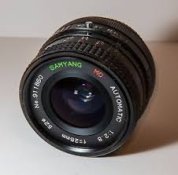
 
Is this the lens? lens.jpg
 
If it's just regular balsam glue, the tip I hear most often for separating LF elements (not that I've tried it), is to very gently and very slowly heat it up in the oven, that'll loosen them enough to slip.
Or acetone, but that'll eat through the paint too (although in your case, that sounds like it'd be a good thing).
 
Paint stripper(Methyl Chloride) is what I use. After trying every other chemical I had available it''s the only one that works consistently.
It does tend to burn quite a bit so rubber gloves are a real necessity. I have tried the heated water on a couple & it didn't work for me.
I did find that if some glass is left in it that it will do very dramatic and permanent damage.
 
You mean Methylene chloride not Methyl chloride.
 
Paint stripper(Methyl Chloride) is what I use. After trying every other chemical I had available it''s the only one that works consistently.

Since some years within the EU the sale of methylene chloride containing paint strippers for private and commercial use is prohibited.
The substitutes may be of different effect.
 
Thanks for the ideas... I'd prefer to just get the front off vs. all of the glued bits coming apart. This is probably a lens from the late 70's or early 80's so it may not be balsam? Maybe I could get acetone to soak into the front seam though, or spot-heat it with something like a soldering tip. I don't know if there's any glass-to-glass assemblies inside there, but if they are I'd like them to stay together.
 
Lenses aren't "glued in". And a soldering iron will do no good. Your whole question is unclear.
 
If you're trying to remove the bezel, check the hardware stores for a rubber plug that will just fit on the bezel (and just inside the filter threads) Most of them then can be removed by pressing the rubber plug against them and turning it. The front element may then drop out, or you may have to use a spanner to remove it. You can probably find a lens spanner on that auction site.
 
Lenses aren't "glued in". And a soldering iron will do no good. Your whole question is unclear.

There are about nine zillion threads on google regarding glued assemblies inside lens casings. There are threads about glass-to-glass assemblies using glue. There are threads about element groups in metal cases that are assembled with glue, not threads or screws. They tend to be from people wanting to clean fungus or repair separated elements and the advice is always "send it to a repair shop".

Per my original post, the inner lens assembly is removed from the lens. The bezel was as simple as the average lens. Remove set screw and then grab and turn.

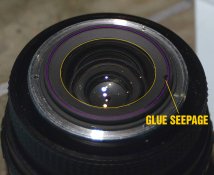
Also per my original post, the metal internal assembly that holds the elements has a glued-on front. I can see the glue seepage from assembly. What's actually glued in place is a metal piece that looks like thin, seated washer. There are no spanner holes.

This assembly moves up and down via the focus helicoid. The rear of the assembly screws off - it's the rear-most element and the iris assembly. The rest is an assembly of elements and black metal, that has no threads, set screws, etc. Appears to be a rear and front element with space between them.

As far as I can tell, this assembly is glued together (I can even see the glue, we're not talking Nikkor or Zeiss here...)

I'm not, let's say, a complete idiot. I've stripped down two RB lenses with stuck shutters and they work like new now, and as far as I'm concerned, that's not a walk in the park. (And inside the RB lens was a similar black steel assembly with glass on each end and no visible way to disassemble further, not that I would have.)
 
Perhaps this will help. (The inner assembly is sitting in the lens housing in this case, front bezel removed. the bezel has no glass, it's just the printed ring and it seals the lens assembly from the front)
lens.jpg

(The chrome ring with three screw holes is part of the external lens assembly. The screw heads overlap the black metal lip to hold the lens group assembly in place.)

The yellow line is the front element. it's convex and protrudes a couple millimeters at the center.

The pink line shows the metal that (I assume) holds the front element and seals the assembly. This has no spanner holes and certainly appears to be glued in - there's a thin line of glue all around and a blob of glue that appears to have seeped out during assembly.

I'd like to open up the assembly by removing that metal band and the front element. Looking for ideas. According to Tom1956, heating this won't work. Solvent maybe?
 
OK, now that it;s clearer--yes these rings can typically be glued. I thought you were saying the lens was glued in as its primary way of keeping it assembled. As for that, it's anybody's guess as to what will break the glue they put on that friction-turned ring. May well be impossible. That looks like it would be one mean assembly to get apart.
 
Here is what I would do, what with it being a cheapo lens I didn't care about: I'd get a very small drill bit and drill 2 holes on opposite sides of the ring that I could use a spanner wrench on. With that glue, all the friction of a rubber-style friction removing ring would probably not break that glue. As for me, I'd skip that angle and go straight to the hole drilling and spanner idea. That looks like one heck of a glue-in. Remember, once you've used liquids, you're committed because they'll seep in and get on the glass and you'll HAVE to get it apart then. GL
 
http://www.liftoffinc.com/
Motsenbockers lift off #2 or possibly FSR applied to the ring and allowed to sit for a few hours to a day or two.
I've used Lift Off #2 on some camera glues that would not soften up quickly but did lose their bond after a period of time and the parts were separable without damage to them.
Many epoxies, which is probably what was used on your lens, soften after 30 minutes in a 250°F oven. They will recure if allowed to cool but not as strong of a bond as it originally was.
 
That spanner idea is greatness (though who knows if that is threaded in or just sits in a pile of glue?) I'd assume if it was threaded that the glue wouldn't be necessary, just some thread lock if they wanted it permanent. Those sorts of element assemblies must be clean-room jobs, but threading it together doesn't seem like glue would be needed.

The oven idea is something that's popped up on searches, but I'm hoping to not have the whole thing fall apart. I think I'll start with direct heat (soldering iron). Since there's extra glue on the surface I should find out pretty quickly if the glue will soften.

Thanks guys, should I end up with some crazy-ass JJ Abrams shots, I'll post some samples.
 
It doesn't sit in a pile of glue. A soldering iron won't work BTDT lots of failed attempts myself. They put a little drop of gleu on the thread and then screw it in, so that little drop is all around the circumference to one degree or another. All the Jap manufacturers do it just to make sure the thing doesn't come apart and cause a warranty problem. You might try a pipe fitting from the hardware store with a few layers of duct tape on the end with some sort of sticky substance, rubber, whatever. It might work. That glue could be brittle now and break right loose.
I suppose if the Brits made it they might use glue too. The Swedes don't seem to use glue.
 
Thanks Tom - sounds like the spanner & holes idea would be conceptually the same as pipe & rubber (though I don't have a spanner. When I took Mamiya lenses apart I used 2 screwdrivers, 2 grip heads and some 5/8 rod... but that was like a 2 or 3" gap).

I guess that could also lead back to the "heat the whole thing in the oven" to get the glue loose. Though if it's aged enough to crumble, I'd try it with the spanner or pipe first.

Anyway, I'll give it some thought and give it a shot after the 4th.
 
Hi everyone,

sorry to exhume the thread after so long time. I am experiencing the same difficulties unscrewing the frontal optical element ring of a Nikkor 135mm f 2.8. It is so 'well' sealed that nor acetone and spanner seem to work.
Before last attempt with oven at 120°C any other suggestion/insight is warmly appreciated! Thanks a lot for much.

Best. Dam
 
Last edited:
Hi again,

a quick update, after several months of attempts oven has brilliantly worked! I regret I didn't it before but I was a bit worried to damage the optical elements.

ef70d778-7cdb-4e10-ab5e-239148fef567.jpg


Anyway I hope it can save time to the ones who have the same difficulty. Thanks so much for the precious help.

Best.
Dam
 
But would that work with synthetic cements at that temperature too?
And would one need synthetic-cemented lens elements to disassemble of each other anyway?
 
But would that work with synthetic cements at that temperature too?
And would one need synthetic-cemented lens elements to disassemble of each other anyway?

Honestly I don't know since I have no experience with it. I suppose the datasheet of the synthetic cement can help, I am sure Jon Goodman can add something more.
 
Photrio.com contains affiliate links to products. We may receive a commission for purchases made through these links.
To read our full affiliate disclosure statement please click Here.

PHOTRIO PARTNERS EQUALLY FUNDING OUR COMMUNITY:


Ilford ADOX Freestyle Photographic Stearman Press Weldon Color Lab Blue Moon Camera & Machine
Top Bottom