


• Welcome to Photrio!
    Registration is fast and free. Join today to unlock search, see fewer ads, and access all forum features.
    Click here to sign up

Sekonic Studio Deluxe L-398 lifespan

  • A
  • Thread starter Deleted member 88956
  • Start date

Spring break

H
Spring break

  • 6
  • 4
  • 79

Recent Classifieds

Forum statistics

Threads
202,855
Messages
2,846,625
Members
101,572
Latest member
apltd
Recent bookmarks
1

Deleted member 88956

As I have accidentally acquired this cult meter (in a box of I was more after), the Sekonic Studio Deluxe L-398, is there a time limit for the selenium cell? Anyone has had a dead one yet? Mine appears to have not been used much and came in a case, so unlikely it was exposed to light much, but was wondering if there is any life span estimate on these.

BTW, I can see how this meter has been coveted so much, I do like it's solid built and precision movements.
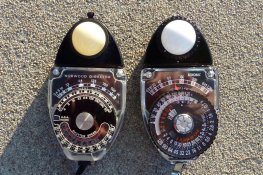
 
I have a Norwood Director Model B meter that's now 70 years old. It reads a stop or so slower than a much newer Sekonic 398. Part of the difference is due to the yellowing of the incident dome on the Norwood, and part I suspect is due to the selenium cell weakening over time. From experience with these and other selenium based meters, though, they hold up quite well over the long haul.
 

Attachments

  • Norwood_4.jpg
    Norwood_4.jpg
    182.5 KB · Views: 344
The Sekonic L398 uses an amorphous silicon cell which is the none cryristine form of solar cells that are used in solar panels that people have on their roofs to turn sunshine into electricity, I suggest that before you assume that because it's old it doesn't give accurate reading you test it and try shooting some film with it, because to accurately estimate the service life of these cells are imponderable.
 
The Sekonic L398 uses an amorphous silicon cell which is the none cryristine form of solar cells that are used in solar panels that people have on their roofs to turn sunshine into electricity, I suggest that before you assume that because it's old it doesn't give accurate reading you test it and try shooting some film with it, because to accurately estimate the service life of these cells are imponderable.
Good to know, thanks. It appears to be quite close to my spot meters so I have no issues with it working properly at this point (and the fact that it is in near pristine condition, suggesting it has not seen hands much).
 
The Sekonic L398 uses an amorphous silicon

I'm afraid there is more to say to it. The original L-398 meter, as well as its successor the L-398M, still use a Selenium cell. The current version, the L-398A, uses the forementioned silicon cell. The OP states he received a L-398 meter.
 
I have a L-28C2 that looks pretty much identical to the L-398 (I don't know if there are any differences). Its age is sometime in the early to mid 70s, and mine is still accurate, and works perfectly. One of my favorite details is the center of the wheel has a button to take your reading. If you look closely, that just physically releases a clamp that holds the needle in place. When you release the button, the clamp presses against the needle keeping it from moving.
 
I have a L-28C2 that looks pretty much identical to the L-398 (I don't know if there are any differences). Its age is sometime in the early to mid 70s, and mine is still accurate, and works perfectly. One of my favorite details is the center of the wheel has a button to take your reading. If you look closely, that just physically releases a clamp that holds the needle in place. When you release the button, the clamp presses against the needle keeping it from moving.
Yeah, I've got the operation already (came with never read manual too). It is a nice meter and since I have it, I'll use it. And it is quite small, especially comparing to Luna Pro or better yet, a Minolta Auto Spot
 
I'm afraid there is more to say to it. The original L-398 meter, as well as its successor the L-398M, still use a Selenium cell. The current version, the L-398A, uses the forementioned silicon cell. The OP states he received a L-398 meter.
Correct you are, just read in the manual to confirm, it is selenium in mine. But so far so good.
 
Funny... I just asked myself the exact same question as I bought last week for a song a Sekonic L-6 and even if it was built 60 years ago, it is dead when compared to my other meters. My other selecnium meter is a Gossen Sixtino I bought in the late 70s and I use on a regular basis as my cameras are all manual (FED 3, Leica M2, Mamiya C330, Lubitel 2).

My guess is that as long as they are not exposed to light when not used, they should outlast me.
 
The Sekonic L398 uses an amorphous silicon cell which is the none cryristine form of solar cells that are used in solar panels that people have on their roofs to turn sunshine into electricity, I suggest that before you assume that because it's old it doesn't give accurate reading you test it and try shooting some film with it, because to accurately estimate the service life of these cells are imponderable.


Only the current version, the L-398A Studio Deluxe III, has the amorphous silicon cell. All of the older L-398 versions use Selenium.
 
My Norwood Director still works. Seems to read the same as when I got it in 1983. At the time it was in a box of 'dead' meters at the store. It had the blank slide with no holes in the slot!

I actually don't use it much because outside it always reads the same as the 'sunny 16' exposure guide (which is easy to memorize) and inside it is not sensitive enough for my purposes.
 
My L-398 is a stop slow. As long as you remember to shift the ISO setting to compensate for that, it's still a very accurate meter. Definitely worth the price I paid.
 
The more I play with L-398 the more I understand all the hooplas about it I've heard and read over the years. Just the feel of it emanates with confidence it does no lie. Surely not a universal for all needs, but still, so long in production and still kicking lots of competition in the rear.
 
Photrio.com contains affiliate links to products. We may receive a commission for purchases made through these links.
To read our full affiliate disclosure statement please click Here.

PHOTRIO PARTNERS EQUALLY FUNDING OUR COMMUNITY:


Ilford ADOX Freestyle Photographic Stearman Press Weldon Color Lab Blue Moon Camera & Machine
Top Bottom
