My wife and I will have about 17 days in Australia, beginning in the middle of December. We plan a few days in Melbourne, a few days exploring the great coast road, and 5 days or so in Tasmania. Normally i carry far more gear than ever get used when I travel, and I want to pare my kit down to a manageable level for this trip. It goes without saying that I will be bringing my Rolleiflex, because it's my everyday camera and it just works for me. Other than that, I have a pretty robust selection of Nikon cameras and primes, a Hasselblad with lenses ranging from 50mm to 250mm, and a Brooks Plaubel Veriwide 6x10 as options. I really rarely shoot wide, but don't really know what to expect. Carrying a full bag of Nikon gear doesn't hold a lot of appeal to me, but maybe I could limit it to 3 lenses or so. But then the Hasselblad and a couple of lenses wouldn't really be that much heavier, especially if I left out the 80mm that's covered by the Rolleiflex. Anyway, I would appreciate any feedback that can be offered
Well, thanks to your feedback, I think that the great ocean road has been dropped from our itinerary, in favor of more time in Tasmania. We are going to spend a couple of days in Neerim South, recuperating from our flight and then, flying to Hobart. We have to be in Philip Island for Christmas, and then 4 days in Melbourne. Thanks for everyone who warned about the seeming horrors of the GOR. I'm a nature person, not a people person, so I think this will be a much more relaxed visit. This will give us 10 days in Tasmania, so hopefully we can get a taste of both coasts
I've been living in Tassie for about twelve years, 30 minutes from Hobart on a few acres. We're very happy here overall. I echo the views previously expressed about Hobart, it's a wonderful city that's not as fast-paced as most of the other Australian capitals, has a lot of history, is well situated between the River Derwent and Mount Wellington and very pretty, in many ways.
I don't know how much of an interest you have in the arts, generally, but David Walsh's
Museum of Old and New Art about 15 minutes drive from Hobart CBD is an interesting place to take a look through. I've got mixed feelings about some of the contents the museum houses, some are of more appeal than others but I love the complex itself, which is partly subterranean, being carved into the rock of the river bank and weaving and winding up, down and in every direction, with surprises around every turn. It's a fascinating architectural study, and an artwork itself.
As far as equipment is concerned, I've used a series of Rollei TLRs and Hasselblad myself for a number of years. They certainly each have much to recommend them. I know what works for me, but which you might consider bringing depends on what you like to shoot and how. If you're a prolific shooter some 35mm kit may be a good idea. But if you'd rather aim for quality over quantity I think the Hasselblad would be a good choice if it is nature and landscape you're considering (unless you plan to be doing a lot of extended walking, where I think 35mm or a Rollei would be the obvious choice).
I'm a huge fan of the Rollei TLRs, actually, I adore them, I have a 2.8C I've just sold, a 2.8D and a Tele (that needs a couple of parts). So please take my next comment in that context. I'm not sure why you would be taking a Rolleiflex and a Hasselblad along with you, if you're not going to be concentrating on the sorts of imaging a Rollei can do better than a Hassy. I don't see either make of camera as being better than the other. Each can do certain things the other can't, or at least, can't do as well, or as easily. But the great strength of the Hasselblad is its sheer versatility. With a couple of magazine backs and a few lenses you can shoot colour or black and white using a wide angle, normal or a telephoto. It's got a lot to recommend it for travel, if you're not sure exactly what you will be shooting, but want to be equipped to manage anything you might encounter.
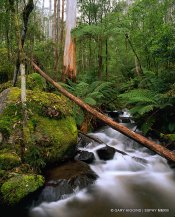
I also don't know what sort of film you prefer to use. But from what you've said it seems clear you want to be getting out into some of the wilderness areas and into the forest canopy. Unless you're into exposing at higher EIs, with your medium format choices you're going to be working with f/2.8 lenses. Whilst you will be visiting during our summer, the weather may still be overcast on some days and on Tasmania's western regions the average rainfall is a great deal higher with more inclement days. Therefore a tripod is likely to be an important item, even for daylight imaging, if you want to stop a lens down for DOF, let alone late in the afternoons, under forest canopy.
You can't really go wrong with any of the state's national parks if that is what you are most interested in experiencing. Not that I've personally been to all of them yet. But I will put a good word in for the drive out to Strathgordon and back. There's no return loop, it is a dead end road into the wilderness that ends in Strathgordon at Lake Pedder and the Gordon Dam, so I think many visitors pass it by, as you have to retrace your route for a couple of hours. But it takes you right out into the South West World Heritage Area through some absolutely stunning scenery. And it continues on from the road to National Park, so if you are planning to see Mount Field, you're already a quarter of the way to Strathgordon. I'd not done the trip for over ten years until late last year when I took some visitors out there for a look, and I had quite forgotten how magnificent the isolation and landscape really is.
I'd also like to put in a recommendation for the
Port Arthur Historic Site. It's only around 90 minutes from Hobart but it's probably the best preserved convict site in the Southern Hemisphere and another designated UN World Heritage Area itself. The modern history of Van Diemens Land is centred around its role as a penal colony, and nowhere in Tassie will you see and learn more about that than at Port Arthur. It's also very close (minutes) to Tasman Island, which has some of the tallest cliffs in the Southern Hemisphere. If you're looking for dramatic colour landscape images, recording the sun rising over Tasman Island is an unforgettable experience if the weather conditions are kind.
As you are arriving in Hobart, I recommend paying a visit to
Wild Island Tasmania gallery at Salamanca Place. In recent years they've scanned and re-printed a number of the late Peter Dombrovskis's wilderness images that he recorded so well on 4x5" transparency with his Linhof Master Technika. Iconic seems to be a much-overused word in the 21st Century, but it is surely justified when describing Peter's unforgettable colour photos made in some of the most remote, and beautiful, parts of Tasmania. Indeed, one of his shots was so influential it played a part in preventing the damming and flooding of the Franklin. If you've a mind to concentrate on the wilderness experience the state offers, as a photographer you still won't find any better inspiration for imaging while you are here, than viewing some of Peter's work.
A visit to the
Tasmanian Museum & Art Gallery is also highly recommended, you'll get a good introduction to the state's social history, the history of its indigenous people, and will have opportunities to learn about the endemic fauna species that live in Tasmania, some of which are found nowhere else on earth.
If native fauna is of particular interest to you, a visit to
Dead Link Removed would be my suggestion, they are about 30-odd minutes from the Hobart CBD. There are plenty of kangaroos, wallabies, koalas, (not endemic to Tasmania), Tasmanian Devils, quolls, wombats, possums, echidnas and other native species to see, some of which you may get up close to. But they do a lot of fantastic work rescuing and rehabilitating injured or orphaned species rescued from various parts of the island, many of which are released back into the wild when possible. I have been a rescue volunteer for them for some years and have seen, first hand, the difference they're making to vulnerable and endangered species, and by visiting the park not only are you enjoying the experience of seeing and learning about them, but are also assisting their welfare and long term survival as a species in some cases.
The best place to purchase film in Hobart is
Walch Optics at 149 Macquarie Street (local call 6223 8855). They don't stock hundreds of rolls, but will always have some Ilford black and white in 35mm & 120, and usually have some Fujichrome and Fujicolor Pro 400H. They charge around $12-14 a roll for Ilford, depending on type and format. Which is, believe it or not, actually not too bad by Australian retail standards. If you should have any equipment issues while you're in Hobart, Walch are the only place that can Eg. quickly fix a minor problem with a Hasselblad, sell you a replacement back, dark slide, a cable release, tripod fitting, or help with any other ad hoc problem that comes up. Their customer service is excellent, anyway, but tell them I sent you, I am well known to them.
Stallards over on Elizabeth Mall will process C-41 several times a week in 35mm & 120, and may have a little film on hand (Eg the Kodak 35mm consumer C-41 types) but are really a digitally focused store, and you have to take pot luck on whatever they may happen to have on hand.
On a personal note I think our tiger snakes are rather beautiful creatures as are our copperhead snakes. We live on seven acres and have plenty of them slithering around but they have never given us any cause for concern. They simply want to be left alone to get on with life and do their thing. If they're encountered in the wild, generally, the best thing to do is hold your ground and give them an opportunity to move away if possible. They're rarely interested in confronting you in my experience, whch has included spotting one less than a metre away. They absolutely demand respect, the three species of endemic serpents in the state are all venomous (though you'd have to stick your jugular into a white lipped snakes fangs to actually get a fatal dose, I reckon, since their fangs are extremely short). But a tiger, whilst it has powerful venom, has only medium length fangs, Bite fatalities are not unknown, but they are quite rare in healthy adults. Given a compression bandage and prompt hospital treatment and antivenom, the prognosis for bite victims is generally very good. Copperheads have even shorter fangs, so, whilst they also demand respect, they should not be a source of undue concern either. I'd be far more concerned about encountering an Eastern Brown snake or Red-Bellied black snake on mainland Australia. Coming from South Australia, originally, whilst I'm not blase about our Tasmanian snake species, I'm also far more relaxed about sighting one than I would be about, say, getting up close to an Eastern Brown, a bite from which is VERY BAD NEWS INDEED. Comparitively speaking, the Tassie snakes are not a big worry, and they eat lots of rats, and I hate rats, so...
Enjoy your stay.
Cheers,
Brett