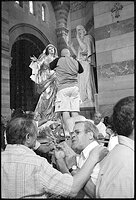
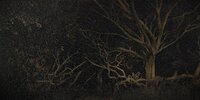

As some of you may know, I have a huge backlog of negatives from my European trip this past summer than I am currently processing. The majority of what I shot was on my fairly new-to-me Mamiya 6. I did use and test the camera prior to my trip, realized the problems it can have with metering and took measures to counter that, often double-checking with my handheld meter to make sure the readings were correct (they were). Unfortunately, it has become clear with every roll I develop that a lot of my negatives suffer from underexposure, which I know is one of the most difficult things to deal with at the printing stage. In many cases, there is detail in the shadows, but it's very thin. I have this problem in all kinds of lighting, but it is more problematic in less contrasty light (indoors, or in a forest, for example). I have been trying to adjust developing times to compensate but I don't want to overdevelop my negatives too much and create another kind of problem.
In any event, I know there are some things I can try AFTER the negatives have been developed (selenium is my most likely choice), but I was wondering if there was something I could do AT the developing stage to deal with negs, that in all likelihood, will be underexposed. In the worse case scenarios, the whole roll in underexposed, but in other cases, it is sometimes only 1-4 frames out of 12. So far I've tried D-76, Xtol, Diafine, and Rodinal (for Acros) but the only negs I am happy with are the ones in Diafine (but I shot those rolls at 1250/1600 specially to be developed in Diafine, and they were shot with a Holga). Of course, I have no way of knowing which rolls will be worse than others, but I think I can kind of guess based on what's come out so far. Anyway, this is what I have:
Films: HP5+ (at 200, 400, 800), Acros (mostly at 80), and Tri-X (almost finished, the rolls that remain were shot at 320/400). The majority of the rolls were shot at (or near) their box speed, ISO was cut in half for contrasty light, and sometimes shot at 800 in very low light.
Available developers I have at home: D-76, Xtol, TMAX, Diafine, R09 Rodinal, Finol (this is new to me, haven't tried it yet). Also available to me in Japan are various Fuji developers (Microfine, etc. - but I haven't used these either), HC-110 (at $80 a bottle!) and ID-11 and Microphen. Mixing my own developers is not possible (I'd have no idea where to source a lot of the chemicals) and more exotic developers like pyro are things that I would like to try (but haven't), and are also not available in Japan either (I'm not against using pyro either, but if Finol (or Tanol, which I can also get here in Japan) could work just as well, that would be great.
Generally speaking my developing process is pretty normal (1 minute initial agitation, 10 sec every minute thereafter) and I usually develop most films a little longer (10-15%) than official times state, which gives me a nicer neg to work with my diffuser enlarger. I have done some stand/semi-stand development with Rodinal but not much. I like the idea of using greater dilutions (1+2 or 1+3 with D-76 or Xtol) and extending development times while reducing agitation, but I'm not sure where to start, or if that would help me much. Right now my tap water is at a perfect temperature for developing (20-23 degrees Celsius) but that won't last long. That said, if raising or lowering developing temperatures (I try to stay around 20 C) would make a difference, I'd be interested in knowing that too.
I am well aware that if there wasn't enough exposure to begin with that there isn't much I can do, but if there is a way to tease out what shadow detail is there I'd appreciate whatever advice people can give me. If there is nothing I can do now, you'll hear from me again in the printing forum.
In any event, I know there are some things I can try AFTER the negatives have been developed (selenium is my most likely choice), but I was wondering if there was something I could do AT the developing stage to deal with negs, that in all likelihood, will be underexposed. In the worse case scenarios, the whole roll in underexposed, but in other cases, it is sometimes only 1-4 frames out of 12. So far I've tried D-76, Xtol, Diafine, and Rodinal (for Acros) but the only negs I am happy with are the ones in Diafine (but I shot those rolls at 1250/1600 specially to be developed in Diafine, and they were shot with a Holga). Of course, I have no way of knowing which rolls will be worse than others, but I think I can kind of guess based on what's come out so far. Anyway, this is what I have:
Films: HP5+ (at 200, 400, 800), Acros (mostly at 80), and Tri-X (almost finished, the rolls that remain were shot at 320/400). The majority of the rolls were shot at (or near) their box speed, ISO was cut in half for contrasty light, and sometimes shot at 800 in very low light.
Available developers I have at home: D-76, Xtol, TMAX, Diafine, R09 Rodinal, Finol (this is new to me, haven't tried it yet). Also available to me in Japan are various Fuji developers (Microfine, etc. - but I haven't used these either), HC-110 (at $80 a bottle!) and ID-11 and Microphen. Mixing my own developers is not possible (I'd have no idea where to source a lot of the chemicals) and more exotic developers like pyro are things that I would like to try (but haven't), and are also not available in Japan either (I'm not against using pyro either, but if Finol (or Tanol, which I can also get here in Japan) could work just as well, that would be great.
Generally speaking my developing process is pretty normal (1 minute initial agitation, 10 sec every minute thereafter) and I usually develop most films a little longer (10-15%) than official times state, which gives me a nicer neg to work with my diffuser enlarger. I have done some stand/semi-stand development with Rodinal but not much. I like the idea of using greater dilutions (1+2 or 1+3 with D-76 or Xtol) and extending development times while reducing agitation, but I'm not sure where to start, or if that would help me much. Right now my tap water is at a perfect temperature for developing (20-23 degrees Celsius) but that won't last long. That said, if raising or lowering developing temperatures (I try to stay around 20 C) would make a difference, I'd be interested in knowing that too.
I am well aware that if there wasn't enough exposure to begin with that there isn't much I can do, but if there is a way to tease out what shadow detail is there I'd appreciate whatever advice people can give me. If there is nothing I can do now, you'll hear from me again in the printing forum.