
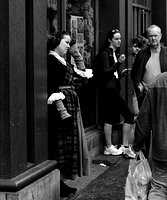
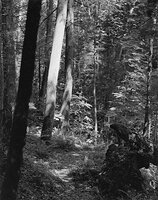
I have been experimenting with Tmax 400 in 135 and 120 sizes. My initial perception was, since these are the same film, they behave identically. However, my short experience is showing me otherwise.
For example...
Tmax400 in 135 developed with XTOL 1:1 at specified time per chart almost always ends up being a little too contrasty in my process. -10% time seems to do it just right for me.
Tmax400 in 120 developed with XTOL 1:1 at specified time per chart seems to be just right.
Looking at negatives, similar exposure looks a lot darker in 135 than 120.
Looking at prints, ones from 120 looks creamier and smoother than 135. (both enlarged to 8x10) but not as much as enlargement factor might otherwise suggest.
Now, the question part....
Are these difference coming from shutter/departure calibration issues in camera? My processing is very consistent with use of water bath, temp, and timing, including agitation.
Or... are these difference coming from different enlargement factor? Obviously, 135 enlarged to 8x10 has been magnified to far greater degree than 120 to 8x10.
Or... are they really not the same film, or shouldn't be treated as such?
These tests weren't scientific. I didn't have two cameras set on tripod side-by-side. But with number of films on both, these tendencies seems to be very consistent.
I'm trying to hone in my calibration and I could use some help.
For example...
Tmax400 in 135 developed with XTOL 1:1 at specified time per chart almost always ends up being a little too contrasty in my process. -10% time seems to do it just right for me.
Tmax400 in 120 developed with XTOL 1:1 at specified time per chart seems to be just right.
Looking at negatives, similar exposure looks a lot darker in 135 than 120.
Looking at prints, ones from 120 looks creamier and smoother than 135. (both enlarged to 8x10) but not as much as enlargement factor might otherwise suggest.
Now, the question part....
Are these difference coming from shutter/departure calibration issues in camera? My processing is very consistent with use of water bath, temp, and timing, including agitation.
Or... are these difference coming from different enlargement factor? Obviously, 135 enlarged to 8x10 has been magnified to far greater degree than 120 to 8x10.
Or... are they really not the same film, or shouldn't be treated as such?
These tests weren't scientific. I didn't have two cameras set on tripod side-by-side. But with number of films on both, these tendencies seems to be very consistent.
I'm trying to hone in my calibration and I could use some help.


