• Welcome to Photrio!
    Registration is fast and free. Join today to unlock search, see fewer ads, and access all forum features.
    Click here to sign up

Safelight for colour paper?

Recent Classifieds

Forum statistics

Threads
203,544
Messages
2,856,339
Members
101,898
Latest member
Orlando Foskew
Recent bookmarks
0
No boiling water, but one person here dropped his film cannister into the kitty litter in the dark after he had opened it. Now, as I remember it, that was fun in the dark. Sifting kitty litter for the metal can. :D

PE
 
I can play the guitar in the dark but I wouldn't fancy cutting up paper with a guilotine:rolleyes:

Cheers Dave


This is no more difficult (or disorienting) than loading film holders or bulk loading 35mm. I've done all of these in total darkness, without encountering boiling water ... :D
 
Hi Dave! I don't have a spare bulb and yes, I believe they are expensive. (My Dad also has a Duka safelight from his colour-printing days. It's been in storage for quite a while and I imagine he might be happy to sell it too...)
 
The spec for Crystal Archive paper shows a dip in sensitivity between approx 580nm and 610nm but I've no idea how that compares in terms of width and depth to Endura's notch.

A carefully selected LED may find a use as a safelight here.


Steve.
 
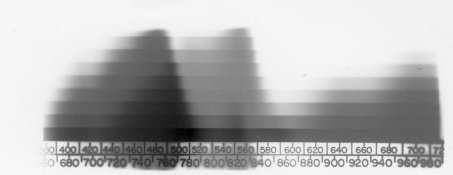
I didn't have any color developer mixed, so here is a B&W sample of Endura exposed in a spectrosensitiometer to give a wedge spectrogram. It was developed in Dektol 1:3. Note the notch at about 600 nm.

PE
 

Attachments

  • endura 0.01 second wedge spectrogram.jpg
    endura 0.01 second wedge spectrogram.jpg
    28.7 KB · Views: 212
A carefully selected LED may find a use as a safelight here.


Steve.

The biggest problem would be finding the perfect led for the purpose. As it can be seen from PE's post and from here (from the horse's mouth, see last page) a LED with peak wavelength at 590nm seems to be ideal.

Finding such a LED is easy, but it will "leak" at neighboring wavelengths. Now try finding a chart that shows the relative output power at other wavelengths. Most of the manufacturers provide only electrical data etc. The aforementioned pdf suggests using a KODAK 13 Safelight Filter (amber). The characteristics of it can be seen at page 16 of this pdf. It seems pretty sharp, doesn't it? LEDs probably aren't that sharp. If that's a problem or not can only be judged by testing.
 
Unfortunately, a 590nm LED is nowhere near that sharp. There is significant output perhaps 40nm or more either side of the centre. This is why a low-pressure sodium lamp would allow more light as I believe they are far more monochromatic than LEDs and naturally emit at exactly the right frequency (it's pure guesswork but I can only assume that is why Kodak put the sensitivity notch at that frequency - it seems an odd coincidence otherwise).
 
That notch is there because it was easy to make the safelight. Materials existed for the safelight. In addition, in the early days, there was a filter dye that could be put in the paper itself to create the notch. I've worked with the filter with shorter red sensitization so as to create an artificial notch. There are all kinds of things that can be done to play with the product. But, the notch stays.

PE
 
An odd coincidence then - a useful one tho.

Wiki says:
... so when the lamp is turned on it emits a dim red/pink light to warm the sodium metal and within a few minutes it turns into the common bright orange as the sodium metal vaporizes. These lamps produce a virtually monochromatic light averaging at a 589.3 nm wavelength (actually two dominant spectral lines very close together at 589.0 and 589.6 nm).
There is a comparison between LED and sodium vapour lamp emissions on this page: http://books.google.co.uk/books?id=...=5#v=onepage&q=sodium lamp bandwidth&f=false with the sodium lamp emission only being 0.6nm wide!
 
Could I tray develop in the dark and walk across the room to light up my LED wristwatch and check the timing, shielding it from the trays?

Or maybe the RH color torch is the better way to go...?
 
Bob, have you tried using a Thomas Duplex safelight with color? If so, which filters did you use and did it work well?
Nope, sorry - I used to have a Duka but the lamp went off before I started doing any colour printing (it was pointless me doing colour without a colour desitometer as I'm somewhat colour-blind so need an absolute measurement of colour to double-check myself!). As mentioned, replacement lamps are very expensive so I never replaced it.

If that graph I found is reasonably accurate tho, I expect you could have it a fair bit brighter than an LED. Hopefully, someone else will have practical experience.
 
Regarding safelights for RA4 work, didn't Jobo produce the Mini/Maxilux? IIRC, they had leds. Any users out there?
 
Regarding safelights for RA4 work, didn't Jobo produce the Mini/Maxilux? IIRC, they had leds. Any users out there?

I have both, used years ago with Kodak EP 2 Ektacolor paper. I moved and have been out of the darkroom for a long time. I am in the process of setting up darkroom again and hope they work with the new color papers.

The Maxi has a rotating filter that also works with B&W.
 
I don't see where anyone mentioned it, but for Type-R (Reversal) and Ciba, no safelight can be used. For Type-C paper, you can use the filter PE mentions, the WR13, and it is actually pretty bright.
 
That is correct Kirk and a good point. Reversal film dyes have no "hole" in them spectrally and therefore the paper for printing them must be full panchromatic. Negative films do not have to be viewed by the human eye and have a hole built in for maskig and therefore the paper can work around that by having a "hole" in the sensitivity. This emphasizes the big difference in dyes for reversal and negative films.

Negative films usually use Status M filters for reading sensitometry while reversal films usually use Status A. These match the dye types. Papers usually use Status D. These are commercial designations of filter sets for color densitometers.

PE
 
Photrio.com contains affiliate links to products. We may receive a commission for purchases made through these links.
To read our full affiliate disclosure statement please click Here.

PHOTRIO PARTNERS EQUALLY FUNDING OUR COMMUNITY:



Ilford ADOX Freestyle Photographic Stearman Press Weldon Color Lab Blue Moon Camera & Machine
Top Bottom