

Dear photographers,
I want to share my experience with the combination Rollei RPX 400 and the developer RPX-D (identical to SPUR PXD). Both, the film and the developer can be bought by Maco. You can find this material in their English pages, but the data sheet is only available in German until now. The recommended times and dilutions are:
ISO Dilution Temperature/°C Time/minutes
.400....1+11.........20............11
.800....1+7...........22...........13
1600....1+5..........24...........14
3200....1+4..........25...........15
Agitation: First 30 seconds permanently, then one sweep every 30 seconds.
Real ASA values are characterized by shadow tones. I did not belief that one can really reach 3200 ASA from a 400 film. From Kodak TMZ I got only 1000 ASA. But if we’d came in the near of 1000 ASA, this could be an interesting combination.
I loaded three cameras with that film and selected a rather contrasty scene. Every film I exposed like 200, 280, 400, 560, 800, 1100 and 1600 ASA. This is a difference of half a stop between each shot. I developed these films with the time, temperature and dilution like 400, 800 and 1600 ASA.
In the lab I selected grade 2 paper and determined at first the minimum time for maximum black. Using this time I made full format prints at 9.5x7 inch paper. I looked at the prints which had decent shadow tones.
I scanned all of these print using identical scanning parameters. The following link gives all images at one view.
Examples - please click
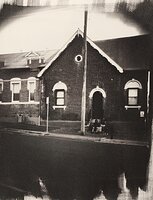
Please look at the shadows at the arches – this shows the following results:
- Developed-as-400 gives 280 ASA. This is quite normal for a “400” film
- Developed-as-800 gives real 800 ASA. It is interesting that that highlight density remains normal. Pushing with other developers leads to burned highlights.
- Developed-as-1600 does not give more shadow density. What not can be seen in the prints: The fog increases obviously.
Besides this I tried make a decent print form a negative exposed like 1100 ASA. Using paper of grade 3.5 this was quite easy. This print is included in the page.
Conclusion: The combination RPX400 – PXD/RPX-D gives real 800-1100 ASA: This is in the range real sensitivity of the high sensitive material like Kodak TMZ. The grain remains low and does not increase with forced development.
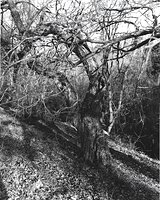
I further experimented with a more difficult scene which is characterized by deep shadows in backlight. The shots need more light, which was clear from the beginning. The prints show well that shadow density cannot be increased using a like-1600 development against a like-800:
More examples - please click
Please compare the Exposed-like-560-prints: Quite similar.
I want to share my experience with the combination Rollei RPX 400 and the developer RPX-D (identical to SPUR PXD). Both, the film and the developer can be bought by Maco. You can find this material in their English pages, but the data sheet is only available in German until now. The recommended times and dilutions are:
ISO Dilution Temperature/°C Time/minutes
.400....1+11.........20............11
.800....1+7...........22...........13
1600....1+5..........24...........14
3200....1+4..........25...........15
Agitation: First 30 seconds permanently, then one sweep every 30 seconds.
Real ASA values are characterized by shadow tones. I did not belief that one can really reach 3200 ASA from a 400 film. From Kodak TMZ I got only 1000 ASA. But if we’d came in the near of 1000 ASA, this could be an interesting combination.
I loaded three cameras with that film and selected a rather contrasty scene. Every film I exposed like 200, 280, 400, 560, 800, 1100 and 1600 ASA. This is a difference of half a stop between each shot. I developed these films with the time, temperature and dilution like 400, 800 and 1600 ASA.
In the lab I selected grade 2 paper and determined at first the minimum time for maximum black. Using this time I made full format prints at 9.5x7 inch paper. I looked at the prints which had decent shadow tones.
I scanned all of these print using identical scanning parameters. The following link gives all images at one view.
Examples - please click
Please look at the shadows at the arches – this shows the following results:
- Developed-as-400 gives 280 ASA. This is quite normal for a “400” film
- Developed-as-800 gives real 800 ASA. It is interesting that that highlight density remains normal. Pushing with other developers leads to burned highlights.
- Developed-as-1600 does not give more shadow density. What not can be seen in the prints: The fog increases obviously.
Besides this I tried make a decent print form a negative exposed like 1100 ASA. Using paper of grade 3.5 this was quite easy. This print is included in the page.
Conclusion: The combination RPX400 – PXD/RPX-D gives real 800-1100 ASA: This is in the range real sensitivity of the high sensitive material like Kodak TMZ. The grain remains low and does not increase with forced development.
I further experimented with a more difficult scene which is characterized by deep shadows in backlight. The shots need more light, which was clear from the beginning. The prints show well that shadow density cannot be increased using a like-1600 development against a like-800:
More examples - please click
Please compare the Exposed-like-560-prints: Quite similar.


