
• Welcome to Photrio!
    Registration is fast and free. Join today to unlock search, see fewer ads, and access all forum features.
    Click here to sign up

Rollei RXA Acid Fixer - Dilutions and Capacities

Recent Classifieds

Forum statistics

Threads
202,920
Messages
2,847,560
Members
101,535
Latest member
photomorg
Recent bookmarks
2

photonaro

Member
Allowing Ads
Joined
Aug 28, 2022
Messages
29
Location
Europe
Format
Multi Format
Hi Everyone!

I'm looking to switch my fixer to the Rollei RXA acid fixer for films and RC papers (I use Rollei RXN for FB) and was wondering about what seems to be conflicting information given by Rollei regarding dilutions and capacity.
Would love to hear your experience!

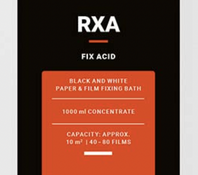
On the front of the 1L bottle and on the Rollei website it says: capacity app. 10m2 (for the concentrate) or 40-80 films.
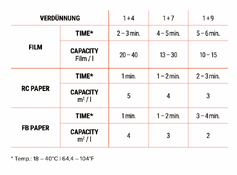
On the back of the bottle and on the date sheet three different dilutions are listed (1+4, 1+7, 1+9) for each - Film, RC & FB papers - along with varying capacities (from 2m2 to 5m2 per diluted liter). I'm attaching the labels.

1. The numbers don't quite add up for me... Let's take film as an example. The front of the bottle says 40-80 films.
However, on the back it says 20-40 films with dilution 1+4, which makes for 100-200 films for the 1L concentrate (5x200ml). A dilution of 1+9 says 10-15 films per diluted liter, which makes for 100-150 films per 1L concentrate (10x100ml). The same goes for paper (calculated capacities for the 1L concentrate according to the back of the bottle should result in 20-32m2). Am I missing something?

2. Is there any recommended dilution for films and for RC paper to your knowledge or from your experience?

Thanks in advance!
 

Attachments

  • Screenshot 2025-12-11 at 23.25.44.png
    Screenshot 2025-12-11 at 23.25.44.png
    170.2 KB · Views: 41
  • Screenshot 2025-12-11 at 23.27.50.png
    Screenshot 2025-12-11 at 23.27.50.png
    295.6 KB · Views: 40
  • Screenshot 2025-12-11 at 23.28.05.png
    Screenshot 2025-12-11 at 23.28.05.png
    90.5 KB · Views: 37
The capacity of fixer is not as clearly determined as the labeling might suggest. Simply put - forget about the numbers. Instead, rely for film on a clearing/clip test and use a fixing time of twice the clearing time. For paper, use a chemical fixer test that stains the paper if any remaining silver is present (sepia toning works nicely for this). There are several chemical formulas/products and workflows for this if you search around a bit.

Dilution is similarly non-determinate. Higher concentration (lower dilution) fixes faster and vice versa. That's the main idea. Capacity of a more dilute working strength fixer will also be lower, but see above. Nobody will come breaking down your door if you fix FB paper with a 1+4 dilution or use 1+10 for film. The latter may be problematic when using tabular grain films (Ilford Delta, Kodak TMAX) esp. if the fixer has been used before. But again, a clip test will show this.
 
Thanks a lot for your answer, koraks.

I'm familiar with the clip test for films, but with the fixer I'd been using previously I used it only to test freshness and not fixing time (it clears after 30 seconds and 1 minute seems to me too short for fixing film).

I know that dilution is variable, sometimes there are certain recommendations (and different opinions.... some say better low dilution and fast fixing for fibre based paper, some say better higher dilution and longer fixing...).

One of the considerations for which brand of fixer to buy is financial, and I was wondering about the discrepancy between the capacities given by Rollei. Hence the fixation (šŸ™ƒ) on numbers...

Would love to hear about other people's experience with this fixer!
 
Hi Everyone!


On the front of the 1L bottle and on the Rollei website it says: capacity app. 10m2 (for the concentrate) or 40-80 films.
On the back of the bottle and on the date sheet three different dilutions are listed (1+4, 1+7, 1+9) for each - Film, RC & FB papers - along with varying capacities (from 2m2 to 5m2 per diluted liter). I'm attaching the labels.

1. The numbers don't quite add up for me... Let's take film as an example. The front of the bottle says 40-80 films.
However, on the back it says 20-40 films with dilution 1+4, which makes for 100-200 films for the 1L concentrate (5x200ml). A dilution of 1+9 says 10-15 films per diluted liter, which makes for 100-150 films per 1L concentrate (10x100ml). The same goes for paper (calculated capacities for the 1L concentrate according to the back of the bottle should result in 20-32m2). Am I missing something?

2. Is there any recommended dilution for films and for RC paper to your knowledge or from your experience?

Thanks in advance!
Yes it does sound confusing but might it be 20-40 films for 1+4 from the whole bottle so in total it will do 20-40 films?

Just a thought

pentaxuser
 
Keep in mind that fixer capacity has more to do with the build-up of fixing by-products in the fixer rather than the amount of fixer concentrate in the solution. Fixer capacity for a 1+4 and a 1+7 dilution will be similar, but the times will be different. The 1+7 dilution will use less fixer concentrate for the same throughput and therefore be a bit more economical. The trade-off is fixing time.

Also, especially with fiber-base papers, the extent of fixation is somewhat variable. Ilford, for example, gives different capacity numbers for "general purpose" and "optimum permanence" degrees of fixation. In other words, if you don't really care if your prints last 100 years or more, you can get away with fixing them to a lesser extent and use your fixer longer.

That can explain a lot of the variance in capacity numbers. I suggest you do a quick search for the Ilford Tech Sheet on Ilford Rapid Fixer and give it a thorough read. The information there applies generally to all similar rapid fixers. Pay attention to the section on optimum permanence if you use fiber-base paper.

Best,

Doremus
 
Yes it does sound confusing but might it be 20-40 films for 1+4 from the whole bottle so in total it will do 20-40 films?

Just a thought

pentaxuser

I wonder... I will do some testing over time and update here when I find out :smile:
 
Keep in mind that fixer capacity has more to do with the build-up of fixing by-products in the fixer rather than the amount of fixer concentrate in the solution. Fixer capacity for a 1+4 and a 1+7 dilution will be similar, but the times will be different. The 1+7 dilution will use less fixer concentrate for the same throughput and therefore be a bit more economical. The trade-off is fixing time.

Also, especially with fiber-base papers, the extent of fixation is somewhat variable. Ilford, for example, gives different capacity numbers for "general purpose" and "optimum permanence" degrees of fixation. In other words, if you don't really care if your prints last 100 years or more, you can get away with fixing them to a lesser extent and use your fixer longer.

That can explain a lot of the variance in capacity numbers. I suggest you do a quick search for the Ilford Tech Sheet on Ilford Rapid Fixer and give it a thorough read. The information there applies generally to all similar rapid fixers. Pay attention to the section on optimum permanence if you use fiber-base paper.

Best,

Doremus

Thanks Doremus, for pointing this out so clearly. I wasn't thinking about capacity relating only to the build-up of by-products and the dilution as relating only to the time. I will do as you say and read through the ilford sheet, that's a good tip, thanks.

For Fibre based paper I prefer to use a neutral fixer (Rollei RXN), but if I used the RXA I suppose I'd rather use the 1+4 for shorter fixing - hence shorter washing - times.
 
Photrio.com contains affiliate links to products. We may receive a commission for purchases made through these links.
To read our full affiliate disclosure statement please click Here.

PHOTRIO PARTNERS EQUALLY FUNDING OUR COMMUNITY:


Ilford ADOX Freestyle Photographic Stearman Press Weldon Color Lab Blue Moon Camera & Machine
Top Bottom