


• Welcome to Photrio!
    Registration is fast and free. Join today to unlock search, see fewer ads, and access all forum features.
    Click here to sign up

Rollei IR 120 weird negatives

Somewhere...

D
Somewhere...

  • 2
  • 1
  • 70
Iriana

H
Iriana

  • 6
  • 1
  • 131

Recent Classifieds

Forum statistics

Threads
202,742
Messages
2,844,963
Members
101,494
Latest member
FlyingDutchman
Recent bookmarks
0

gijsbert

Subscriber
Joined
Jun 17, 2014
Messages
219
Format
Medium Format
Hi,
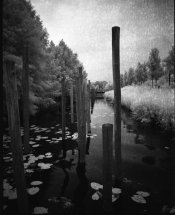
I got weird spots in the dark areas of Rollei IR400 120 developed in DD-X. Is this the infamous mottling caused by backing paper? In the same tank I developed another roll IR400 120 (bought at the same time), same problem. I also had a roll Fuj Acros 120 in the same tank which looks okay, so I'd say that the chemicals and process was okay.

Developed in unicolor film tank on uniroller: presoak 5min, DD-X 1:4 10min (72F I think), ilfostop 30s, 2x ilford fix 3min, 6x water wash 2min each, photoflo 1:100 soak, dried in Prinz dryer.

IR400 was shot in a Plaubel Makina with IR 720 filter, no red window. The backing paper looks okay, some scratches but could easily have happened when I was putting the film on the dev reel. No pattern like on the photo obvious on the paper. It does smell, the ink I suppose, the acros paper seems odourless.

What could cause this? I'm about to develop some Delta 400 rolls so I want to make sure it is not my process before messing up my trip photos.

Thanks!
Gijsbert
 

Attachments
  • 2019-07-19-pm67w-ir004 copy.jpg
    2019-07-19-pm67w-ir004 copy.jpg
    331.7 KB · Views: 308
Last edited:
Did you soak the film first in a water bath to remove the anti-halation layer?
 
Did you soak the film first in a water bath to remove the anti-halation layer?
I did for 5 minutes, probably more, I just let the uniroller roll with water while I prep the chemicals.
 
To me it looks like the classic humid storage induced mottling.
 
when did you buy the IR film? where did you buy it from? did you contact Maco yet?

I had this same issue a few years ago and was hoping that it was a one time issue.
 
Did you soak the film first in a water bath to remove the anti-halation layer?

I never ever heard of presoaking film before I joined Apug.

Nor, does Agfa, who made this film, hint at a presoak.


To my understanding this presoaking is a mere american idea.


This film has its anti-halation layer embedded, it cannot be removed without destroying the film.
 
when did you buy the IR film? where did you buy it from? did you contact Maco yet?

I had this same issue a few years ago and was hoping that it was a one time issue.
Bought in July in Amsterdam, it was just in a silver wrapper no longer in the canister thingy. I was surprised they had it, I thought IR400 was no longer available and was using Retro 400 for IR.
 
I never ever heard of presoaking film before I joined Apug.

Nor, does Agfa, who made this film, hint at a presoak.


To my understanding this presoaking is a mere american idea.


This film has its anti-halation layer embedded, it cannot be removed without destroying the film.
I use pre-soak to avoid bubbles and use standard development times in rotary development.
 
I presoaked Rollei IR 400 120 before I develop in replenished XTOL.
 
I would suspect the film had been frozen and thawed multiple times and what little moisture was present in the wrapper finally had an effect on the emulsion.
 
I would suspect the film had been frozen and thawed multiple times and what little moisture was present in the wrapper finally had an effect on the emulsion.
yeh, that would be a good guess. the fact that it wasnt in a box would be a sign to me of improper storage
 
Looks like backing paper issue.

Well, there are several "backing paper" issues:

-) related to long storage in extreme humid condition
-) related to chemical interaction between backing-paper/printing and the emusion
-) abrasion/stress between paper and emulsion

-
 
I never ever heard of presoaking film before I joined Apug.

Nor, does Agfa, who made this film, hint at a presoak.


To my understanding this presoaking is a mere american idea.


This film has its anti-halation layer embedded, it cannot be removed without destroying the film.
... pre-soaking can be useful if there's a big difference between your usual processing temp and the ambient temp of your darkroom. It ensures that the tank and reel don't change the temp of the incoming solutions. The anti halation layer is a water soluble dye dispersed in the emulsion - and the washes out in the pre soak, coloring it in the process. Not sure this idea can be claimed by the Americans.
 
You are right on brining the reel loaded with film to temperature, but this can be achieved by other means too.
Any presoak will affect the dynamics of the processing.
There is no need to wash-out any dye before starting the processing proper.
 
You are right on brining the reel loaded with film to temperature, but this can be achieved by other means too.
Any presoak will affect the dynamics of the processing.
There is no need to wash-out any dye before starting the processing proper.

There is a use besides temperature tempering, if you are reusing the developer, the developer will not be polluted by the blue or purple dyes.
 
Well, there are several "backing paper" issues:

-) related to long storage in extreme humid condition
-) related to chemical interaction between backing-paper/printing and the emusion
-) abrasion/stress between paper and emulsion

-

Regardless, it all points to the backing paper. Never used to be an issue...or has it?
 
Last edited:
Well, the humidity cause basically applies on all rollfilms. Since ever.

The other causes so far were reported for Kodak, Ilford and Foma.
 
Regardless, it all points to the backing paper. Never used to be an issue...or has it?
Actually it did, but for quite a long period when 120 volumes were very high and photographic product shipping was quite efficient - from the 1970s or maybe a bit earlier - it wasn't often seen.
 
I guess when volumes were high, people never stored film, nor would it sit baking in trucks. They bought it and shot it.... However, I always kept a few rolls in my desk drawer in Japan, which is notorious for hot and humid summers. Never saw backing paper issues.
 
I guess when volumes were high, people never stored film, nor would it sit baking in trucks. They bought it and shot it.... However, I always kept a few rolls in my desk drawer in Japan, which is notorious for hot and humid summers. Never saw backing paper issues.

You likely kept it in its sealing wrapper anyway.
 
Just to point out that I had a very similar problems with a 35mm film that I printed up recently.

I'd have to try and check before mentioning what it was, but another thread talks about it being made by the overuse of wetting agent, at the end of processing...?

Terry S
 
You are right on brining the reel loaded with film to temperature, but this can be achieved by other means too.
Any presoak will affect the dynamics of the processing.
There is no need to wash-out any dye before starting the processing proper.
...what other ways would you suggest of bringing the tank and reel to process temp? Tempering with water would be the most effeicient - especially with 'plastics'. I can believe that the process dynamics will be changed tempering vs non tempering - but it's not important as long as you are consistent. The dye will either wash out into the developer or the tempering wash - it doesn't react with the developer.
 
Photrio.com contains affiliate links to products. We may receive a commission for purchases made through these links.
To read our full affiliate disclosure statement please click Here.

PHOTRIO PARTNERS EQUALLY FUNDING OUR COMMUNITY:


Ilford ADOX Freestyle Photographic Stearman Press Weldon Color Lab Blue Moon Camera & Machine
Top Bottom
