

• Welcome to Photrio!
    Registration is fast and free. Join today to unlock search, see fewer ads, and access all forum features.
    Click here to sign up

Rodinal minimal agitation and stand development

Coburg Street

A
Coburg Street

  • 0
  • 0
  • 12
Jesus

A
Jesus

  • 0
  • 0
  • 20

Recent Classifieds

Forum statistics

Threads
201,729
Messages
2,829,222
Members
100,916
Latest member
mikenickmann99
Recent bookmarks
1

Alan Johnson

Subscriber
Allowing Ads
Joined
Nov 16, 2004
Messages
3,374
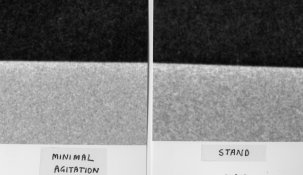
Attachment shows positives from 0.1 in squares of Tri-X negative (photos of a gray card on a black card) developed in Rodinal:
1:100 minimal agitation 27 min 68F agitate every 3 min.
1:200 stand 90 min 68F
The edge effects,visible as a lighter line on the gray side of the gray/black border, are less for minimal agitation but the grain is also smaller and ,of course, the problems with streaks at the ege of the film (can't see that here) are less.
I guess different people with different developers and tanks have different preferences for this.
 

Attachments

  • stand vs minimal agitation copy-1.jpg
    stand vs minimal agitation copy-1.jpg
    207 KB · Views: 784

Nick Kanellos

Subscriber
Allowing Ads
Joined
Feb 14, 2006
Messages
22
Location
Ottawa
Format
4x5 Format
Thanks Allen. Great experiment. Actually, looking at the thumbnails above, instead of the full images, you can really see the edge effects. It almost looks like a white line marking the gray/black divide. Closer inspections of the full images also shows that the black side is blacker closest to the gray/black boundary.
 
OP
OP

Alan Johnson

Subscriber
Allowing Ads
Joined
Nov 16, 2004
Messages
3,374
I have wondered about the existence of a darker line on the dark side of the positive(it's called a fringe effect) ever since I read Dr R Henry's book 'Controls in Black and White Photography' He said '..dozens of plots failed to show any fringe effects' (p214).This is when no pre-exposure is made.Perhaps my black card wasn't all that black.
I'm not sure.
 
Last edited by a moderator:

df cardwell

Member
Allowing Ads
Joined
Jul 16, 2005
Messages
3,358
Location
KY USA
Format
Multi Format
'(Dr. Henry)..dozens of plots failed to show any fringe effects'

Henry's book is very good, but it is flawed.

He used D-76 to test FX, which will fail to produce FX unless diluted beyond its usefulness.
Had he tried Rodinal, or drew upon any of Crawley's work, he would have had different results.

Minimal agitation is very useful for inducing FX.
However, the most valuable outcome is the ability to alter
the relationship of the highlights and the shadows, relative to the midtones.
In effect, you can give N- develop to the highlights while maintaining midtone placement,
shadow placement, local contrast and full ISO speed.

My tests and observation over 40 years suggest
that 10 minutes rest periods is the maximum time to can
consistently process 35mm and expect even density.
For 120, 5 minutes, and for 4x5, it depends on how you process.
5 minute cycles seems to be optimum, balancing FX, tonal control, and safety.
 
Last edited by a moderator:
Photrio.com contains affiliate links to products. We may receive a commission for purchases made through these links.
To read our full affiliate disclosure statement please click Here.

PHOTRIO PARTNERS EQUALLY FUNDING OUR COMMUNITY:


Ilford ADOX Freestyle Photographic Stearman Press Weldon Color Lab Blue Moon Camera & Machine
Top Bottom
