• Welcome to Photrio!
    Registration is fast and free. Join today to unlock search, see fewer ads, and access all forum features.
    Click here to sign up

Reversal Processing of 120 size Rollei Superpan 200 in the Adox Scale Reversal Kit

Ferns

H
Ferns

  • 0
  • 0
  • 11
between takes

H
between takes

  • Tel
  • Mar 21, 2026
  • 2
  • 0
  • 34

Recent Classifieds

Forum statistics

Threads
202,866
Messages
2,846,762
Members
101,577
Latest member
tograp
Recent bookmarks
0
I tried also diluiting the permanganate more but sometimes I got underbleached slides.
It's better to err on safe side: note the underbleach time and add a minute or two the next time around.

Yeah, stable temps help. I do this very simply too - I put all my chems in glass bottles and when reversal time comes, I put them into 25l bucket, fill it to the brim and stabilize temps at 20C. That water provides not only thermal mass, but rinse water at the same temperature too - only the last rinse is then straight tap water for obvious reasons.

//Bathtub reversal : D
 
Last edited:
It's better to err on safe side: note the underbleach time and add a minute or two the next time around.
Didn't try long enought to get there, because I feared that up to a certain point, and past it, the bleach I used did not have sufficient "power" to do its job anymore.
 
What was your dilution?

Take this example of underbleach for example:


Underbleached by underagitation, was using 1/3 dilute. Problem solved either by additional time in bleach or constant agitation.
Another triangle: Concentration / Time / Temperature. Make it a happy square by adding Agitation.
 
Last edited:
That's a pretty cool effect...
 
A year ago I made a post about reversal processing Pan F: https://www.photrio.com/forum/threa...f-plus-in-the-adox-scala-reversal-kit.190152/. (Thank you for all the feedback.)

The results were "OK" but I had quite a few problems, particularly with emulsion softening and marks on the processed film. So recently I tried two rolls of Rollei Superpan 200 in 120 size, exposed at ISO 200, on the advice from someone at Adox (their recommended Scala films are only available in 35mm), and the results are excellent. I followed the Kit instructions almost to the letter, in particular I did not use any fixer, but with a First Development time of 9:00 minutes @ 21degC. (I was aiming for 20degC processing but the room was too hot!). Agitation was 15sec per minute implemented as 12 inversions.

I can highly recommend Superpan 200 with the Adox kit for those who use 120 film. The only "feature" is that not everyone might like the extended red sensitivity of this film (apparently it's aerial film stock).

If anyone has suggestions for other 120 films to use with the Adox Scala Kit, I would be interested to hear of them ... please give a First Development time/temperature and any other hints!

Of course it would be great if someone compiled a list of "good" films and first development times for use with the Adox Scala Kit. My 9mins @ 21deg for Rollei Superpan 200 exposed at ISO 200 is one line of the table.

Chris

I completely solved the emulsion softening problem by hardening it right before bleaching. I treat the film with 0.8 formaldehyde solution (20 ml of 40% formalin to make one litre) for about 5 or 6 minutes. Still much safer than using chromates :smile:
 
Still another very toxic chemical to deal with...
 
What was your dilution?

Take this example of underbleach for example:


Underbleached by underagitation, was using 1/3 dilute. Problem solved either by additional time in bleach or constant agitation.
Another triangle: Concentration / Time / Temperature. Make it a happy square by adding Agitation.


I was using half amount of permanganate, so I had 1g per 500ml bleach bath A and 55g bisulfate in 500ml bleach part B.
 
So much less toxic than dichromate

To me it's the about the same and its use is not wortwhile imho, I mean I wanna live longer instead of having some perfect slides...
To put in perspective.
 
I was using half amount of permanganate, so I had 1g per 500ml bleach bath A and 55g bisulfate in 500ml bleach part B.
Cutting it in half could indeed be insufficient, but 1/3 does magic - saves chems, saves emulsion, gives neat slides with the same bleach time/workflow.

I have dichromate on hand and soviet gas masks, but avoid touching it regardless - why should I increase my exposure to harmful chems when permanganate bleach does the job? If I had some sort of a fume hood and properly ventilated bathroom... maybe then. For a comparative test : )
 
Cutting it in half could indeed be insufficient, but 1/3 does magic - saves chems, saves emulsion, gives neat slides with the same bleach time/workflow.
I'm trying to find the sweetspot of the permanganate solution concentration.
Since the pourpose of the bleach is to remove the already exposed silver halides I thought that if I take some film, expose it to light and then process normally as a reversal I should obtain a perfectly clear strip. Let's say I take half of a 36exp roll, that is about 0,7mt of film. It should be sufficient relating to the bleachable area and the bleach exhaustion respect to the real world use.
Then I take another piece of the same film and put it straight into the fixer and again I should obtain some perfectly crystal clear strip.
From there I should be able to see the base+eventual fog of the unbleached end and I should be able to compare it to the bleached one and eventually it would tell me if the bleach worked to completion or not or pinpoint some errors along the way.
 
Last edited:
Hmm, seems like a good test at first glance and it would be film stock dependent. What about bleach staining?
 
Hmm, seems like a good test at first glance and it would be film stock dependent. What about bleach staining?

The MnO2 stains should be removed by the subsequent clearing bath and should be minimized by adding hexametaphosphate in the bleach 20gr/lt...
 
Last edited:
A year ago I made a post about reversal processing Pan F: https://www.photrio.com/forum/threa...f-plus-in-the-adox-scala-reversal-kit.190152/. (Thank you for all the feedback.)

The results were "OK" but I had quite a few problems, particularly with emulsion softening and marks on the processed film. So recently I tried two rolls of Rollei Superpan 200 in 120 size, exposed at ISO 200, on the advice from someone at Adox (their recommended Scala films are only available in 35mm), and the results are excellent. I followed the Kit instructions almost to the letter, in particular I did not use any fixer, but with a First Development time of 9:00 minutes @ 21degC. (I was aiming for 20degC processing but the room was too hot!). Agitation was 15sec per minute implemented as 12 inversions.

I can highly recommend Superpan 200 with the Adox kit for those who use 120 film. The only "feature" is that not everyone might like the extended red sensitivity of this film (apparently it's aerial film stock).

If anyone has suggestions for other 120 films to use with the Adox Scala Kit, I would be interested to hear of them ... please give a First Development time/temperature and any other hints!

Of course it would be great if someone compiled a list of "good" films and first development times for use with the Adox Scala Kit. My 9mins @ 21deg for Rollei Superpan 200 exposed at ISO 200 is one line of the table.

Chris

Just an update, I used an IR cut off filter to convert the Rollei Superpan 200 to normal panchromatic sensitivity (I prefer that) and it worked great, I've just processed a film exposed at ISO200 at the same 9mins @ 21deg First Dev time. Beautiful results!
 
Just an update, I used an IR cut off filter to convert the Rollei Superpan 200 to normal panchromatic sensitivity (I prefer that) and it worked great, I've just processed a film exposed at ISO200 at the same 9mins @ 21deg First Dev time. Beautiful results!
Did you find you need to cut off the NIR, was it in the way?
I'm asking out of curiosity and because of the energy certain wavelengths of light carries. NIR has less energy than UV, thus everything before NIR has a good chance to owerpower it, therefore visual light cutoff filter is needed to expose film only to NIR...
 
Using Rollei Superpan 200, I found that green leaves (for example) came out too light for my liking. I find the results with a filter that cuts out the NIR preferable ... but of course this is personal preference. By the way, exposing with the cut-off filter at ISO200 and processing as I describe gave beautiful B&W transparencies (actually mine are MF stereo photos) with excellent dark black and good highlights.
 
Can you upload your result?

Because density is just density and I'm interested to have a taste of its latitude when filtered such way.
 
Can you upload your result?

Because density is just density and I'm interested to have a taste of its latitude when filtered such way.

Will do, please give me a day or two as I do not normally scan (these are stereo pairs meant for optical viewing, nothing digital anywhere!).
 
Can you upload your result?

Because density is just density and I'm interested to have a taste of its latitude when filtered such way.

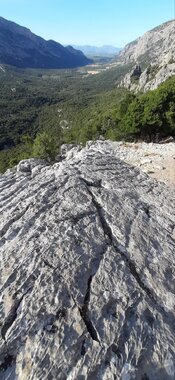
Here is a scan, not at full resolution because of 2MBy limit on file size. Perfection 3200 using VueScan 9. The original looks a more contrasty, has more "zip". As I explained, I do MF stereo, where the results are two images mounted in a frame and viewed using a decent quality optical viewer. Digital displays don't begin to match this quality, and so if you scan and look at the digital image you lose a lot.

Superpan200-Sample-1.jpeg
 
Thanks!

Looks quite good indeed - maybe a little too hot on the highlights.
 
Thanks!

Looks quite good indeed - maybe a little too hot on the highlights.

Agreed. I shot the whole roll at 1/125 @ f/16 (I need f/16 or f/22 for depth of field ... with stereo everything should be in focus) so some frames were a bit underexposed and others a bit over-exposed.
 
What was your dilution?

Take this example of underbleach for example:


Underbleached by underagitation, was using 1/3 dilute. Problem solved either by additional time in bleach or constant agitation.
Another triangle: Concentration / Time / Temperature. Make it a happy square by adding Agitation.


This is ABSOLUTELY STUNNING!!
Sorry to repeat myself but that's my reaction when I look at that pic!
 
Just another update of reversal processing of Rollei Superpan 200 in the Adox Scala kit. I just processed another film today, first developer time of 9mins @21deg, film exposed at ISO 200 and I used an IR cut film to make the film panchromatic rather than super-panchromatic. Really pleased with the results. I suppose I should try some other films (120 size) but "if it ain't broke, don't fix it" ...
 
Photrio.com contains affiliate links to products. We may receive a commission for purchases made through these links.
To read our full affiliate disclosure statement please click Here.

PHOTRIO PARTNERS EQUALLY FUNDING OUR COMMUNITY:


Ilford ADOX Freestyle Photographic Stearman Press Weldon Color Lab Blue Moon Camera & Machine
Top Bottom