




Andreas Thaler
Subscriber
This report covers the first project using the brand new Reveni Labs Autocollimator, which arrived at my home in Vienna in early 2026.
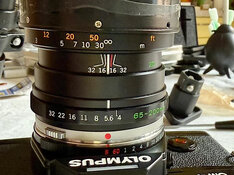
Originally, I wanted to set up a Minolta wide-angle lens for the premiere. However, I then decided on the Olympus OM Zuiko 65-200/4 auto zoom, as I am familiar with the procedure for adjusting it to infinity.
I had already worked on this lens about two years ago. One of the rear lenses had become cloudy, which I was able to fix by cleaning it. While exploring the lens, I had misaligned the infinity setting.
See

 www.photrio.com
Now, I wanted to fix that
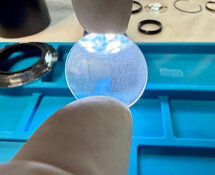
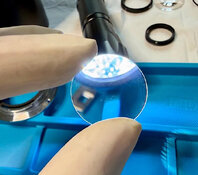
But first, I had to clean the lens again
Apparently, vapors in the tube cause clouding from time to time, so I need to take a closer look at that later.
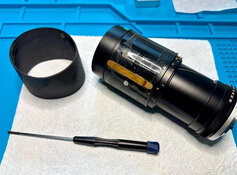
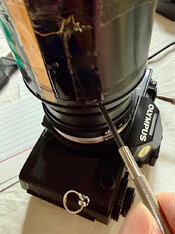
Removing and dismantling the rear lens unit is easy. I was able to remove the cloudiness with lens cleaning fluid.
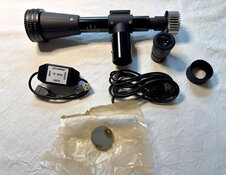
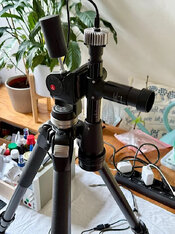
The Reveni Labs autocollimator
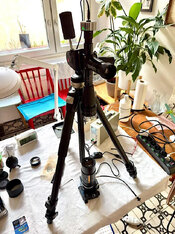
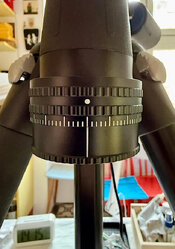
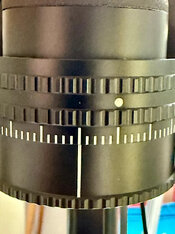
is well-made and quick to set up thanks to the clear user manual. A sturdy tripod is recommended for operation.
See
Reveni Labs Autocollimator user manual
Before using it for the first time, the eyepiece must be adjusted to your own visual acuity.
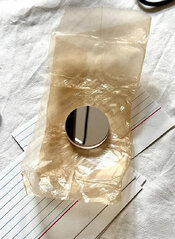
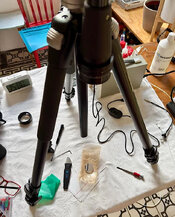
To do this, it is adjusted using the precision mirror supplied and then fixed in place with an adjusting screw. The process is described in the user manual and only needs to be done once. The autocollimator is then ready for use. The adjustment can be checked at any time later using the mirror.
Adjusting a lens to infinity
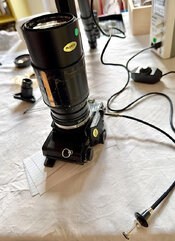
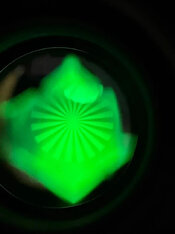
The SLR with the lens attached must be placed under the autocollimator so that the target appears as bright and centered as possible in the autocollimator's eyepiece. A small bag filled with rice would be ideal for this purpose.
The brightness of the target can be continuously adjusted using the supplied LED dimmer. A USB port serves as the power source.
Film or mirror?
As an alternative to a test film, infinity adjustment can also be performed using the supplied mirror, which is attached to the film plane. The target then appears brighter and sharper. However, film provides the actual conditions, as this is where the lens projects the image. But that’s open to debate; the film isn’t flat due to warping and that can vary from film to film.
After reevaluating the situation, I have concluded that measuring against the mirror is the standard method, since the mirror always lies flat against the film plane, unlike the film itself.
I will therefore continue working on this zoom lens and also measure the shorter focal length end using the mirror.
Spot on
I was able to set my Olympus zoom at f/200 mm precisely to infinity.
A subsequent test focusing on a tower building on the horizon showed that the infinity setting is now spot on.
This assumes that the SLR's rangefinder is properly calibrated. We'll look at this topic later.
Conclusion
The Reveni Labs autocollimator is impressive in every respect. It is solid, well-made, easy to use, and a pleasure to handle. It comes ready to use with an USB connection cable and expands the possibilities of your DIY workshop.
I am completely satisfied and can recommend the autocollimator without reservation.
This review reflects my personal opinion and is independent of the manufacturer.
+++
 A word of caution
Please keep in mind that you’ll be using highly flammable solvents for service work, and their fumes are harmful to your health. Soldering also produces fumes that should not be inhaled. Dangerous high voltages can be present when handling electronics, especially in conjunction with electronic flash units and mains. Therefore, familiarize yourself with the safety regulations beforehand and ensure your safety. Depending on the activity, protective gear may be advisable.
All information provided without guarantee and use at your own risk.
Acknowledgments
Without the work of Master Larry Lyells, in particular, we wouldn’t have the detailed technical information we need today for service/repair of SLRs.
The SPT Journal and The Camera Craftsman, which he helped shape significantly as an author, and which contain all the necessary information and instructions are available for a fee through Learn Camera Repair.
We owe our access to them to Eugene Pate, the founder of Learn Camera Repair.
Originally, I wanted to set up a Minolta wide-angle lens for the premiere. However, I then decided on the Olympus OM Zuiko 65-200/4 auto zoom, as I am familiar with the procedure for adjusting it to infinity.
I had already worked on this lens about two years ago. One of the rear lenses had become cloudy, which I was able to fix by cleaning it. While exploring the lens, I had misaligned the infinity setting.
See
Olympus Zuiko 65-200/4 Auto-Zoom: Strong lens clouding removed, infinity adjustment
For years I lived under the belief that nothing and no one could help my Zuiko Zoom. One of the rear lenses was so cloudy that only a milky disc could be seen in the LED light. It couldn't be used for photographic tasks. Why did I believe that? Because an Olympus expert told me so. And of...
www.photrio.com
Now, I wanted to fix that
But first, I had to clean the lens again
Apparently, vapors in the tube cause clouding from time to time, so I need to take a closer look at that later.
Removing and dismantling the rear lens unit is easy. I was able to remove the cloudiness with lens cleaning fluid.
The Reveni Labs autocollimator
is well-made and quick to set up thanks to the clear user manual. A sturdy tripod is recommended for operation.
See
Reveni Labs Autocollimator user manual
Before using it for the first time, the eyepiece must be adjusted to your own visual acuity.
To do this, it is adjusted using the precision mirror supplied and then fixed in place with an adjusting screw. The process is described in the user manual and only needs to be done once. The autocollimator is then ready for use. The adjustment can be checked at any time later using the mirror.
Adjusting a lens to infinity
- To check a lens for its infinity setting, it is placed on an SLR, the largest aperture is selected, and it is focused to infinity. This requires that the flange focal distance on the SLR body is correct.
- The shutter is opened and fixed in this position (position B with a cable release or T on Nikon F cameras). A test film is inserted into the camera.
- The lens of the autocollimator projects a luminous target into the camera lens, which appears to be infinitely far away for the camera.
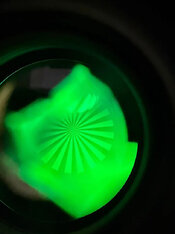
- Through the eyepiece of the autocollimator, you then can observe whether the target is sharply focused on the film plane.
- If this is not the case, the lens on the camera is adjusted until the target appears sharp in the eyepiece of the autocollimator. Depending on the lens, the infinity stop is readjusted and then fixed.
- I limit myself to adjusting the zoom lens to its longest focal length (f/200 mm) and do not check the infinity setting for the shortest focal length (f/65 mm) to keep things clear.
- But note: When calibrating a zoom lens, you should measure both the longest and shortest focal lengths to obtain a valid result. If there are any discrepancies, they may be due to the zoom mechanism or the flange focal distance of the SLR.
The SLR with the lens attached must be placed under the autocollimator so that the target appears as bright and centered as possible in the autocollimator's eyepiece. A small bag filled with rice would be ideal for this purpose.
The brightness of the target can be continuously adjusted using the supplied LED dimmer. A USB port serves as the power source.
Film or mirror?
As an alternative to a test film, infinity adjustment can also be performed using the supplied mirror, which is attached to the film plane. The target then appears brighter and sharper. However, film provides the actual conditions, as this is where the lens projects the image. But that’s open to debate; the film isn’t flat due to warping and that can vary from film to film.
After reevaluating the situation, I have concluded that measuring against the mirror is the standard method, since the mirror always lies flat against the film plane, unlike the film itself.
I will therefore continue working on this zoom lens and also measure the shorter focal length end using the mirror.
Spot on
I was able to set my Olympus zoom at f/200 mm precisely to infinity.
A subsequent test focusing on a tower building on the horizon showed that the infinity setting is now spot on.
This assumes that the SLR's rangefinder is properly calibrated. We'll look at this topic later.
Conclusion
The Reveni Labs autocollimator is impressive in every respect. It is solid, well-made, easy to use, and a pleasure to handle. It comes ready to use with an USB connection cable and expands the possibilities of your DIY workshop.
I am completely satisfied and can recommend the autocollimator without reservation.
This review reflects my personal opinion and is independent of the manufacturer.
+++
A word of cautionPlease keep in mind that you’ll be using highly flammable solvents for service work, and their fumes are harmful to your health. Soldering also produces fumes that should not be inhaled. Dangerous high voltages can be present when handling electronics, especially in conjunction with electronic flash units and mains. Therefore, familiarize yourself with the safety regulations beforehand and ensure your safety. Depending on the activity, protective gear may be advisable.
All information provided without guarantee and use at your own risk.
Acknowledgments
Without the work of Master Larry Lyells, in particular, we wouldn’t have the detailed technical information we need today for service/repair of SLRs.
The SPT Journal and The Camera Craftsman, which he helped shape significantly as an author, and which contain all the necessary information and instructions are available for a fee through Learn Camera Repair.
We owe our access to them to Eugene Pate, the founder of Learn Camera Repair.
Last edited:


