
• Welcome to Photrio!
    Registration is fast and free. Join today to unlock search, see fewer ads, and access all forum features.
    Click here to sign up

Results from LED Enlarger light Source

Recent Classifieds

Forum statistics

Threads
203,287
Messages
2,852,411
Members
101,766
Latest member
Onetrick
Recent bookmarks
0

Steve Smith

Member
Allowing Ads
Joined
May 3, 2006
Messages
9,110
Location
Ryde, Isle o
Format
Medium Format
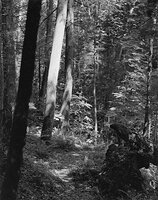
Further to my posts on getting a large format enlarger and converting it to use an LED light source, here are some scans of some actual prints produced!

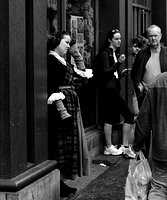
The first is one which I'm optimistically calling 'normal' contrast uses both the blue and green LEDs on together. It does appear normal to me:

LED-normal.jpg


The next print I made was with just the blue LEDs. As can be seen, the contrast is higher:

LED-high.jpg


And with only the green LEDs being used, contrast is lower:

LED-low.jpg


The negative is 5" x 4" and is one of four I took on the first trip out with my home made camera a few years ago (yes, I only owned two film holders at the time!). It is not particularly exciting but is adequate to test the enlarger out. Prints are 10" x 8" on Ilford MG IV.


Steve.
 
Last edited by a moderator:
Whow nice!

And with less powerfull leds placed in a kind of matrix you should fine-tune the contrast?
 
I can fine tune the contrast using varying ratios of blue to green on time. I have plans to make a rotary 'contrast' control which is green only at the anti-clockwise end and blue only at the clockwise end, crossing over with 50-50 in the middle using pulse width modulation.

It could be done just as easily with separate exposures for each colour though.

I think I am getting about grade 1 with the green LEDs and no higher than 3.5 with the blue. Whilst it would be nice to have a grade 0 to grade 5 range, having it limited a bit may make me think a bit more about getting the contrast right in the negative!

There is a bit more information on my previous thread here: (there was a url link here which no longer exists)


Steve.
 
Arduino controller for control?

Steve;

Really interesting thoughts! Thank you.

For a timer/contrast controller, the little Arduino boards may be good for it. Program in "C"; can take a potentiometer as input (or switches, or...) and IIRC the newer boards can directly control a couple of leds using PWM outputs, just what you need for controlling the amount of light output.

Whatever - you are doing really neat work. I have 2 older Omega condenser enlargers, and you have me thinking... (b600 and b66xl)

JohnS,
Ottawa.
 
For a timer/contrast controller, the little Arduino boards may be good for it. Program in "C"; can take a potentiometer as input (or switches, or...) and IIRC the newer boards can directly control a couple of leds using PWM outputs, just what you need for controlling the amount of light output.

I will build the controller myself then I can have exactly what I want. Plus I don't like spending money on things I can build!!!

Since you had red LEDs in there originally, you may want to replace some with LEDs that extend higher in the blue wavelength to gain more contrast. If they are violet or near UV it may give more of a grade 5. Just a guess. More of a yellow green may also produce lower contrast.

Whilst that is a good plan, I like the idea of having it limited to around 1 to 3.5 as I will then think a bit more about getting the negative right.

The reds are wired in so I can have a safe setting for checking that the easel hasn't moved and for positioning dodge and burn masks before exposing, etc.


Steve.
 
Fascinating and inspiring! Thank you Steve for posting this series of articles and sharing your findings. The preliminary(?) results looks very encouraging.

A few questions poped into my mind so, I'm just going to blurt them out...
What are you using for a diffuser?

What is the distance, roughly from the LEDs to the negative? and where is the diffuser relative to the negative?

In your previous post, you showed a photo of the LED array...is that an off the shelf item?
any idea what the specs are for the individual LEDs?


Thanks again!
 
The LED PCB came from an LED stage light like this: http://www.matrixproductions.com.au/images/gallery/Equipment/LED_Par_64.jpg

Being sold here: http://www.ledssuperbright.com/par-64-led-black-dj-light-rgb-p-205

I do some live sound engineering for a local sound company and repaired a couple of their lights and got to keep a PCB from one of them.

I have no idea what the specifications are. They are probably the cheapest and brightest the light manufacturer could get.

The LEDs are about 5" above the negative. There is a diffuser layer near the LEDs and one just above the negative. The one above the negative is part of the original light system which used a water filled diffuser (I couldn't believe it either!). I cut out most of it leaving just the base which is a semi-translucent/milky plastic. The diffuser just below the LEDs is a few sheets of velvet textured polyester (Autotex V207) which we use at work for printing control panel/membrane switch graphics onto.

The diffusion seems to work well as the prints appear to be evenly exposed all over. A quick, un-scientific check with a light meter showed this to be the case too.


Steve.
 
Steve:

If you are looking for ideas ....

For those who are into split grade printing, it would be very useful to have an "either/or" control. By that I mean a control that either uses the rotary control, or uses a switch that goes from full green to full blue, and gives repeatable results each time.
 
For those who are into split grade printing, it would be very useful to have an "either/or" control.

That's probably what I will do. At the moment I just have a rotary switch with four positions: Red, green, blue and all three. I will arrange it so it works through this permanently at 100% or via the variable controller. It will need a permanently on position anyway for focusing.


Steve.
 
Well I think a controller like the arduino should be great for a full auto exposure monster... Something with a cds cell embeded to use instead the test strips...
A higher wavelenght Uv source should be interesting for alt processes (but will ned a UV friendly coating on the lenses ) that's just thoughts.

The idea is great! I will try to keep following this thread...
 
At the moment I just have a rotary switch with four positions: Red, green, blue and all three. I will arrange it so it works through this permanently at 100% or via the variable controller. It will need a permanently on position anyway for focusing.

Consider focusing with green light only. That's where the human eye is most sensitive, and Patrick Gainer did some tests (published in Photo Techniques a while back) in which he found that focus via a grain focuser was best when using either green or white light. Since your "white" light is a combination of separate red, green, and blue wavelengths, it's not clear that it would be the same as "white" light from a typical enlarger bulb. FWIW, I'm in much the same situation via different technology, since I've got a Philips PCS130/PCS150, which uses a color head with red, green, and blue light produced via halogen bulbs with filters. I use green light for focusing.
 
If the color balance is close enough for the eye to percieve the light as "white" from the red, green, and blue LEDs, it will be good enough. Certainly better than using red alone.
 
If the color balance is close enough for the eye to percieve the light as "white" from the red, green, and blue LEDs, it will be good enough. Certainly better than using red alone.

I have been using blue and green together as they are the colours the paper is sensitive too. It's bright enough without the red.


Steve.
 
How possible would it be to construct a colour LED enlarger head?

In theory, the head under discussion in this thread would work for this, depending on the exact frequencies of the red, green, and blue LEDs vs. the sensitivity of the red-, green-, and blue-sensitive layers in color paper. You could then vary the brightness of the red, green, and blue LEDs instead of adding cyan, magenta, and yellow filtration. This would work just like a Philips Tri-One (PCS130/PCS150 or PCS2000) enlarger.

steve smith said:
I have been using blue and green together as they are the colours the paper is sensitive too. It's bright enough without the red.

The sensitivity of the paper isn't really important, unless your lens suffers from pretty bad chromatic aberration. (Some do, but good enlarging lenses minimize these effects.) What's important is the sensitivity and focus characteristics of the human eye. Patrick Gainer's article in the January/February 1997 issue of Photo Techniques magazine tells the story in detail, but the summary is that he got best results using either green alone or white light. I don't believe he tested the blue/green combination, but blue alone was slightly worse than green alone or white, and red alone was abysmal compared to green or white.
 
but the summary is that he got best results using either green alone or white light. I don't believe he tested the blue/green combination, but blue alone was slightly worse than green alone or white, and red alone was abysmal compared to green or white.

The fact that blue was worse than green is interesting in view of the fact that some of the grain focusing devices come with a blue filter. Perhaps a green filter would be better.


Steve.
 
How possible would it be to construct a colour LED enlarger head?

Tom

I'll let you know in a month when I complete my 'proof-of-concept' version. Fifty RGB Endor Stars, with each color on a separate PWM circuit.

justus
 
These things have their own micro-controller and are meant to be controlled by computer. Some control is available from the switches on the back.

The DMX protocol is available on the web http://en.wikipedia.org/wiki/DMX512

DMX is designed to be used by dummies (volunteers at the community theater and that sort of thing) and will generally make sense out of anything that 'looks about right'. Some of these lights will work connected to an RS232 port - just because that's often what happens to them - along with the RS485 signaling specified.

You can send the light a simple command to set the intensity of the three color channels as a level between 0 and 255. The lamp's micro-controller does 3 channels of PWM to control the intensity. 255 grades of paper should make most anyone happy.

You could make rather a nice VC head/f-stop timer connecting one of these to a lap-top and doing a bit of programming. Oh, dear, cat's out of the bag...

Google for more.
 
Last edited by a moderator:
Steve,

Thanks for all of this - I had been thinking about this for some time and feel very inspired to draught up my own designs. Very innovative work and I look forward to going through your articles more thoroughly right after I make this post. Startiinnnng.....NOW!
 
What's the possibility of a design that the average person with good technical and building skills can take and actually make an LED head for an enlarger right in their own shop? Has the home application to a variable contrast head come along far enough to make one that works well?
 
It's all fairly simple stuff which you can make as complicated as you like. You can have a micro-controller sorting out your blue/green ratios via PWM drivers if you want or you can just have some switches. I prefer the simple approach and the most complicated thing I will do is build the single control variable contrast PWM controller. But it will be with discrete components rather than a micro-controller.

The PCB from the stage light which I used is easy to get out, has an illuminated diameter of about 5" and can be used as is in an enlarger. Ignore the DMX controller and the PCB just has four connections: red, green and blue. just add a power supply and it is ready to go.


Steve.
 
How possible would it be to construct a colour LED enlarger head?

I'll let you know in a month when I complete my 'proof-of-concept' version. Fifty RGB Endor Stars, with each color on a separate PWM circuit.

A month has passed. Do you have anything to show us?!!!


Steve.
 
Photrio.com contains affiliate links to products. We may receive a commission for purchases made through these links.
To read our full affiliate disclosure statement please click Here.

PHOTRIO PARTNERS EQUALLY FUNDING OUR COMMUNITY:


Ilford ADOX Freestyle Photographic Stearman Press Weldon Color Lab Blue Moon Camera & Machine
Top Bottom
