
Hello,
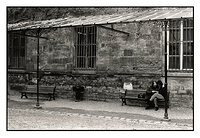
The attached picture is one of my first 4x5" shots, made about two years ago. At that time, being new to large format, I was so concerned with getting the technical matters right that I didn't notice that sun ray falling on my wife's nose.
Burning it in during printing doesn't work. The nose gets gray instead of white, but still with no detail. Besides, it must be done so heavily that there's no way to hide it. Even with a #00 filter it still shows.
That's why I gave up and forgot about it.
I recently rediscovered this negative and thought I'd give it a second chance.
I can think of only one thing that could rescue it, and I'm determined to try despite the risk of damaging it for good. After all, it's unusable as it is, so it can't get worse than that. I'm thinking about a reducer.
As far as I know, there are two kinds of negative reducers: ones that affect all areas to the same degree, and others that affect highlights more than shadows - I believe these are called proportional reducers. I'm thinking of using a proportional reducer. This should in theory reduce the density of the nose without affecting the rest of the image too much.
First, do you think it will work? Is it possible to reduce the nose to normal density without reducing the shadows to an unprintable level?
Second, could you recommend me a formula for a reducer that would be appropriate in this case?
Thank you.
The attached picture is one of my first 4x5" shots, made about two years ago. At that time, being new to large format, I was so concerned with getting the technical matters right that I didn't notice that sun ray falling on my wife's nose.
Burning it in during printing doesn't work. The nose gets gray instead of white, but still with no detail. Besides, it must be done so heavily that there's no way to hide it. Even with a #00 filter it still shows.
That's why I gave up and forgot about it.
I recently rediscovered this negative and thought I'd give it a second chance.
I can think of only one thing that could rescue it, and I'm determined to try despite the risk of damaging it for good. After all, it's unusable as it is, so it can't get worse than that. I'm thinking about a reducer.
As far as I know, there are two kinds of negative reducers: ones that affect all areas to the same degree, and others that affect highlights more than shadows - I believe these are called proportional reducers. I'm thinking of using a proportional reducer. This should in theory reduce the density of the nose without affecting the rest of the image too much.
First, do you think it will work? Is it possible to reduce the nose to normal density without reducing the shadows to an unprintable level?
Second, could you recommend me a formula for a reducer that would be appropriate in this case?
Thank you.