


• Welcome to Photrio!
    Registration is fast and free. Join today to unlock search, see fewer ads, and access all forum features.
    Click here to sign up

Recommend developer for grain enhancement

Somewhere...

D
Somewhere...

  • 2
  • 1
  • 70
Iriana

H
Iriana

  • 6
  • 1
  • 131

Recent Classifieds

Forum statistics

Threads
202,744
Messages
2,844,969
Members
101,494
Latest member
FlyingDutchman
Recent bookmarks
0

Steve@f8

Member
Allowing Ads
Joined
May 5, 2017
Messages
342
Location
UK
Format
35mm
Hi guys,
Unlike some here, possibly, I quite like B&W grain so I’m looking for recommendations for choice of developer, dilution and agitation to bring out the grain. My go-to film is HP5+.
A Google search suggested Rodinal at 1:25 plus agitation to enhance the grain, but the next google hit came up with contradictory recommendations to use 1:100, as the lengthy development makes the silver grains swell and increase in size.

Any recommendations please?
 
I don't know Steve and sympathise with your dilemma but I look forward to the day when we might on Photrio at least be able to agree a list of pointers as to how to achieve an ascending scale of grain I'd have thought that Rodinal at 1+25 for HP5+ in 135 format was a very good start at least

Ideally what you need is a poster A who have used both Rodinal at 1+25 and can say that they also used developer X and it was even grainier, Then poster B who has used developer X but found that developer Y was even better You might start to be able to rank developers, dilutions, agitations etc into some kind of a ranked order :smile:

pentaxuser
 
jnantz will probably recommend Dektol :D
 
+1 on the Rodinal suggestion. I've used it since 1971. Keep in mind that the grain will have a very high acutance.
 
Last edited:
You cannot increase gain, grain size is baked in, you want a developer that is low on silver solvent resulting in high acutance or edge sharpness. As noted Dektol, Rodinal, you also think about Acufine, or dilute a standard developer like D76 or Mic-X to 1:3.
 
The grain in the negative is not the grain in the positive. The grain in the positive is a map of the spaces between the grains of the negative. To make these spaces conspicuous start with a non-solvent developer to produce a dense negative (few spaces) and then make big enlargements on to high contrast photographic paper. Lots of grain.
 
As Michael said, Rodinal and Ilfosol will do it, but at least in Rodinal, HP5+ is not very well seen... I have not tried it in Ilfosol. Possibly Ilfosol at 800-1600.
 
Hi guys,
Unlike some here, possibly, I quite like B&W grain so I’m looking for recommendations for choice of developer, dilution and agitation to bring out the grain. My go-to film is HP5+.
A Google search suggested Rodinal at 1:25 plus agitation to enhance the grain, but the next google hit came up with contradictory recommendations to use 1:100, as the lengthy development makes the silver grains swell and increase in size.

Any recommendations please?
Are you going to make darkroom prints? If you are going to scan you can add grain with software.
 
An example of medium format, very little cropping. Bergger Pancro 400, Rodinal 1+50. Printed hard.
Jet in Sky MDR_PDR.jpeg
 
Hi guys,
Unlike some here, possibly, I quite like B&W grain so I’m looking for recommendations for choice of developer, dilution and agitation to bring out the grain. My go-to film is HP5+.
A Google search suggested Rodinal at 1:25 plus agitation to enhance the grain, but the next google hit came up with contradictory recommendations to use 1:100, as the lengthy development makes the silver grains swell and increase in size.

Any recommendations please?

If a grainy and lower fidelity look is the goal, you might also consider shooting with a 35mm half frame camera. That, and HP5+ pushed a bit with Rodinal should get you heaps of sharp noticeable grain and contrast once you enlarge for screens or printing.
 
Hi guys,
Unlike some here, possibly, I quite like B&W grain so I’m looking for recommendations for choice of developer, dilution and agitation to bring out the grain. My go-to film is HP5+.

Beutler's developer. I ran a series of tests with FP4 and HP5 in D23, Pyrocat, and Beutler's and the Beutler's formula won, hands down. With FP4 it is incredibly sharp with almost no apparent grain at 16" (from 120 rolls). With HP5, it gives a gorgeous grayscale with very sharp, well defined grain. I would choose it over anything, even Rodinal.
 
If you're willing to switch film, Foma Retropan is very grainy.

In general. though, increasing the activity of the developer and decreasing solvency will increase grain. So, dilute a developer and add some sodium carbonate or tsp or sodium hydroxide. Increasing agitation more frequently brings fresh developer into the areas of the film that are more actively developing (and thereby exhausting the "local" developer), so that should increase grain, also. But a lack of agitation, with an increase in alkalinity, should increase grain and also allow more tonality.

Or you could always try to force reticulation, if that would suit your needs.
 
Overexposure, longer and more frequently agitated in Rodinal.

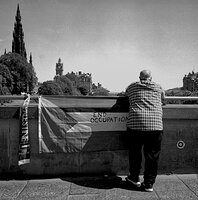
A crop from one of my prints with that recipe:

http://kuvau.tuu.fi/accidentals/

But the horror is at printing. I've got so dense negatives that at our camera club darkroom I cannot see the photo on white easel (quite bright safelights there too). Other workshop members shake their heads of confusion when I expose the papers..

Complete print here:

 
Overexpose and overprocess. Rodinal at 1+25 or so does a good job, though you can use ID-11/D-76 etc too. Print on a hard grade of paper and grain comes up strongly. All the stuff about agitation is more to do with affecting the effective rate of development than anything to do with actual sharpness. It is not a difficult technique to try, but you will want a fairly powerful lamp in the enlarger/ a scanner with good Dmax.
 
jnantz will probably recommend Dektol :D
contrast yes, grain no ..
steve@f8. I wouldn't do stand development at 1:100. that can be a recipe for problems
good luck with your adventure, you're going to get a lot of varied recommendations..
my recommendation is shoot a small format and enlarge ..
have fun!
John
 
Last edited:
Thank you all for your replies which I’m now assimilating.
A couple of points about my situation:
I’m resuming film development after a massive gap from my teenager days, so I thought I’d ask before buying the necessary equipment and chemicals. I’m restricted to film processing since there’s no opportunity for a darkroom (space and keeping the wife happy!), hence scanning only.
I’m not restricted to HP5 and happy to try different films as mentioned above. Camera wise, apart from a number of film cameras, SLRs and a RF, I have a rather a nice Pen F and I’ve made a note to use it more.
 
Remember that a developer like Rodinal is not intrinsically grainy; it's just honest; it has no solvent action and makes for sharp edged grain that appears more conspicuous to the eye. Choice of film and printing technique are just as important. I can't speak to scanning as I'm 100% analogue. You have some fun ahead of you.
I tried Foma 400 and Retro 320; they have grain like sand!
 
If you ever get a chance of acquiring some rolls of Kodak 2475 High Speed Recording film, just go for it. Unfortunately I believe the film was discontinued around 2001. I shot a lot of in the late 1970s. It had the most beautiful pronounced grain of any film I have ever used. Several years ago I was able to get my hands on a 20 roll brick of the film. Way out of date, but the film was frozen after it was purchased and still very useable. Unfortunately found myself using up the rolls way too quickly. In 1970 used several rolls to shoot the Powder Ridge Rock Festival in the middle of the night. Power was cut off to the site so any lighting was by generators, car lights, or flashlights. Vague memory of processing it in, I think, D-19 to squeak out printable images from the very, very severely under exposed images.
 
TMZ-3200, overexposed, overdeveloped in Dektol.
Use a 20mm lens in place of a 50mm and enlarge the heck out of the negative.
Use a #5 contrast filter (if you overexpose and overdevelop enough you will need it).
 
Photrio.com contains affiliate links to products. We may receive a commission for purchases made through these links.
To read our full affiliate disclosure statement please click Here.

PHOTRIO PARTNERS EQUALLY FUNDING OUR COMMUNITY:


Ilford ADOX Freestyle Photographic Stearman Press Weldon Color Lab Blue Moon Camera & Machine
Top Bottom
