
• Welcome to Photrio!
    Registration is fast and free. Join today to unlock search, see fewer ads, and access all forum features.
    Click here to sign up

Rechargeable battery in lightmeter?

Tompkins Square Park

A
Tompkins Square Park

  • 8
  • 0
  • 75
Siesta Time

A
Siesta Time

  • 2
  • 1
  • 57

Recent Classifieds

Forum statistics

Threads
202,859
Messages
2,846,699
Members
101,573
Latest member
IanSeehorn
Recent bookmarks
0

JPD

Member
Allowing Ads
Joined
Mar 24, 2007
Messages
2,178
Location
Sweden
Format
Medium Format
Are there any reasons not to use a rechargeable NiMH battery in your lightmeter? I have only used a alkaline AA in my Gossen lightmeter, but I have plenty of Eneloops.

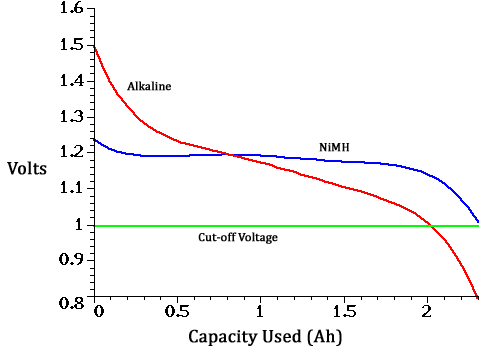
If I understand it correctly, the 1,5 V is only the initial voltage in a alkaline battery, and that it steadily goes lower. A small electric motor would run slower and slower. But a NiMH battery will stay at 1,2 V for most of its "life", so a motor would run at constant speed for a longer time.
 
The voltage of the cell used in a light meter is really not very important as that can be compensated for by the circuit design. The discharge curve in contrast is VERY important. It must be as near to horizontally flat as possible. There are very few cells that can fulfill this requirement and rechargeable cells do not. This why silver oxide or zinc cells used.

http://battery.berkeley.edu/Unprotected/9_27_07_PerformanceMetrics2.pdf
 
Last edited:
The discharge curve in contrast is VERY important. It must be as near to horizontally flat as possible.

And what does current supply characteristics have to do with a light meter, which has a very low current draw by nature?!

Curious, I pulled out my Minolta Autometer Vf incident meter, measured a constant light source indoors
and get ISO 100 1/30 f/1.4 +0.1EV for all three
  • Old alkaline measured at 1.305V
  • New alkaline measured at 1.597V
  • Imedion li-ion (stored months after charging without any use) measured at 1.288V
Based solely upon this comparison, finding no difference in light readings, in spite of comparing
  • aged alkaline vs new alkaline voltage, and
  • aged alkaline vs. a li-ion voltage
  • new alkaline vs. a li-ion voltage

...I see no reason NOT to use li-ion in a meter normally using AA
 
Last edited:
Which meter? It may or may not be able to handle the lower voltage, depends on what the meter is using for voltage regulation.
 
Which meter? It may or may not be able to handle the lower voltage, depends on what the meter is using for voltage regulation.

...but we're dealing with a meter (Gossen) which was designed to have an AA battery which has known variable voltage characteristics from about 1.25V to 1.50+V, and would have providisions for identifying an old AA with too-low voltage
 
Last edited:
Which meter? It may or may not be able to handle the lower voltage, depends on what the meter is using for voltage regulation.

Gossen Sixtomat Digital http://www.gossen-photo.de/english/foto_p_sixtomat.php

The voltage of the cell used in a light meter is really not very important as that can be compensated for by the circuit design. The discharge curve in contrast is VERY important. It must be as near to horizontally flat as possible. There are very few cells that can fulfill this requirement and rechargeable cells do not. This why silver oxide or zinc cells used.

The Gossen Sixtomat Digital I use is made for normal AA batteries and the manual doesn't say that any special type should be used.

The discharge curve for NiMH batteries is much flatter than the one for alkaline:

nimh_vs_alkaline.gif
 
The specification section of the manual for that meter says nothing about the type of 1.5V AA battery.

But the section of the manual that discusses the battery (page 29) specifies a 1.5 V AA (alkaline-manganese) battery.

http://www.gossen-photo.de/pdf/ba_sixtomat_digital_e.pdf
 
But the section of the manual that discusses the battery (page 29) specifies a 1.5 V AA (alkaline-manganese) battery.

German humor. They say the craziest things. :laugh:

I have now compared the alkaline and NiMH batteries, and the meter gave the exact same readings with both. :smile:
 
Just for information, in my Gossen Multisix, which is designed for alkaline 9V batteries, I use NiMH Tensai 8.4 V. I don't remember performing tests but, if the battery is in there, it means I performed some tests and the battery gave the same result.

My general rule of thumb with electronics is: if a device designed for alkaline batteries does not complain with fully charged accumulators, then it should work well.
If the device complains of "low-battery" state with fully charged batteries, then it could work well or it couldn't, one has to make some tests.

I ignore the instructions to feed the device "alkaline" batteries because, in user-manual parlance, that means that they advice against zinc-carbon batteries.

Only if the instruction booklet explicitly says not to use rechargeable batteries, then I do comply or don't buy the contraption.
 
Quite some compact AF cameras I got take 2 AA batteries, but in the chamber is a sign "NO-Nicads".
Maybe these need a certain minimum voltage around 1.2V. But so far I did not experiment on this.
As they all got a built in flash it could be a matter of the lower resistance of the Nicads too. Just a weird guess.
 
Are there any reasons not to use a rechargeable NiMH battery in your lightmeter? I have only used a alkaline AA in my Gossen lightmeter, but I have plenty of Eneloops.

If I understand it correctly, the 1,5 V is only the initial voltage in a alkaline battery, and that it steadily goes lower. A small electric motor would run slower and slower. But a NiMH battery will stay at 1,2 V for most of its "life", so a motor would run at constant speed for a longer time.
I use rechargeable 9V batteries exclusively in my Gossen light meters without problems. They don't last as long but work just fine
 
Some light meters, old Pentax Spotmatics for example, used a bridge circuit where accuracy is maintained over a fairly wide range of battery voltages. Old Nikons relied on the nearly constant voltage of mercury cells, and are less accurate with other batteries. Some newer cameras may well use voltage regulator circuits that compensate for low battery voltage. We can test our own meters as others have done in previous posts rather than rely on generic advice.
 
Photrio.com contains affiliate links to products. We may receive a commission for purchases made through these links.
To read our full affiliate disclosure statement please click Here.

PHOTRIO PARTNERS EQUALLY FUNDING OUR COMMUNITY:


Ilford ADOX Freestyle Photographic Stearman Press Weldon Color Lab Blue Moon Camera & Machine
Top Bottom