• Welcome to Photrio!
    Registration is fast and free. Join today to unlock search, see fewer ads, and access all forum features.
    Click here to sign up

Real Agfa formulae:-)

Grill

H
Grill

  • 4
  • 0
  • 92

Recent Classifieds

Forum statistics

Threads
202,792
Messages
2,845,629
Members
101,536
Latest member
Roeym
Recent bookmarks
1

Ian Grant

Subscriber
Allowing Ads
Joined
Aug 2, 2004
Messages
23,418
Location
West Midland
Format
Multi Format
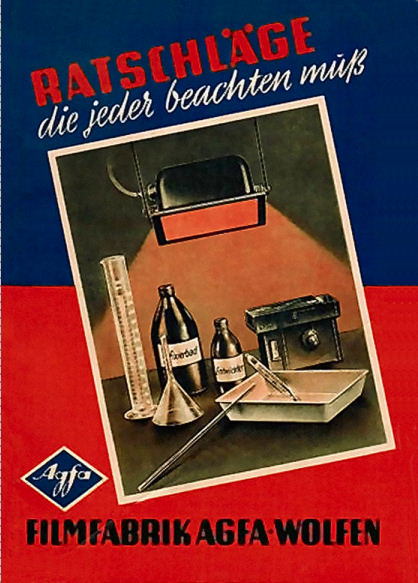
Finally found a 1951 book of real Agfa Formulae etc, none of your ersatz right wing US propped up West German Agfa rubbish :D

wolfen2.jpg


Will go nicely with my Windisch - "The new Photo School" 1938 in English & "Die neue Fotoschule", 1941, in German :smile:

The Agfa book is nice because I use a similar vintage Carl Zeiss Jena 150mm f4.5 Tessar, an odd rare but excellent & exceptionally well coated LF lens that was probably made for Linhof. But 1951/52 was the vpoint where the Communists pulled Zeiss Jena & Agfa Wolfen away from possibly re-uniting with their new West Geraman off-sring and heralded the start of the cold war.

Ian
 
I have read that Agfa-Gevaert supplied/sold raw materials to OWRO for many years. When did this stop? Do you have the original Rodinal formula in that book?
 
Wow! You are going to upload some of its contents? Please. Pretty please with sugar on:smile:
 
My edition of the book is a couple of years NEWER than yours, Ian. *brags* :D

And, yes, it's very good. :smile:
 
Oh, Ian, didn't "recognise" you. New avatar.
The formula of the famous Agfa rodinal, is there? I thought it was secret.
Well, I suppose the later formulas were secret. The pre war ones don't seem to be.
 
No, Agfa 9 (Rodinal) isn't published in this book.
 
JPD is right I don't think the formulae for RO9 (Rodinal) has ever been published by Agfa or Orwo, but the pre-WWII/Wartime formula was published in the F.I.A.T. Report (Allied Intelligence reports on German Industries, compiled at the end of the War) and by Glafkides, and I have it somewhere.

The formulae for R08 (Glycin based) and R10 a p-Aminophenol 2 part developer have been published.

Wow! You are going to upload some of its contents? Please. Pretty please with sugar on

There's a lot of Formulae I'll be posting on APUG over the next few months. I'm always on the search for more books of Formulae to verify the 500+ that I already have in my database, and there's at least another 250, more likely over 300 yet to add. I should add taht I haven't checked the DCB or FDC, or Photo-Lab Index at this stage for additional formulae.

Ian
 
For Rodinal fans:

In 1910 the Agfa handbook of Formulae etc says:

In connection with the use of "Agfa Rodinal" the following remarks should be carefully noted:

In addition to neutrai sulphite and water "Agfa Rodinal" contains only an alkaline salt of Paramidophenol, but no excess of caustic alkali.


The method of manufacturing the developing agent was Patented so it was no secret.

LP Clerc gives a formula for making Rodinal in his 1938 book where an alkaline salt of p-Aminohenol is made, precipitated & filtered it's the re-dissolved in the minimum amount of NaOH it takes to dissolve it and Sulphite added. On an industrial scale that was how Rodinal once used to be made. Of course we don't know how Agfa adapted the formula over the years but the biggest changes were made when Agfa (West Germany) re-formulated the product and probably changed the original manufacturing process and raw chemistry.

My copy of Clerc is in the UK or I'd post the formula.

Alternative formulae use p-Aminophenol hydrochloride or in Kodak's case the oxalate, Kodak sold both the hydrochloride form & the oxalate as Kodelon.

Rodinal equivalents were made by Ilford "Certinal", May & Baker and other large photo chemistry manufacturers.

Ian
 
Only bought the book last night John, I won't get it for a while as it'll go to my UK address, and I've no idea when I'll actually get to see the books unless I can persuade someone to bring them over to Turkey.

I do have most of the Agfa formulae already including Agfa 130, but I've not been able to cross check it as of yet. Agfa 130 is one of the handful of developers that is quite different in formulae & type between Agfa-Ansco in the US and Agfa/Orwo in Gernany:

AGFA / ORWO 130

Metol 2.5 g
Sodium Sulphite (anhyd) 30 g
Hydroquinone 7 g
Sodium Carbonate (anhyd) 30 g
Potassium Bromide 1 g

Water to make 1 litre


AGFA -ANSCO 130

Metol 2.5 g
Sodium Sulphite (anhyd) 30 g
Hydroquinone 11 g
Sodium Carbonate (anhyd) 67.5 g
Potassium Bromide 5.5 g
Glycin 11.0 g
Water to make 1 litre

For use dilute 1+1. Development times 2 - 6 min.

hope that helps

ian
 
For Rodinal fans:

In 1910 the Agfa handbook of Formulae etc says:

In connection with the use of "Agfa Rodinal" the following remarks should be carefully noted:

In addition to neutrai sulphite and water "Agfa Rodinal" contains only an alkaline salt of Paramidophenol, but no excess of caustic alkali.


The method of manufacturing the developing agent was Patented so it was no secret.

LP Clerc gives a formula for making Rodinal in his 1938 book where an alkaline salt of p-Aminohenol is made, precipitated & filtered it's the re-dissolved in the minimum amount of NaOH it takes to dissolve it and Sulphite added. On an industrial scale that was how Rodinal once used to be made. Of course we don't know how Agfa adapted the formula over the years but the biggest changes were made when Agfa (West Germany) re-formulated the product and probably changed the original manufacturing process and raw chemistry.

My copy of Clerc is in the UK or I'd post the formula.

Alternative formulae use p-Aminophenol hydrochloride or in Kodak's case the oxalate, Kodak sold both the hydrochloride form & the oxalate as Kodelon.

Rodinal equivalents were made by Ilford "Certinal", May & Baker and other large photo chemistry manufacturers.

Ian


Rodinal contains 3 ingredients and is trivial to make. IDK what the big fuss is. You should be able to reproduce this formula out of memory Ian and publish it here.

PE
 
So how does this relate to Mr. Gainer's Rodinal like developer from metol?
(there was a url link here which no longer exists)
 
Rodinal contains 3 ingredients and is trivial to make. IDK what the big fuss is. You should be able to reproduce this formula out of memory Ian and publish it here.

PE

Rodinal originally wasn't made from the free base & involved precipitating the free base first than re-dissolving it.

At one point Agfa were owned by IG Farben and the formulae probably changed when p-Aminophenol (free base) became commercially vailable.

Yes I could put a formula online that would be very close to the RO9, pre-WWII version that's still made by Calbe but it's not the same as modern Rodina;.

There are at least 5 ingredients in Rodinal not 3 and we have no idea what the 5th, the anti-foggant is, or how sighnificantly Agfa (West Germany) improved the formula.

There's already too many speculative formulae purporting to be Rodinal to go adding another.

Ian
 
So how does this relate to Mr. Gainer's Rodinal like developer from metol?
(there was a url link here which no longer exists)


I have not tried it but it appears rather complex with a filtration step.

Rodinal, IIRC, did not require filtration.

PE
 
Rodinal originally wasn't made from the free base & involved precipitating the free base first than re-dissolving it.

At one point Agfa were owned by IG Farben and the formulae probably changed when p-Aminophenol (free base) became commercially vailable.

Yes I could put a formula online that would be very close to the RO9, pre-WWII version that's still made by Calbe but it's not the same as modern Rodina;.

There are at least 5 ingredients in Rodinal not 3 and we have no idea what the 5th, the anti-foggant is, or how sighnificantly Agfa (West Germany) improved the formula.

There's already too many speculative formulae purporting to be Rodinal to go adding another.

Ian

Ian;

There are indeed quite a few formulas, but if you properly label it with your disclaimers, I believe it would be a benefit. You should post it. One that I saw had an egregious outright error in it, ending up being much larger in volume than specified in the ingredients. I could only guess at the correct action to take to fix it.

Go ahead, post it for all of us!

PE
 
Last edited by a moderator:
hi ian

it helps TONS!
thanks ...

john

Only bought the book last night John, I won't get it for a while as it'll go to my UK address, and I've no idea when I'll actually get to see the books unless I can persuade someone to bring them over to Turkey.

I do have most of the Agfa formulae already including Agfa 130, but I've not been able to cross check it as of yet. Agfa 130 is one of the handful of developers that is quite different in formulae & type between Agfa-Ansco in the US and Agfa/Orwo in Gernany:

AGFA / ORWO 130

Metol 2.5 g
Sodium Sulphite (anhyd) 30 g
Hydroquinone 7 g
Sodium Carbonate (anhyd) 30 g
Potassium Bromide 1 g

Water to make 1 litre


AGFA -ANSCO 130

Metol 2.5 g
Sodium Sulphite (anhyd) 30 g
Hydroquinone 11 g
Sodium Carbonate (anhyd) 67.5 g
Potassium Bromide 5.5 g
Glycin 11.0 g
Water to make 1 litre

For use dilute 1+1. Development times 2 - 6 min.

hope that helps

ian
 
Abbreviated from L.P.Clerc 1937 reprinted 1946 p262:
Concentrated Paraminophenol Developer of the Rodinal Type(J.Desalme 1913)
A.Dissolve 75g paraminophenol hydrochloride in 600 to 700 cc hot water and filter if necessary.
B.Dissolve 10g sodium sulphite and 35g dry sodium carbonate in 200 cc tepid water.
Add B to A. This produces a precipitate of the free base which is filtered on a cloth after cooling.Drain the paste so it does not occupy a bulk of more than 300 cc and add to it 100 cc of liquid sodium bisulphite of density 35 degrees Be,and then,little by little,soda lye of density 40 degrees Be until the precipitate has completely dissolved.
Then a very small quantity of the bisulphite is again added to obtain a persisting precipitate.
Add water to bring up the total to 500 cc.Filter,divide into a number of hermetically sealed bottles.
For use this concentrated developer is diluted with 20 to 30 times its volume with water.
Note. Clerc also gives the formula in grains but his conversion factor of grams to grains differs from one substance to another and appears unreliable.Considering the object is only to make p-aminophenol free base the exact weight is probably not important.
 
Well, Alan, thanks but I wanted to get Ian's version.

In any event, can you translate Baume into concentration? I cannot find a conversion table and have tried.

PE
 
C'Mon Ian Pleasssse...:smile:

Well, Alan, thanks but I wanted to get Ian's version.

In any event, can you translate Baume into concentration? I cannot find a conversion table and have tried.

PE

OK, I'm on the case :D

As Alan & Ron have mentioned one problem is that without knowing exact Baume/Secific gravities etc it's difficult to get the exact proportions.

One thing we do know is that Rodinal is Carbonate free, so any formula containing Carbonate isn't close but may well be similar to Agfa's other P-Aminohenol formula R10, which unlike Rodinal has been published officially.

Ian
 
Ian is correct. Getting a formula in terms of Baume is virtually untranslatable depending on chemical. And, the formula was carbonate free, so we only have an Ersatz Rodinal formula.

Baume measurements is also a problem with old emulsion formulas.

PE
 
Actually I've found that for some chemicals transposing the Baumé to percentage W/V is remarkably easy.

In the case of "100 cc of liquid sodium bisulphite of density 35 degrees Be" that's actually just a 29/30% solution w/v and in fact is the strength of commercially available Sodium Metabisulphite solution, sold in bulk :D

So armed with the Specific Gravity's of the chemicals used in Ridinal it'll be easier to get close to the formula for Rodinal/R09

Ian
 
Actually I've found that for some chemicals transposing the Baumé to percentage W/V is remarkably easy.

In the case of "100 cc of liquid sodium bisulphite of density 35 degrees Be" that's actually just a 29/30% solution w/v and in fact is the strength of commercially available Sodium Metabisulphite solution, sold in bulk :D

So armed with the Specific Gravity's of the chemicals used in Ridinal it'll be easier to get close to the formula for Rodinal/R09

Ian


As you said previously, it can be difficult. Ammonium Hydroxide is one of those that is difficult due to having densities lower than 1.0.

PE
 
dont know if this is any use, i have acopy of photography and focus dated 1915 with an ad for rodinal now british made. also a1912 agfa handbook with a few recipes in. dave.
 
Photrio.com contains affiliate links to products. We may receive a commission for purchases made through these links.
To read our full affiliate disclosure statement please click Here.

PHOTRIO PARTNERS EQUALLY FUNDING OUR COMMUNITY:


Ilford ADOX Freestyle Photographic Stearman Press Weldon Color Lab Blue Moon Camera & Machine
Top Bottom