



• Welcome to Photrio!
    Registration is fast and free. Join today to unlock search, see fewer ads, and access all forum features.
    Click here to sign up

RA4 Blix Crystallization

Tablao Flamenco

A
Tablao Flamenco

  • 0
  • 0
  • 0
Untitled

A
Untitled

  • 1
  • 2
  • 55

Forum statistics

Threads
204,325
Messages
2,867,159
Members
102,223
Latest member
jeffwiedner
Recent bookmarks
1

ac123

Member
Joined
Jun 29, 2023
Messages
61
Location
USA
Format
35mm
A couple months ago, I purchased a set of the Silver Pixel developer/blix to print RA4, and upon opening the bottles, measured out enough for several working sessions which I then stored separately, as concentrates, in nearly-full glass bottles.

Due to waiting on some equip, I actually had a couple months break where I did not use my darkroom or these chemicals.

I finally just went to go mix up a batch and noticed that most of my bottles of Blix Part A have crystallized as such:
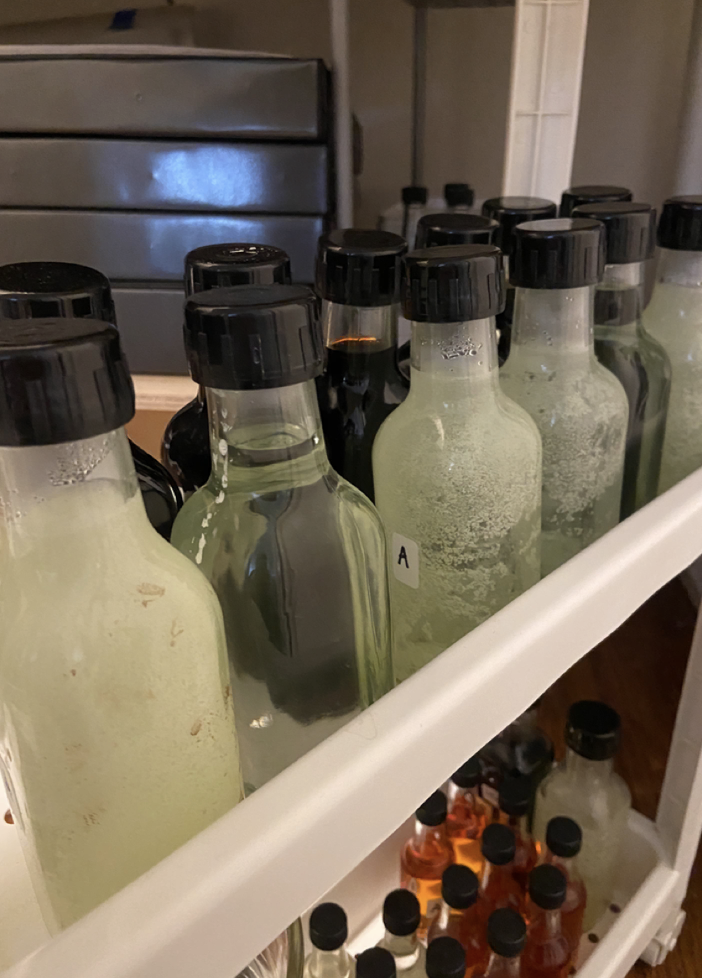
Screen Shot 2024-11-01 at 11.24.25 AM.png


Is this normal/to be expected with Blix Part A? How could I go about minimizing the risk here in the future? And for the crystallized bottles, are these essentially dead/unusable chems?

They are being stored in my darkroom 'closet' which tends to get a bit colder than the rest of the apartment, though I doubt it ever got colder than 60 degrees in there at night.

Thanks for any suggestions.
 
No. That's not normal. I wouldn't use either the Blix or the bottles. A little bit of sedimentation of the A component can be tolerated if it's filtered out; but what you have looks gross.
 
As @DREW WILEY indicated - no, this is not what is supposed to happen. Essentially this is the fix part of the block that has started to sulfur out. In mild cases it can be mostly reverted by adding a little sulfite (preferably ammonium sulfite, but sodium sulfite is much easier to get). However, your fix seems to be beyond the point where this will really help. In your place I would try to filter the stuff until it's clear, add a little sulfite and store are room temperature in entirely full glass bottles with no air on top.
You may find that the blix lasts better once both parts are mixed together - but it's a bit of a gamble.
My best experience is with Fuji monopart blix; that's a truly stable concentrate.
 
Fixer part went bad forming white elemental sulfur, it happens also in B/W fixer and theoretically you should throw it out and buy again. Nevertheless, I had use it filtered for non important or non final prints.

How long have you stored it? I use a similar way with amber glass bottles and never had that problem. CD-3 and fixer parts are the ones with the shortest shelf life, they can't go bad even in the original packaging if they are kept for too long time (years for original packaging).
 
Last edited:
What puzzles me most is the fact that the (obviously identical) bottles show all levels of degradation from completely unaffected, to absolutely ruined.
Are the bottles' caps airtight?
 
What puzzles me most is the fact that the (obviously identical) bottles show all levels of degradation from completely unaffected, to absolutely ruined.
Are the bottles' caps airtight?

Thiosulfate doesn't fail smoothly. It looks good good good ... good good and then bamm! bad. Therefore tiny differences in bottle material, screw cap tightness or whatever can change the amount of time it takes to go from good to bad, and if it does go bad it goes from good to completely and visibly bad.
 
Thanks for all the input here.

It's probably been around 3 months that they've been stored like this (not my typical storage time but I had to replace some equip). It's likely just a cause of sitting too long in bottles that may not be perfectly airtight. I may try to strain out the crystalized bits and just use these chems for test print sessions.

In general, how sensitive are these stored concentrates to temperature changes? I'm in LA and it doesn't get too cold, but the closet I keep them in may get down to around 60 degrees more or less as there's no heating inside. Is general temperature shift something to be conscious of for shelf life?
 
Temperature is t the main concern really. It's oxygen thats the enemy for the fixer concentrate and also the developer. At low temperatures things may crystallize a bit, but it usually goes back into solution if things warm up again and/or when you dilute it for use.
 
Rather than try to use the fixer portion you can substitute Ilford rapid fixer in a pinch. I've done this in a similar situation.
 
Photrio.com contains affiliate links to products. We may receive a commission for purchases made through these links.
To read our full affiliate disclosure statement please click Here.

PHOTRIO PARTNERS EQUALLY FUNDING OUR COMMUNITY:


Ilford ADOX Freestyle Photographic Stearman Press Weldon Color Lab Blue Moon Camera & Machine
Top Bottom
