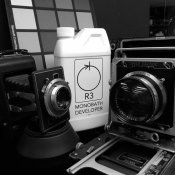


I've seen this Dead Link Removed" mentioned on the internet several times now.
Mixing developer with fix feels a bit quirky though, but who knows.
I was wondering if anyone on APUG used it and what the results were:
- Was it any good?
- Does the developer have a good shelf life?
- Any comments on archival quality of (older) prints or films developed with this monobath developer?
The recipe is mentioned here:
BTW: I've seen (there was a url link here which no longer exists) about R3 Monobath as a print developer.
 (sample from New55 FILM)
Mixing developer with fix feels a bit quirky though, but who knows.
I was wondering if anyone on APUG used it and what the results were:
- Was it any good?
- Does the developer have a good shelf life?
- Any comments on archival quality of (older) prints or films developed with this monobath developer?
The recipe is mentioned here:
400TX 135, souped ten minutes, 75 F.
16 ml HC-110 USA concentrate
50 ml household ammonia (ammonium hydroxide, 5% solution)
10 ml Ilford Rapid Fixer concentrate
water to make 256 ml
Mixed by adding most of the water to the HC-110 concentrate, then ammonia, then fixer, then remainder of water to make up volume. Heated to 75 F in an external hot water bath.
IMPORTANT: Be certain the ammonia used is a 5% concentration. Test it first using an ammonia hydrometer available through ebay or Amazon.
Result: normal appearing negatives, within approximately 1 stop of rated speed at worst. I won't know for certain until I can scan them (they're drying now, probably won't get them scanned tonight), but to my eye contrast range appears normal and low light details are preserved -- I intentionally shot at a wide range of exposure, from about +2 to -2 stops, to test whether the latitude of the 400TX would be preserved, and it appears it was; there is considerable detail in a shot taken with a simple camera (most likely f/11, 1/100) in a grocery store aisle by available light, a situation that normally demands f/2.8 at 1/30 with ISO 400, give or take one stop.
BTW: I've seen (there was a url link here which no longer exists) about R3 Monobath as a print developer.