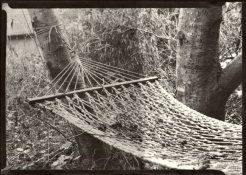
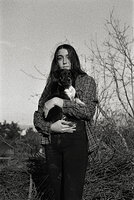

Inspired by Denise's success on subbing and coating celluloid diacetate sheet, I made a quick experiment and succeeded quite well and quite easily.
I ordered a 0.005" diacetate roll from dickblick.com.
I made a subbing from gelatine, acetic acid, methanol and acetone. I took some random piece of cloth and gently wiped the acetate sheet with the cloth using a squeegee. The problem was that the subbing made sheet wrinkle somewhat, making proper coating impossible with our blade.
Then, a second try; I sprinkled some water to a clean glass plate, put the acetate sheet on top and then carefully squeegeed the sheet to the glass (trying to get rid of all air bubbles) and secured the corners with masking tape. This was quite easy and guarantees the flatness throughout the rest of the process.
Then I wiped the subbing layer on the sheet. Some minor streaking occur at this stage, but this really doesn't seem to be visible in the final scan after coating.
I let the subbing layer dry for 15 minutes and made a test "emulsion";
17 g hot tap water
2.0 g gelatin (PIG food grade, of course! )
)
1.0 g glyoxal 4%
5 drops Agepon
A tad of erythrosine
And coated with a blade set at about 300 um gap.
Then I let it dry and harden for 2 days.
It remained perfectly flat on the glass plate for the whole time while drying, but curled somewhat after removed from the glass.
I cut a 60mm wide test stripe with a box cutter and "processed" it at 24C:
1% sodium carbonate for 10 minutes with almost vigorous agitation
1% acetic acid for 3 minutes
Wash for 5 minutes
Final rinse with Agepon for 1 minute
Dry in warm air.
It survived!! Totally different from our results with unsubbed PET, which started flaking at the borders after 1 minute and was completely loosened after 5 minutes or so.
The only real problem seems to be that cutting the film causes emulsion cracks at the borders. Emulsion is very "hard" in this sense. The curling is also heavy and more force is needed to lay it flat than with any real film. I think adding sorbitol will solve these problems well enough for us. I think the pig gelatin is not the best one in this sense.
The emulsion flakes of at the cut borders where the emulsion has cracked, but now the adhesion is strong enough so that the flaking remains only at the cracked site, not spreading at all.
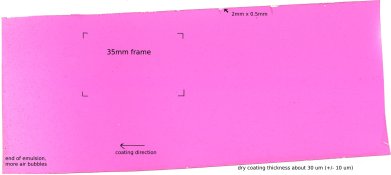
Attachment: a scan of the "processed" and dried 60mm wide strip. Darker spots may be erythrosine spots because I added it just before coating. Or they may be air bubbles or dust.... Better cleaniness next time!
I think we are ready to go for a next real emulsion.
I ordered a 0.005" diacetate roll from dickblick.com.
I made a subbing from gelatine, acetic acid, methanol and acetone. I took some random piece of cloth and gently wiped the acetate sheet with the cloth using a squeegee. The problem was that the subbing made sheet wrinkle somewhat, making proper coating impossible with our blade.
Then, a second try; I sprinkled some water to a clean glass plate, put the acetate sheet on top and then carefully squeegeed the sheet to the glass (trying to get rid of all air bubbles) and secured the corners with masking tape. This was quite easy and guarantees the flatness throughout the rest of the process.
Then I wiped the subbing layer on the sheet. Some minor streaking occur at this stage, but this really doesn't seem to be visible in the final scan after coating.
I let the subbing layer dry for 15 minutes and made a test "emulsion";
17 g hot tap water
2.0 g gelatin (PIG food grade, of course!
)1.0 g glyoxal 4%
5 drops Agepon
A tad of erythrosine
And coated with a blade set at about 300 um gap.
Then I let it dry and harden for 2 days.
It remained perfectly flat on the glass plate for the whole time while drying, but curled somewhat after removed from the glass.
I cut a 60mm wide test stripe with a box cutter and "processed" it at 24C:
1% sodium carbonate for 10 minutes with almost vigorous agitation
1% acetic acid for 3 minutes
Wash for 5 minutes
Final rinse with Agepon for 1 minute
Dry in warm air.
It survived!! Totally different from our results with unsubbed PET, which started flaking at the borders after 1 minute and was completely loosened after 5 minutes or so.
The only real problem seems to be that cutting the film causes emulsion cracks at the borders. Emulsion is very "hard" in this sense. The curling is also heavy and more force is needed to lay it flat than with any real film. I think adding sorbitol will solve these problems well enough for us. I think the pig gelatin is not the best one in this sense.
The emulsion flakes of at the cut borders where the emulsion has cracked, but now the adhesion is strong enough so that the flaking remains only at the cracked site, not spreading at all.
Attachment: a scan of the "processed" and dried 60mm wide strip. Darker spots may be erythrosine spots because I added it just before coating. Or they may be air bubbles or dust.... Better cleaniness next time!
I think we are ready to go for a next real emulsion.
Attachments
Last edited by a moderator: