• Welcome to Photrio!
    Registration is fast and free. Join today to unlock search, see fewer ads, and access all forum features.
    Click here to sign up

Question on film recorders and output film size

Tybee Beach Pier

A
Tybee Beach Pier

  • 1
  • 0
  • 30
Local Artists Work

D
Local Artists Work

  • 2
  • 3
  • 28

Recent Classifieds

Forum statistics

Threads
201,137
Messages
2,819,625
Members
100,549
Latest member
Franklee
Recent bookmarks
0

zoneV

Member
Allowing Ads
Joined
Feb 9, 2007
Messages
5
Format
Large Format
This is my first post here, although I've been posting at apug for a few years under a different name.

I'd appreciate advice from those who have had negatives made from film recorders. Which film format would be best for what I want to do?

In the near future, I plan to have b&w negatives made from digital files so can I make conventional silver prints in the darkroom. I'd like to print 11x14.

I've heard great things about LVT technology, and if we need to, we're willing to spend the extra money to have the negatives made with one of these film recorders. However, I want to try the least expensive method first, and that is CRT technology. I plan to use Dr5 for the negatives. They offer CRT output on 35mm, 6x7 cm, and 4x5 film. They offer LVT output for 4x5 and 8x10.

Am I likely to be able to get away with the CRT 6x7 output? My enlarger is a Besseler 23C, and will handle medium format but not large format.

Thanks and I look forward to learning more from this forum.
 

pellicle

Member
Allowing Ads
Joined
May 25, 2006
Messages
1,175
Location
Finland
Format
4x5 Format
Hello

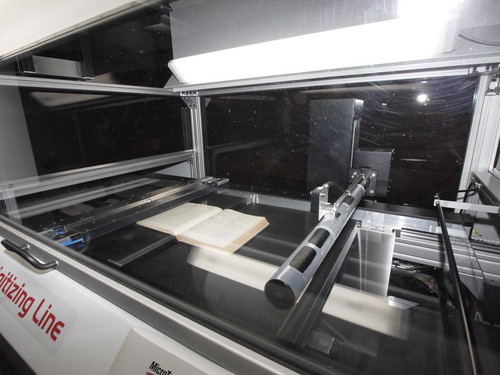
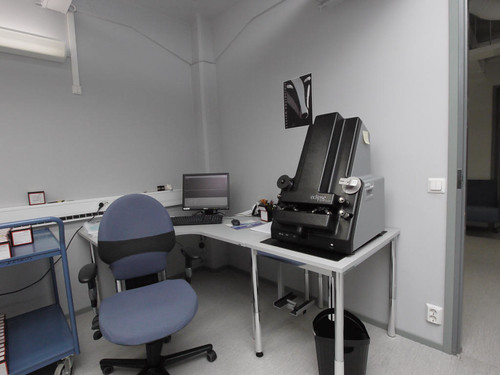
if you don't get any answers we've just bought one at work so I'll post my results when I get them ... be about a month is my guess.

some of the nifty toys at my work include:

3986584136_1873c20442.jpg


3985812179_635b931310.jpg
 

Joe Lipka

Member
Allowing Ads
Joined
Sep 24, 2002
Messages
908
Location
Cary, North
Format
4x5 Format
In my experience the use of a digital negative always implied a contact print process as the final output. The Final contact print could be either a silver gelatin print or some alternative process. I have never heard of anyone successfully using digital negatives for enlargement.

My original workflow for producing negatives for platinum printing was to scan 4x5 film negatives, perfect the scan in photoshop at the final image size (8x10 at 300 dpi) and then ftp the files to the prepress house. They would output continuous tone negatives on graphic arts film and ship them to me.
 

pellicle

Member
Allowing Ads
Joined
May 25, 2006
Messages
1,175
Location
Finland
Format
4x5 Format
In my experience the use of a digital negative always implied a contact print process as the final output. The Final contact print could be either a silver gelatin print or some alternative process. I have never heard of anyone successfully using digital negatives for enlargement.

mmm ... perhaps I misread this ... although I have heard of 11 x 14 contact print negs being made from 4x5 inch negs, which I guess qualifies as enlargement of one sort or another.

I was however thinking that you can scan or photograph larger materials and then output onto 35mm microfilm when answering the question.

pardon me
 

sanking

Member
Allowing Ads
Joined
Mar 26, 2003
Messages
5,437
Location
Greenville,
Format
Large Format
mmm ... perhaps I misread this ... although I have heard of 11 x 14 contact print negs being made from 4x5 inch negs, which I guess qualifies as enlargement of one sort or another.

I was however thinking that you can scan or photograph larger materials and then output onto 35mm microfilm when answering the question.

pardon me

Typically most digital negatives were made for contact printing with alternative processes. If the negative is printed on an inkjet printer the maximum resolution you can get is between 360 dpi to 720 dpi, which is the equivalent of 7-14 lp/mm. I personally don't see any difference in resolution with my Epson 3800 printing at 360 dpi and 720 dpi so I think 7 lp/mm is the more realistic number. Naturally you could not enlarge such a negative very much without it falling apart.

LVT negatives are capable of much higher resolution and today you find some silver printers working on the image file digitally and then having an LVT negative made for projection printing in the darkroom. There are a number of places that provide this service, including the Chicago Albumen Works.

LVT negatives may or may not offer some advantage to alternative printers, depending on the detail in the original negative and in the degree of enlargement.

Sandy King
 
OP
OP

zoneV

Member
Allowing Ads
Joined
Feb 9, 2007
Messages
5
Format
Large Format
Thanks for all the input.

After reading the thread linked to below and also talking with David Wood of Dr5 via email, I'm wondering if files from a Nikon D700 would have the necessary resolution for film output that could be used for conventional b&w enlarging. It doesn't sound like they are large enough. I'm also being told NOT to interpolate the files (film recorders burn each pixel smaller than the film grain clumps, and interpolation apparently results in a blurred image).

http://photo.net/bboard/q-and-a-fetch-msg?msg_id=005SEn

I'm starting to think that I may be able to get superior quality in my particular case (versus that of the film recorder) by simply photographing an RA-4 print made from the original digital file, and then using the resulting negative for the darkroom prints (in effect making a copy print). I have Kodak's book "Copying and Duplicating" and the results of this method look encouraging. It's possible to nearly match the quality of the original print.

I'm also planning to try the inkjet negative method.

Thoughts on any of these methods?
 

pschwart

Subscriber
Joined
Jul 15, 2005
Messages
1,147
Location
San Francisco, CA
Format
Multi Format
Thanks for all the input.

After reading the thread linked to below and also talking with David Wood of Dr5 via email, I'm wondering if files from a Nikon D700 would have the necessary resolution for film output that could be used for conventional b&w enlarging. It doesn't sound like they are large enough. I'm also being told NOT to interpolate the files (film recorders burn each pixel smaller than the film grain clumps, and interpolation apparently results in a blurred image).

http://photo.net/bboard/q-and-a-fetch-msg?msg_id=005SEn

I'm starting to think that I may be able to get superior quality in my particular case (versus that of the film recorder) by simply photographing an RA-4 print made from the original digital file, and then using the resulting negative for the darkroom prints (in effect making a copy print). I have Kodak's book "Copying and Duplicating" and the results of this method look encouraging. It's possible to nearly match the quality of the original print.

I'm also planning to try the inkjet negative method.

Thoughts on any of these methods?

Why not just make digital negatives and make 11x14 contact prints? This will actually provide more control than making enlargements.
 
OP
OP

zoneV

Member
Allowing Ads
Joined
Feb 9, 2007
Messages
5
Format
Large Format
Why not just make digital negatives and make 11x14 contact prints? This will actually provide more control than making enlargements.

You mean on an inkjet printer? :confused:

This is one of the other methods I had mentioned I intend to try. :wink:

As for making 11x14 negatives on a film recorder, if that's what you meant: it's not possible, for many reasons, not the least of which is that 8x10 is the largest available.

But there's also nothing stopping from me from enlarging a 6x7 cm positive from a film recorder onto ortho sheet film that is 11x14, and then using that to contact print. :D
 

pschwart

Subscriber
Joined
Jul 15, 2005
Messages
1,147
Location
San Francisco, CA
Format
Multi Format
You mean on an inkjet printer? :confused:

This is one of the other methods I had mentioned I intend to try. :wink:

As for making 11x14 negatives on a film recorder, if that's what you meant: it's not possible, for many reasons, not the least of which is that 8x10 is the largest available.

But there's also nothing stopping from me from enlarging a 6x7 cm positive from a film recorder onto ortho sheet film that is 11x14, and then using that to contact print. :D
I was thinking of digital negatives produced on an inkjet printer, or you could find a service bureau to make the negs on an imagesetter. There is a fairly steep learning curve for making digital negatives using an inkjet printer, but once mastered it's a lot cheaper and quicker than using a service bureau.
 

jd callow

Moderator
Subscriber
Allowing Ads
Joined
Jan 31, 2003
Messages
8,466
Location
Milan
Format
Multi Format
lightjets made a device that output up to 11x14 using lasers -- LightJet 2080 if memory serves me. Lightjet out performed the Rhino LVT in my experience (I was able to use them side by side) and the LVT was limited to 8x10. Both produced negs that could be projected, but generally they were used for producing film positives for printing -- back at the tail end of when the print industry hadn't converted completely to digital. Just under the the LVT was the Solitaire 16. The Solitaire was good enough to create 70mm for the film industry which was obviously good enough to be projected.
 

amphoto

Member
Allowing Ads
Joined
Oct 31, 2006
Messages
86
Format
Medium Format
In the near future, I plan to have b&w negatives made from digital files so can I make conventional silver prints in the darkroom. I'd like to print 11x14.

You could skip the negative and go straight from digital to silver prints using a De Vere 504DS: http://de-vere.com/products.htm

Very expensive I suspect...would like to see prints made with it, just out of interest.
 

dr5chrome

Member
Allowing Ads
Joined
Dec 29, 2006
Messages
461
Format
Medium Format
JD.. calibration would be the only problem between the 2 machines. The lightjet also had 'tubes' the emit the light which would go out and be very costly to replace. the LVT used LED to emit the light.

both would burn @ 80res. which is 80 lines per mm. :wink:

dw


lightjets made a device that output up to 11x14 using lasers -- LightJet 2080 if memory serves me. Lightjet out performed the Rhino LVT in my experience (I was able to use them side by side) and the LVT was limited to 8x10. Both produced negs that could be projected, but generally they were used for producing film positives for printing -- back at the tail end of when the print industry hadn't converted completely to digital. Just under the the LVT was the Solitaire 16. The Solitaire was good enough to create 70mm for the film industry which was obviously good enough to be projected.
 

8x10 user

Member
Allowing Ads
Joined
Apr 11, 2010
Messages
3
Format
Large Format
I can output to films as large as 16x20".

PM me for details.
 

gmikol

Subscriber
Allowing Ads
Joined
Mar 2, 2009
Messages
634
Location
Vancouver, W
Format
35mm
8x10user, due to spamming problems, I believe there is a 10-post threshold that new users must meet before PM-ing is allowed.

http://www.hybridphoto.com/forums/showthread.php?p=13263

Also, make sure PM's and (optionally) emails are turned on in your profile, so that others can contact you.

That being said, I'm interested in hearing more about the services you offer, as I imagine others might be as well. Perhaps you should start your own thread in "Digital Negatives" to discuss this, assuming it's OK with the mods...There really isn't an area for commercial services on this site.

Otherwise, please send me an email through the forums, and we can discuss it off-line.

--Greg
 

8x10 user

Member
Allowing Ads
Joined
Apr 11, 2010
Messages
3
Format
Large Format
I sent you an email Greg, let me know if you did not receive it.

After I get my new site up I will check with to mods to find out the policies regarding off site commercial services. If I am able to I will start a new thread regarding my output services.

By the way, can someone tell me what emulsions and film densities work best for various traditional and alternative processes?

Thank you,
Ed
 
Photrio.com contains affiliate links to products. We may receive a commission for purchases made through these links.
To read our full affiliate disclosure statement please click Here.

PHOTRIO PARTNERS EQUALLY FUNDING OUR COMMUNITY:


Ilford ADOX Freestyle Photographic Stearman Press Weldon Color Lab Blue Moon Camera & Machine
Top Bottom