

• Welcome to Photrio!
    Registration is fast and free. Join today to unlock search, see fewer ads, and access all forum features.
    Click here to sign up

Question about sepia toning please

Procession

A
Procession

  • 0
  • 0
  • 12
Millers Lane

A
Millers Lane

  • 1
  • 2
  • 42

Recent Classifieds

Forum statistics

Threads
202,894
Messages
2,847,158
Members
101,531
Latest member
F2_User
Recent bookmarks
0

David Lyga

Member
Allowing Ads
Joined
Nov 25, 2007
Messages
3,449
Location
Philadelphia
Format
35mm
Why is it that sepia toning should NOT be done in full roomlight (as Kodak mandates)?

Amazingly, after 51 years in the darkroom I sill do not know why that is. But, I have rarely toned, so maybe that becomes an excuse, of sorts.
The bleach (potassium ferricyanide) is usually used as a reducer with full room light.

What am I missing in my very, very old age? - David Lyga
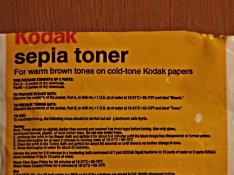
 

Attachments

  • Sepia Toner.jpg
    Sepia Toner.jpg
    921.6 KB · Views: 166
I have never heard of that one, must be a kodak idea, I do a lot of sepia toning and mainly use Fomatoner sepia or Fotospeed and all the instructions on them both, also on Tetenal sepia, (The sulphide smelly toner) state that toning is carried out in normal roomlight, indeed, Tetenal reccomend that you do not use sulphide toner in darkroom as it can effect un exposed paper, maybe Kodak sepia toner formulation is different to any others, but I can't think what, AFIK you have either thiocarbmide toner or sulphide toner, and 99% these days is the thiocarbimade non smelly version, at least over this side of the pond, Indeed, I don't ever remember kodak sepia toner in any dealers here
 
I have to say that I have always been (innately?) cynical about the ferricyanide working in full room light.

I think the reason is this: if you take a piece of photo paper and expose it to room-light, after a few minutes it will slowly begin to get darker. The bleach brings that paper back to its 'virgin' state; thus, perhaps that 'halide' state is, again, sensitive to room light.

Does that reasoning make any sense? - David Lyga
 
I have to say that I have always been (innately?) cynical about the ferricyanide working in full room light.

I think the reason is this: if you take a piece of photo paper and expose it to room-light, after a few minutes it will slowly begin to get darker. The bleach brings that paper back to its 'virgin' state; thus, perhaps that 'halide' state is, again, sensitive to room light.

Does that reasoning make any sense? - David Lyga

YES if you are using a rehalogenating bleach.
 
My guess is that if you use it under safelight, you avoid any partial "printing out".

The rehalogenating bleach converts the silver back into an exposed silver salt that can again be developed. The toner stage accomplishes that development.
 
My guess is that if you use it under safelight, you avoid any partial "printing out".

The rehalogenating bleach converts the silver back into an exposed silver salt that can again be developed. The toner stage accomplishes that development.

This is what I would expect. Though I haven't bleached directly under lights, I think it would be counter productive. You can see this effect, easy enough, by placing a test strip of your favorite printing-paper under an indoor light for an extended period.
 
Last edited by a moderator:
You really have to expose it to some brightness for an extended period of time. The only "printing out" I have ever seen during sepia toning was from several flash discharges right on the bleached print (attempting to produce mackie lines, to no avail) and even then the redevelopment did not amount to much. I don't worry about it.
 
I once bleached a bunch of long-expired (but still good) RC paper, doing lith tests.

I left them in a water tray for a while, and when I redeveloped, they were full of right-angled sections of density differences- realized it was where the paper overlapped in the tray.

The tray was under a spiral fluorescent bulb, which could have had something to do with it? (Color temp, daylight vs. tungsten, phase of the moon??)

Anyway, if I'm not toning right away, I try to keep the prints from direct light.
 
Due to the smell, I have done this process outside with no adverse or detrimental effects that I can discern.
 
Photrio.com contains affiliate links to products. We may receive a commission for purchases made through these links.
To read our full affiliate disclosure statement please click Here.

PHOTRIO PARTNERS EQUALLY FUNDING OUR COMMUNITY:


Ilford ADOX Freestyle Photographic Stearman Press Weldon Color Lab Blue Moon Camera & Machine
Top Bottom
