
• Welcome to Photrio!
    Registration is fast and free. Join today to unlock search, see fewer ads, and access all forum features.
    Click here to sign up

Question about film EI and developing time

Recent Classifieds

Forum statistics

Threads
201,849
Messages
2,831,116
Members
100,984
Latest member
Larrygaga00
Recent bookmarks
0

reakeener1970

Member
Allowing Ads
Joined
Mar 4, 2015
Messages
52
Format
35mm
Hi,
possibly a silly question, but, generally speaking, I know you get denser negatives shooting film a half a stop or stop lower. So, shooting 400 speed film at 300 or 200, for example. When doing this, should I be developing it for the normal (400 ISO) length of time or for a reduced length of time as if I am 'pulling' it?

I am speaking of generalities with this technique -- not a philosophical discussion about what I want to see, what film, what developer, etc.

I have been getting good results with shooting at 200/300 and developing at its normal (400, in this case), but I have not gotten around to doing proper density tests or anything with my results -- just contact sheets and a handful of prints so far. But I was curious if, when I use the "shoot a stop lower" technique, if that also includes an unspoken parameter that I should be developing at a stop slower, too.
thanks!
 

RobC

Member
Allowing Ads
Joined
Nov 5, 2007
Messages
3,880
Location
UK
Format
Multi Format
giving extra exposure without altering development will just shift everything up the curve without altering its gradient. You will capture more shadow detail.

But a film exposure and print is a whole system. You can't ignore the other parameters in the system and expect to get what you want except if the change of one parameter by chance happens to be the right change which suits the subject and print.

With negative film a little over exposure does no harm and may help in some circumstances. Under exposure is usually to be avoided unles you really know its the right thing to do.

Err on the side of over exposure. The reverse is true for reversal film (transparencies/slides)

Go figure.
 
Last edited by a moderator:

ic-racer

Member
Joined
Feb 25, 2007
Messages
16,729
Location
USA
Format
Multi Format
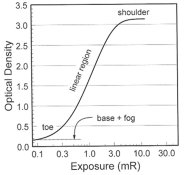
Changes in exposure move your subject right or left on the curve. Changes in development make the right hand portion of the curve higher or lower.
image1.jpg
 

markbarendt

Member
Allowing Ads
Joined
May 18, 2008
Messages
9,422
Location
Beaverton, OR
Format
Multi Format
Hi,
possibly a silly question, but, generally speaking, I know you get denser negatives shooting film a half a stop or stop lower. So, shooting 400 speed film at 300 or 200, for example. When doing this, should I be developing it for the normal (400 ISO) length of time or for a reduced length of time as if I am 'pulling' it?

I am speaking of generalities with this technique -- not a philosophical discussion about what I want to see, what film, what developer, etc.

I have been getting good results with shooting at 200/300 and developing at its normal (400, in this case), but I have not gotten around to doing proper density tests or anything with my results -- just contact sheets and a handful of prints so far. But I was curious if, when I use the "shoot a stop lower" technique, if that also includes an unspoken parameter that I should be developing at a stop slower, too.
thanks!

Not a silly question.

The old standard wisdom was that if you exposed more, you developed less. It has to do with the way the negative's "curve" relates to a specific paper Grade "curve".

The problem with this is that it can make many photos look flat, they just don't pop.

With others certain subjects can start looking odd with reduced development. For example let's say you're taking a picture of a black car on a sunny day. You can add extra exposure and develop lees to get the details behind the tires under the wheel wells and the highlights straight printable, but if you do that the details behind the tires under the wheel wells the car will look ok but the car will look gray.

When shooting landscapes that's not as big an issue as you might imagine, when you add a car or a face or something else that the viewer can use as a reference it can be a big problem.

In my opinion most people Will be best off if they develop normally.
 

Steve Smith

Member
Allowing Ads
Joined
May 3, 2006
Messages
9,110
Location
Ryde, Isle o
Format
Medium Format
The most usual advice given is to reduce development by 20-25% for an extra stop of exposure.


Steve.
 

Gerald C Koch

Member
Allowing Ads
Joined
Jul 12, 2010
Messages
8,131
Location
Southern USA
Format
Multi Format
If you are within the latitude of the film (-3-1/2 stops over to 1 stop under) exposure and develop normally then you will get normal contrast. If you vary the development time then contrast will vary. It depends on what you want to obtain.
 
Last edited by a moderator:
OP
OP

reakeener1970

Member
Allowing Ads
Joined
Mar 4, 2015
Messages
52
Format
35mm
Not a silly question.

The old standard wisdom was that if you exposed more, you developed less. It has to do with the way the negative's "curve" relates to a specific paper Grade "curve".

The problem with this is that it can make many photos look flat, they just don't pop.

With others certain subjects can start looking odd with reduced development. For example let's say you're taking a picture of a black car on a sunny day. You can add extra exposure and develop lees to get the details behind the tires under the wheel wells and the highlights straight printable, but if you do that the details behind the tires under the wheel wells the car will look ok but the car will look gray.

When shooting landscapes that's not as big an issue as you might imagine, when you add a car or a face or something else that the viewer can use as a reference it can be a big problem.

In my opinion most people Will be best off if they develop normally.

thanks Mark (and everybody else)!
most of my photography is portraits, whether it be close-ups of faces or whole people doing things (running, playing, interacting). I find myself liking the "pop" I get when overexposing by around a stop and then develop for the film's rated speed. Most of my photos are outside with backgrounds brighter then subjects and the increased exposure time also helps alleviate under exposure of the subject. Additionally, when the face IS brighter than the background, it stands out better being on the brighter side of normal. Most of my shooting is 35mm with some 120 and a small amount of 4x5 (though my child (my favorite subject) is still too young to hold still long enough to make large format very easy to do --I have, but the sheet film is a bit $$$ when half your shots are blurry!). Anyway, because I use roll film, I try to find methods that will work reasonably well for a wide range of situations.
That said, even though I like the results I am getting with 400 shot at 200/300, it would be nice to get the same (or at least very close) results actually 'at' 400 (and it's faster shutter speed -- remember: running child. I have flash but prefer to avoid when able). I suppose I should shoot at 400 and develop (push) to 800 -- I just try to avoid graininess on my small 35mm negatives as much as possible.
 

Rick Jones

Member
Allowing Ads
Joined
Feb 9, 2004
Messages
127
Location
Maryland
Format
Multi Format
I look at exposure and development as two separate issues. If shadows lack detail I start reducing film speed in 1/3rd stops increments until they print to my liking. At that point I look carefully at how highlights are printing. If important highlights are too dark I will increase development in 10% jumps until they look right. If they print too light (washed out) I decrease development times until, on average, they print to my liking. With that said I find my 35mm TMY looks good at E.I. 250 and developed less than Kodak suggests printed on my condenser enlarger.
 
Joined
Sep 10, 2002
Messages
3,676
Location
Eugene, Oregon
Format
4x5 Format
Since you're printing contact sheets, use them as a down-and-dirty test for both exposure and development.

The first thing you have to do is find the "proper proofing time," i.e., the time it takes to print a clear area of the negative to an acceptable black (close to maximum paper black is best). Do a test strip with a strip of paper sticking out past your negative edges. Choose the proofing time for the first strip that prints the clear edge the same black as the uncovered paper black in good viewing light.

Now, proof your negs at that time (same everything, e.g., lens aperture, light source, enlarger height, etc.) on grade 2 paper and see how they are.

Too little shadow detail? Expose more. Too little contrast? Develop more (and vice-versa). Dialing in your system this way is almost as precise as doing Zone System tests with a densitometer and takes your printing paper into account as well. Once you've done this, you can use the other paper grades to take up the slack for situations that don't fit normal. Or, if you're more ambitious, you can find your development and exposure times for contrastier and less-contrasty situations.

Best,

Doremus
 

nworth

Member
Allowing Ads
Joined
Aug 27, 2005
Messages
2,228
Location
Los Alamos,
Format
Multi Format
Not at all a silly question, but a fairly complicated one. The EI you use depends on the film, the subject, the light, and especially on you. Everyone uses the camera and the light meter a little differently, so the EI may not be the same for everyone. Also, meters vary more than is generally realized, and your meter may be a bit off. In general, exposure controls shadow density (the darkest thing you can see distinctly in the picture) and development controls contrast. You should probably develop normally for most things. The difference between your EI and the film speed is most likely a matter of technique. Even if it is not, a one stop overexposure will not affect things that much. As a matter of fact, you should probably aim for good negatives with normal development for normal subjects, regardless of the EI.
 
OP
OP

reakeener1970

Member
Allowing Ads
Joined
Mar 4, 2015
Messages
52
Format
35mm
Thanks for the great advice everyone! I just developed two rolls 35mm of delta 400 shot at 400 in full str xtol for 800. Also one roll of 120 tri-x shot at 400, also developed as if pushing to 800. Negatives look pretty good but haven't done the contact sheet yet. I am still not that great at evaluating negatives for contrast and density without a contact sheet to see it outright. So we will see...
At this point, having fun trying out different films and developers but hoping to start paring it down soon to just a couple and getting to know them inside and out. I really enjoyed stand developing in rodinal 1:100 but also want to try it with hc-110 and xtol and see how those compare to the rodinal. Also just to mix things up even more, may also try to semi-stand development and see if that makes any difference over pure stand. Half of the fun is the journey ....


Sent from my iPad using Tapatalk
 
OP
OP

reakeener1970

Member
Allowing Ads
Joined
Mar 4, 2015
Messages
52
Format
35mm
Quick update. The contact sheets for all of the above came out well and look great. Haven't printed enlargements yet.


Sent from my iPad using Tapatalk
 
Photrio.com contains affiliate links to products. We may receive a commission for purchases made through these links.
To read our full affiliate disclosure statement please click Here.

PHOTRIO PARTNERS EQUALLY FUNDING OUR COMMUNITY:


Ilford ADOX Freestyle Photographic Stearman Press Weldon Color Lab Blue Moon Camera & Machine
Top Bottom
