• Welcome to Photrio!
    Registration is fast and free. Join today to unlock search, see fewer ads, and access all forum features.
    Click here to sign up

Pyrocat-hd development times?

Two Horses

A
Two Horses

  • 2
  • 1
  • 0
Billboard, Cork city 1977

H
Billboard, Cork city 1977

  • Tel
  • Mar 17, 2026
  • 0
  • 0
  • 15

Recent Classifieds

Forum statistics

Threads
202,799
Messages
2,845,689
Members
101,539
Latest member
UwBouwMeester
Recent bookmarks
0

1kgcoffee

Member
Allowing Ads
Joined
Jan 19, 2017
Messages
500
Location
Calgary
Format
Medium Format
So far I have only used xtol to develop film. Very straightforward developer.

Getting into pyrocat-hd, but having a hard time finding development times/temps for different films, especially pushing and pulling.

What are some good guidelines for:
pan-f @25
pan-f @50

tri-x @200
tri-x @400

hp5 @400
hp5 @800


-thanks in advance,
1kgcoffee
 
Pyrocat seems to be slow to build density and contrast unless you agitate frequently such as use in a JOBO. Those times are published in the links above.
My initial research indicated about 13minutes if developing in a tank at the 1:1:100 dilution with agitation every 2 minutes. reduce agitation for thinner, increase it for denser.

however as I did more research I found several images from folks using different dilutions which showed me how flexible this developer can be.
So I ran a test with FP4 and Delta 100. I used a 7.3 stop scene and did two different dilutions using Minimal agitation (initial agitation of 2 minutes and then 2 30 second interim agitations).
4.5A:3B:525 for 15, 22, and 30 minutes; 3A:2B:500 for 20 and 25 Minutes. two sheets in a SSP445 tank.
All were very printable negatives. The 30 minute negative required almost double the print time of the 15minute negative and had midtone and darktone differences.

Steve Sherman has a premium video describing the minimal agitation process and why it works - worth every penny. He provides the times and A/B mixes he uses for up to N+6 to N-6 .

I have since processed two other D100 negatives at 22 minutes total time using the 3:2:500 dilution and they were very easy to print and had good separation of midtones.
Here is an example http://www.searing.photography/at-woody-gap/
 
Thanks for the responses...It seems this is not a developer for pushing films, but good for pulling?

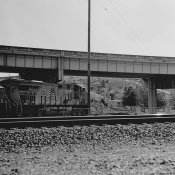
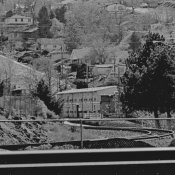
I have developed a roll of hp5plus at 200 for around 12 minutes and 73*fahrenheit and agitation every minute or so. A little overdeveloped perhaps, but getting weird results (attached). First off there are unexplained spots all over the place which should not appear on fresh film. Second it looks almost like posterization or a lack of detail as seen in the crop of the town. There is high accutance but it looks almost painted in the details, with not a lot of sharpness and the blacks are crushed even on the negative. Ansel Adams preferred these compensating developers. Are they just more suited to larger formats than 6x6?

I like your photo, Eric. Maybe I need to try at higher dilution and ratio.
 

Attachments

  • img085.jpg
    img085.jpg
    161 KB · Views: 307
  • img085crop.jpg
    img085crop.jpg
    829.5 KB · Views: 325
I personally hate HP5 in sheet film even though many say it is forgiving. I do use the 35mm HP5 in my rangefinders since that tends to be more snapshots with variable lighting conditions.

If this is a scan of your negative try a contact print/enlargement before you make any adjustments. I was surprised at how much shadow detail I had. I'm also finding the staining is pushing down the amount of magenta contrast filtration I used previously with HC110. My estimated 13 minutes was for 70 degrees 1:1:100 and with less agitation. Frequent agitation would be good if your scene has only 5 EV Range/stops if you want to expand the negative contrast a bit but don't want to change times. Otherwise if 73 is your normal temp reduce the time. If you are shooting at 1/2 box speed (200) maybe even a little less time or agitation.

IF scanning is your work flow you may want to aim for a thinner negative. I have to scan prints on my cheapo scanner since it will not get all the dark detail from the pyro negatives. A light table and digital camera may work better.

I too had the spots on one run. Solution B can precipitate out of solution so it may need to be heated slightly and remixed. Mine was due to fixer particulates. I have started using TF5 but I find all kinds of crud in it that I do not get with Ilford rapid fix. You can try to rewash and then wipe gently with isopropyl alcohol and a negative cleaning cloth or fine microfiber cloth .

OF course its all relative to what you like too. So try to have some fun and experiment.
 
I personally hate HP5 in sheet film even though many say it is forgiving. I do use the 35mm HP5 in my rangefinders since that tends to be more snapshots with variable lighting conditions.

If this is a scan of your negative try a contact print/enlargement before you make any adjustments. I was surprised at how much shadow detail I had. I'm also finding the staining is pushing down the amount of magenta contrast filtration I used previously with HC110. My estimated 13 minutes was for 70 degrees 1:1:100 and with less agitation. Frequent agitation would be good if your scene has only 5 EV Range/stops if you want to expand the negative contrast a bit but don't want to change times. Otherwise if 73 is your normal temp reduce the time. If you are shooting at 1/2 box speed (200) maybe even a little less time or agitation.

IF scanning is your work flow you may want to aim for a thinner negative. I have to scan prints on my cheapo scanner since it will not get all the dark detail from the pyro negatives. A light table and digital camera may work better.

I too had the spots on one run. Solution B can precipitate out of solution so it may need to be heated slightly and remixed. Mine was due to fixer particulates. I have started using TF5 but I find all kinds of crud in it that I do not get with Ilford rapid fix. You can try to rewash and then wipe gently with isopropyl alcohol and a negative cleaning cloth or fine microfiber cloth .

OF course its all relative to what you like too. So try to have some fun and experiment.
Eric,
You said that your 30 minute time was printable, but the dark tones and mid-tones were different? Compressed or what? What about the highlights(upper zones) with 30 minute? As to the fixer problem...............I use homebrew TF2 and had the same problem as you. I now run my fixer through a double filter before I use it and then just before I dump it back into the jug. Problem solved.
 
... First off there are unexplained spots all over the place which should not appear on fresh film...
... I too had the spots on one run. Solution B can precipitate out of solution so it may need to be heated slightly and remixed. Mine was due to fixer particulates...

I've had cases of spots when using Pyrocat HD too and it certainly wasn't any kind of fixer particulates. When dumping the used developer to a beaker, I noticed that it had quite a lot of particles. Solution B may have some undissolved carbonate, but mine didn't because it was much more dilute (on purpose). In any case, this can be avoided if heated and shaken, but the best IMHO approach is to prepare it half strength and adjust its amount accordingly (2x). If I had to make a guess, it would be that hard tap water reacts with sodium/potassium carbonate of part B, precipitating calcium carbonate.
 
as a rule of thumb ( my thumb) I always mix my carbonate for each use. depending on film, aggitation method, temp I either use 3.3g, 5g, 6.6g, 7.5g, or 10g for each 1000ml . so I will take my carbonate add it to 50-100 ml of water, dissolve thoroughly, add solution A, ( sometimes 5 ml, 0r 10ml, or 20 ml) then top off to 1 L, (let it sit for 5 minutes till it turns pink) while I prewash my film in water, dump water, then add developer.

depending 0n the results that you want . . . . you need to test..... for time, temp, aggitation method and concentration of A and B, . . . .that best fits your needs.
 
Scanned as a transparency and managed to pull quite a bit of detail out of the shadows. They look pretty dark though on the negatives maybe a result of too much staining.

My agitation was a little inconsistent too, I'm thinking doubling the interval and halving the agitation to maybe every 30s. Looks like there was a little bromide drag on some of the other negatives yet to be scanned
 
I've been developing HP5 Sheet film in Pyrocat-HD 2+2+100 21C for 15 years. For me, it has been the best developer for this film. Most of my images in the gallery were developed in Pyrocat-HD. Normal scenes, EI 250, 10:30, tubes.
Acros_Pyrocat.jpg
I also develop FP4, Rollei IR, Efke IR, X-ray, and now Acros 100, in it. The image above is Acros and Pyrocat-HD 1+1+100, 17:00, 21C. Tube.
 
Eric,
You said that your 30 minute time was printable, but the dark tones and mid-tones were different? Compressed or what? What about the highlights(upper zones) with 30 minute?

Time 15 30
Highlights: dull and compressed down | bright with details
mid tones: separated but flat | brighter and more separated
Shadow: compressed but still having detail | separated and defined

Shadow area consisted of leland cyprus trees, dark bushes, as well as mulch in shadow. I can see the detail well in the mulch, some in the bushes, but the Leland branches are not very distinct tones on the 15 minute images. at 30 minutes all have distinct tonal separation. My 22 and 25 minute negatives are more natural looking. Delta also had less shadow separation than FP4 in the 15minute process and was more black in tone.
 
Last edited:
Time 15 30
Highlights: dull and compressed down | bright with details
mid tones: separated but flat | brighter and more separated
Shadow: compressed but still having detail | separated and defined

Shadow area consisted of leland cyprus trees, dark bushes, as well as mulch in shadow. I can see the detail well in the mulch, some in the bushes, but the Leland branches are not very distinct tones on the 15 minute images. at 30 minutes all have distinct tonal separation. My 22 and 25 minute negatives are more natural looking. Delta also had less shadow separation than FP4 in the 15minute process and was more black in tone.
Eric,
Thanks, I was just curious since I have never pushed my Pyrocat past 21 minutes.
 
Hope the OP doesn't mind if I chime in. I am an amateur who is getting back into things after an absence of 15 or 20 years. I know enough to be dangerous...lol. I'm interested in using Pyro HD but I'm wondering why almost all references to it are for large format films... when it would seem they would need pyro less than smaller formats. I'm working with 35mm right now ( and a little 120), and am trying to tame grain on 8 x 10 enlargements, using d76 and Tri-x. All tips appreciated.
 
If you're looking to tame grain, then perhaps you shouldn't use Tri-X, but switch to TMax400, an exceptional film. Now, regarding Pyrocat, in my experience it isn't a very fine grain developer. It's ok with low ISO, fine grain films, but can look gritty with films like Tri-X in 135. It's not an issue in 120, much less so in LF, and this may explain why it's mentioned along medium and large format films. Besides, the most important feature of it, what's most talked about is the way it prints.
 
If you're looking to tame grain, then perhaps you shouldn't use Tri-X, but switch to TMax400, an exceptional film. Now, regarding Pyrocat, in my experience it isn't a very fine grain developer. It's ok with low ISO, fine grain films, but can look gritty with films like Tri-X in 135. It's not an issue in 120, much less so in LF, and this may explain why it's mentioned along medium and large format films. Besides, the most important feature of it, what's most talked about is the way it prints.
I'm going to try shooting more tmy with d76 1+1....until I get it right...lol. Thanks.
 
Photrio.com contains affiliate links to products. We may receive a commission for purchases made through these links.
To read our full affiliate disclosure statement please click Here.

PHOTRIO PARTNERS EQUALLY FUNDING OUR COMMUNITY:


Ilford ADOX Freestyle Photographic Stearman Press Weldon Color Lab Blue Moon Camera & Machine
Top Bottom