• Welcome to Photrio!
    Registration is fast and free. Join today to unlock search, see fewer ads, and access all forum features.
    Click here to sign up

Pyro Vs. Kodak Xtol developer

Sunk

H
Sunk

  • 1
  • 0
  • 30

Forum statistics

Threads
201,227
Messages
2,820,775
Members
100,599
Latest member
chibill
Recent bookmarks
0

Bob Carnie

Subscriber
Allowing Ads
Joined
Apr 18, 2004
Messages
7,735
Location
toronto
Format
Med. Format RF
Yes I jump a grade as well.
For split printing Non Stain normal scene I will start at about grade 1
For split printing Pyro somewhat normal scene I will start at about grade 2.
Ralph L had some points about 00 and Ilford Warmtone not recording well.
With Pyro negs I can confirm that 0 or 00 is not great with Ilford WT .
I found this out on a sheet of film of one of the most beautiful portraits I have ever worked on.
Tibetan Warriour- photographed in a black tent with very mininmal exposure on the film. At the time I was doing 0 and 5 splits and my client pointed out to me that my blacks though detailed were not black enough. We moved up a grade and man did the print pop.
from that day on I only use 0 or 00 with Ilford Warmtone as an accent of extra tool to place tone in difficult highlights and I do not recommend splitting with 0.
This problem is very hard to see but look in your blacks, if they look a bit muddy and you are using Ilford Warmtone and splitting starting with 0 filter then move up a grade and watch some magic happen.
I disagree with most split printers on this , I only use Ilford Warmtone so maybe its not an issue with other VC papers.

I'm beginning to wonder if there is a large difference between Pyrocat derivatives and pyrogallol based developers, grain wise. I have 16x12" silver gelatin prints on VC paper and FP4+ film, 35mm, where I have trouble seeing the grain a couple of feet from the print surface.
But the negatives seemed to print well on Grade 2 graded paper, but I had to jump to Grade 3 for VC paper for the most part using the same negative.

It is an interesting thread this, and I'm learning quite a bit about pyro developers. I might get some just for the heck of it to try in very large brightness range photos.
 

Bob Carnie

Subscriber
Allowing Ads
Joined
Apr 18, 2004
Messages
7,735
Location
toronto
Format
Med. Format RF
He had the ability to hire some real fancy pancy printers in the day, I swear its pyro without the stain.
No I do not think he processed them himself, though I am sure he looked at every negative..
Lots of people used a mature replenished line, others flew with film to Picto to have it developed by inspection.
He was with the same group as Irving Penn and that dude really pushed the envelope when it came to film and printing, so I think for that period he could very well have been using pyro.

Penn and Avedon were great, and would leave no stone unturned.

Hi Bob,
Given the time period most likely a mature replenished dev.
Not sure if he processed them himself. Did he ?
G
 

Guillaume Zuili

Subscriber
Allowing Ads
Joined
Aug 3, 2005
Messages
2,999
Location
Los Angeles
Format
Multi Format
He had the ability to hire some real fancy pancy printers in the day, I swear its pyro without the stain.
No I do not think he processed them himself, though I am sure he looked at every negative..
Lots of people used a mature replenished line, others flew with film to Picto to have it developed by inspection.
He was with the same group as Irving Penn and that dude really pushed the envelope when it came to film and printing, so I think for that period he could very well have been using pyro.

Penn and Avedon were great, and would leave no stone unturned.


Agree. :smile:
There are/were Replenished non stain Pyro dev.
Best of both world.
:smile:
 

Guillaume Zuili

Subscriber
Allowing Ads
Joined
Aug 3, 2005
Messages
2,999
Location
Los Angeles
Format
Multi Format
There are two kinds of stain, general stain is like fog, imagewise stain is proportional to silver density. Imagewise stain is the desirable one.

For sure. But even a very thin pyro negative (almost transparent) has much more meat and contrast than expected. Way more. So there is really something magical with that stain, whichever it is.
 

Sirius Glass

Subscriber
Joined
Jan 18, 2007
Messages
50,717
Location
Southern California
Format
Multi Format
Yes I jump a grade as well.
For split printing Non Stain normal scene I will start at about grade 1
For split printing Pyro somewhat normal scene I will start at about grade 2.
Ralph L had some points about 00 and Ilford Warmtone not recording well.
With Pyro negs I can confirm that 0 or 00 is not great with Ilford WT .

Thomas your jump from graded #2 to VC #3 seems logical to me, at least directionally.

So when I said:

Hence,
  1. The pyro staining is non-uniform and therefore useful.
  2. The result of the staining is that the contrast of the negative is effectively higher, although not visually higher to the eye, and therefore one can start with a lower grade filter and have a greater range of increased contrast available if needed.
I should have said:

Hence,
  1. The pyro staining is non-uniform and therefore useful.
  2. The result of the staining is that the contrast of the negative is effectively lower, although not visually higher to the eye, and therefore one should start with a higher grade filter.
Right?

Steve
 

2F/2F

Member
Allowing Ads
Joined
Apr 29, 2008
Messages
8,031
Location
Los Angeles,
Format
Multi Format
I keep hearing conflicting answers on staining. One camp with Per, staining is proportional to exposure, use it.
The other camp with Sandy King [correct me if I am wrong], staining is uniform like a fog, do not use it.

The term "staining" being used so loosely is causing the confusion. Staining happens during development, and it is proportional to density. Staining can also happen in a post-fixer bath, in which case it is not proportional to density IME. So I would say that based on my own negatives, Per is right, if you clarify that he was talking about the staining that happens during development, and Sandy is right, if you clarify that he is talking about the post-fixer staining bath. I only use the post-fixer staining bath if I want to add fog (which can actually be quite useful sometimes). Otherwise, I do not.
 

Ian Grant

Subscriber
Allowing Ads
Joined
Aug 2, 2004
Messages
23,370
Location
West Midland
Format
Multi Format
You can all worry to much about the type of stain, effect of stain etc. But those of us using these developers see advantages for our work with practical experience sometimes there's too many theoretical explanations usually by inexperienced usewrs.

Ian
 
Joined
Jan 21, 2003
Messages
15,715
Location
Switzerland
Format
Multi Format
But Ian, don't you agree that there can be some important differences for those that want the last bit of print quality in high contrast lighting?

When I used Pyrocat I shot in early morning sun mostly, with some wicked brightness ranges, from deep shadow to directly sunlit partially white walls. I could have worked with Xtol to get the general contrast correct, but to get the highlights to pop, I needed that extra detail, and it worked very well in my opinion.

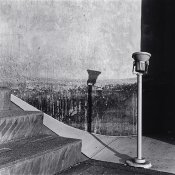
Attached example is Tri-X 400 film, Pyrocat-MC at 1+1+100 / 70*F / 13m - agitate full first minute and then two inversions every 3 minutes. Printed on Kentmere Bromide Grade 2 paper. Pretty much a straight print with little manipulation. I have used this negative to print on Ilford MGIV as well, and if I remember correctly I had filtration set at Grade 3 or 3.5. Haven't tried split grade printing it yet.
 

Attachments

  • BH05 - Lamp Divide.jpg
    BH05 - Lamp Divide.jpg
    401.4 KB · Views: 226

GraemeMitchell

Member
Allowing Ads
Joined
Aug 14, 2005
Messages
420
Location
NYC
Format
Multi Format
If you look at Richard Avedon's studio portraits of lets say the Duke and Dutches of Windsor or Marylin Monroe you will see lots of uneven backgrounds for one, but also the grain is very defined, I have always thought that his film for this time period was developed in Pyro and unstained- most likely triX.

Super sharp, but extreme edge sharpness on these portraits on grey background.
I am not talking about In the American West or his work on white backgrounds.

Not sure if anyone else ever noticed this and I wonder how he made the negs.

Bob, I swear I heard somewhere that early on (not sure as early as that Marilyn portrait) Avedon's studio used 777 (replenished of course) but then later switched the tanks to D-76. But I can't remember at all where I heard or read it...so just more internet hearsay unfortunately.

But YES, Penn and Avedon pushed envelopes. Not many people appreciate any longer how groundbreaking their work was creatively and technically. Avedon's size. And Penn's platinum. I mean, any chance to see his platinum work is an inspiration in craft...and then to hear he did some of them from color film and the such is insane. No scanners and digi negs out at his Long Island darkroom.

Prostrate.
 

Steve Sherman

Subscriber
Allowing Ads
Joined
Sep 14, 2003
Messages
548
Location
Connecticut
Format
ULarge Format
Stain is proportional to the amount of silver halide reduced, meaning in highlight areas a fair amount of density when printing is coming from the stain. So what I'm saying is that if you look at the negative, the highlight areas might look comparitively thin (ie overall contrast looks low) while in printing the combined optical/spectral density of the silver and stain might be normal. So all we're talking about here is the fact with a pyro negative the density is a combination of silver and stain.

Above quote is right on and may well offer some insight to why many are seeing a need to bump contrast filtration with Pyro negs.

My experience tells me that Pyro developed negs do not like heavy exposure, this tends to move much of what we saw as dark tones in the original scene to move up onto the straight line and be impacted by development and in the case of pyro, increased stain. This is also the exact reason I do not redevelop pyro negs in used developer, the stain compromises mid tone / edge contrast and that is the single most difficult component of printing to get correct.

For me personally, my pre pyro negs were heavy and required a lot of manipulation in the darkroom with graded paper to get the effect I was looking for.

I find quite the opposite with Pyro negs and Multi Contrast paper, a well exposed, almost @ manufacturer's box speed and developed to a lower contrast index to yield some of the finest prints I have seen.

I use exclusively Pyrocat HD, the first stuff Sandy formulated and find it works well with continuous agitation or with reduced agitation regimes. I mix it from powder (the most toxic as dust can cause respiratory problems), once in liquid form it is quite safe and extremely inexpensive.

Sandy King has spend untold hours and research on formulating Pyrocat, I cannot understand the debate about developers!

Go make some photographs!

Cheers
 

c6h6o3

Member
Allowing Ads
Joined
Oct 16, 2002
Messages
3,215
Format
Large Format
My experience tells me that Pyro developed negs do not like heavy exposure,

I expose the hell out of 'em. I find that it's heavy development, leading to overall heavy density, that it really doesn't like. I rate TMax 400 at 200 and place my shadows on Zone IV (so some might say I'm really rating it at 100) but I'm very careful not to over-develop. Nothing's harder for me to print than an over-developed Pyrocat negative, especially one I've developed semi-stand. I get much better prints from ones which are a little too thin than I do from ones which are too dense.

BTW, Tom Bertilsson: nice photograph!
 

Bob Carnie

Subscriber
Allowing Ads
Joined
Apr 18, 2004
Messages
7,735
Location
toronto
Format
Med. Format RF
Me too. I try to rate tri x at 160 or even lower and drop process
I expose the hell out of 'em. I find that it's heavy development, leading to overall heavy density, that it really doesn't like. I rate TMax 400 at 200 and place my shadows on Zone IV (so some might say I'm really rating it at 100) but I'm very careful not to over-develop. Nothing's harder for me to print than an over-developed Pyrocat negative, especially one I've developed semi-stand. I get much better prints from ones which are a little too thin than I do from ones which are too dense.

BTW, Tom Bertilsson: nice photograph!
 
Joined
Jan 21, 2003
Messages
15,715
Location
Switzerland
Format
Multi Format
I too used Pyrocat while exposing FP4+ at 64 and Tri-X at 200. Super negatives to print.
If you do extreme minimal agitation, you can expose at a higher exposure index, like box speed, because the longer developing time will bring back some of that shadow detail.

But Steve is right. Go take some pictures! :smile: That's what I'll do, I think.
 

Steve Sherman

Subscriber
Allowing Ads
Joined
Sep 14, 2003
Messages
548
Location
Connecticut
Format
ULarge Format
I expose the hell out of 'em.
I get much better prints from ones which are a little too thin than I do from ones which are too dense.

Is this an oxymoron ?

Whatever it is, if you have problems getting negs to print easily you need to look no further than "Expose the hell out of them". Jim, you know as well as anyone that exposure and development are forever linked together, when one is wrong than the other has to be forsaken in favor of the first error, hence when one is wrong so is the other.

Personally speaking, changing to a pyro based developer and VC paper caused a fundamental change in exposure and development for me, naturally this didn't come about in one or two adjustments, it took many ill advised exposure and development choices before the puzzle became clear.

When you get to our stage Jim revelations don't come around that often. Back in the mid 90's switching to PMK was a revelation. Another revelation came in the form a phrase by a photog we both know and whose wife's work is much in line with our sensibilities.

The phrase "you must anchor your low values" opened my eyes to why so many of my negs were difficult to print. Prior to that conversation in Pennsylvania I used to meter and place my important shadows on Z4 with film rated @ 1/2 box speed. Since then and with more consistent ease of printing I have rated film @ a tick under box speed and first find a Z2 tonality and then determine the relationship between that Z2 tonality and what I perceive to be important shadow values. So long as those values are within 2 zones of one another I have found my exposure value.

Lastly, if you like the look you get from Reduced Agitation negatives you will best achieve that look by exposing accurately and developing to a lower contrast index and allowing the VC paper to do what it does best, lay down the most difficult part of the final print....mid tone micro contrast

2 cents,

Cheers
 

GraemeMitchell

Member
Allowing Ads
Joined
Aug 14, 2005
Messages
420
Location
NYC
Format
Multi Format
Steve, great point on anchoring the shadows and thinner negs.

For me though it also applies to non-pyro developers. Shadows and highlights come easily w/ understanding exposure and dev, but it took me years to discover how to begin to control midtones to put them where I wanted, and my first epiphany in that search was beginning to work w/ thinner negatives and, as you put it, anchoring the blacks.

It's enlightening, if given the opportunity, to see what other photographers consider they're favorite negatives to print and resulting prints. Actually might be interesting thread.
 

c6h6o3

Member
Allowing Ads
Joined
Oct 16, 2002
Messages
3,215
Format
Large Format
@Steve: With TMax, which has a very long straight line portion to its characteristic curve and almost no shoulder, all exposure does is slide the density range up or down that straight line portion. My epiphany was in realizing that no matter where I put that image's density range on the curve, the paper I print on can't hold anywhere near the density range that the film can. What development does is lengthen or shorten that density range. In my experience, two separate parameters. Yes, you can expose a negative so much that you lose control in development and vice versa, but we're never that extreme.

But now you've got me reexamining my working methods, because almost all of my negatives of late will only print at about Grade 2-1/2 (G3 Azo with water bath). I will try backing off on exposure a little and expanding development a little to see if I can't come closer to a Grade 2 standard.

BTW, the last time I visited the photographer you mentioned I saw some of his new work and it was jaw dropping. I'd never seen finer prints. I asked him what his new secret was, because something had definitely changed and he said "thinner negatives". He was forced to slide the density range of his negatives down the curve and expand development a little because his film is so fogged. (Base fog around density .5). While his density range is the same as it has always been, the overall density is lower.
 

c6h6o3

Member
Allowing Ads
Joined
Oct 16, 2002
Messages
3,215
Format
Large Format
first find a Z2 tonality and then determine the relationship between that Z2 tonality and what I perceive to be important shadow values. So long as those values are within 2 zones of one another I have found my exposure value.

What do you do with a flat scene where there are no Z2 values? I've been encountering this a lot lately.
 

Steve Sherman

Subscriber
Allowing Ads
Joined
Sep 14, 2003
Messages
548
Location
Connecticut
Format
ULarge Format
What do you do with a flat scene where there are no Z2 values? I've been encountering this a lot lately.

Semi-Stand baby! No question!

The print you like so much of mine was exposed with only three zones of tonality registering on the meter. Exposed lowest reading on Z 3 and let the the SS do the rest. Those negs were the first I'd ever developed that way, I exposed JC 200 @ 200, a 1:175 ratio of Pyrocat HD, an educated guess that worked perfectly and I went with a 60 minute total time in solution with one agitation cycle @ 30 M.

BTW, the photog you mention, he actually saw those negs in person and to put it mildly was dumbstruck, you know the quote of his in the View Camera article.

You don't suppose, nah, couldn't be, you think he made an adjustment after seeing my negs and prints?

Next Friday, first Friday in Louisville, will miss ya, but will have one / two in your honor.

Cheers!
 

Gerald C Koch

Member
Allowing Ads
Joined
Jul 12, 2010
Messages
8,131
Location
Southern USA
Format
Multi Format
I cannot get any fully scientifically tested [with proper controls] results stating that staining is either good or bad. Most threads that try to thrash that out get into flame wars and I stop reading them.
Steve

This is what I found when researching a question on another thread. When you try to research staining developers what you find is speculation and personal bias with little real information. For example, on this thread 5 people say to place the negative back in the used developer and 3 say don't do it. None of the 8 people offer any scientific basis for their opinion.
 

john_s

Member
Allowing Ads
Joined
Nov 19, 2002
Messages
2,194
Location
Melbourne, A
Format
Medium Format
..........with Pyro negs and Multi Contrast paper, a well exposed, almost @ manufacturer's box speed and developed to a lower contrast index to yield some of the finest prints I have seen........


Cheers

I deliberately develop to a lowish contrast and find that VC papers behave better at medium to slightly higher contrast settings.

Exposure has to be adequate, even a bit generous. Setting the ISO on the meter is only half the story: the way one points the meter and makes decisions is the other half.

I should add that developing to a lower contrast makes the stain less extreme, and so avoids to some extent the drop in contrast in highlights that can be a problem when staining is very strong. I am sure that I'm still benefiting from the stain, though.
 

Steve Sherman

Subscriber
Allowing Ads
Joined
Sep 14, 2003
Messages
548
Location
Connecticut
Format
ULarge Format
None of the 8 people offer any scientific basis for their opinion.

To the core of the above quote I am guilty, certainly by scientific standards my observations hold little credence. My tests have always been making photographs and making only slight one at a time changes to my methodology. I hate garage doors and grafts.

However, I have on scores of occasions emptied large waste baskets of both negatives and prints based on small adjustments and educated trial and error.

Technology is a wonderful thing 95% of the time but let us not forget the eye test as the final grade.

2 cents!
 

Bob Carnie

Subscriber
Allowing Ads
Joined
Apr 18, 2004
Messages
7,735
Location
toronto
Format
Med. Format RF
Not speaking for the other 7 here but you are right Gerald I cannot offer a scientific basis for my opinion.

What I can offer is over 30,000 roll processed in pyro , contacted then prints made from over the last 15 years. Not to mention the Sheets of film.

Some people make charts and plot curves, drink wine and pontify about printing
Others make a living from it and work 7 days a week at photography.

Which group do you fall into??

This is what I found when researching a question on another thread. When you try to research staining developers what you find is speculation and personal bias with little real information. For example, on this thread 5 people say to place the negative back in the used developer and 3 say don't do it. None of the 8 people offer any scientific basis for their opinion.
 

Bob Carnie

Subscriber
Allowing Ads
Joined
Apr 18, 2004
Messages
7,735
Location
toronto
Format
Med. Format RF
Next week I get to see Sherman's Semi Stand Prints in Louisville, I hope he dosen't let me down, he has been talking a big story on this thread. Apparently there is a case of Dumante ordered , I hope Gittings dosen't show up.
 
Photrio.com contains affiliate links to products. We may receive a commission for purchases made through these links.
To read our full affiliate disclosure statement please click Here.

PHOTRIO PARTNERS EQUALLY FUNDING OUR COMMUNITY:


Ilford ADOX Freestyle Photographic Stearman Press Weldon Color Lab Blue Moon Camera & Machine
Top Bottom