
• Welcome to Photrio!
    Registration is fast and free. Join today to unlock search, see fewer ads, and access all forum features.
    Click here to sign up

Prontor Shutters

Afternoon Calm

D
Afternoon Calm

  • 3
  • 0
  • 43
Toby's Bar

H
Toby's Bar

  • Tel
  • Apr 25, 2026
  • 1
  • 0
  • 63

Recent Classifieds

Forum statistics

Threads
203,500
Messages
2,855,605
Members
101,870
Latest member
army0007
Recent bookmarks
3

shutterfinger

Member
Allowing Ads
Joined
Feb 25, 2013
Messages
5,018
Location
San Jose, Ca.
Format
4x5 Format
I have uploaded these Prontor service manuals to my google drive. They were previously available from other sites that may have closed.
Servicing Prontor shutters 3956 kb PDF
Prontor Press 7651 kb PDF
Prontor S-SV-SVS1 14731 kb PDF
Prontor S-SV-SVS suppliment 12409 kb PDF

https://drive.google.com/drive/folders/0B1sPJkp-MdghNGM1aGY5akgtTmc?usp=sharing
Please download rather than reading/referencing online.
 
Thanks very much. I added them to my library.

I don't like Prontor shutters, but with the Hasselblad CF lenses...

- Leigh
 
Thank you! They will be helpful some day.
 
Thank you! I lacked the one on press-camera-shutters.

(It looks like the 001_pdfsam_pronto.pdf and PRONTOR-S-SV-SVS1.pdf files are the same document? Only, the first one is a less good scan.)
 
Not quite, one has 80, the other 203 pages, consisting of 10 more pages servicing plus the rest containing single parts drawings.
 
Last edited:
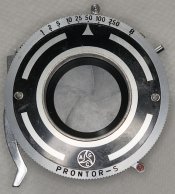
I tried to flush the Prontor-S with lighter fluids and I am afraid slow speeds still very slow after a day.

Complete dissembly can be challenging...
 
nice find!
 
I tried to flush the Prontor-S with lighter fluids and I am afraid slow speeds still very slow after a day.
Complete dissembly can be challenging...
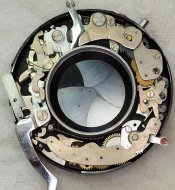
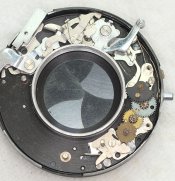
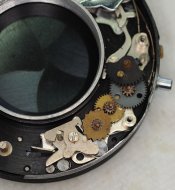
Take good pictures as you disassemble, makes reassembly much easier even with a manual.
copy 1.jpg copy 1.jpg 2.jpg 3.jpg
Images from Nikon D300 60mmf2.8 macro, Phoenix ring flash
Rusted parts soaked in cider vinegar for 15 to 30 minutes then rinsed in cold water, dried and rubbed down with TriFlow oil.
Would not fire at first then at one speed only regardless of speed setting. All parts were removed from the case, delay gear train was not disassembled, flushing with solvent and light oil is all it needed.
Now its this
test results.jpeg
1.jpg

Surprise yourself!
 
Last edited:
* Self timer works but slow speeds are sticky again after a day.

I am planning to soak it bit longer and finally with ultrasonic cleaner.

Those blades are really clean but I see lot of stain from lighter fluids.
 
I do not use lighter fluid for anything. I will not use lighter fluid for cleaning.
90% Isopropyl Alcohol or electronic contact cleaner will work better. Use extra fine powdered graphite on aperture blades and shutter blades/controller, sprinkle on and gently rub in with a cotton swab.
 
Use extra fine powdered graphite on aperture blades and shutter blades/controller...
I do not recommend graphite for anything. It fell out of favor in the repair industry long ago.
The problem is the grains are pancakes. They slide easily against each other, hence the lubricity.
But if they stand up on edge they become extremely abrasive, almost as hard as diamond.

The modern alternative is molybdenum disulphide, commonly called "moly-d".
Its grains are little round balls, like ball bearings, hence no abrasion possible.

- Leigh
 
I do not recommend graphite for anything. It fell out of favor in the repair industry long ago.
The problem is the grains are pancakes. They slide easily against each other, hence the lubricity.
But if they stand up on edge they become extremely abrasive, almost as hard as diamond.

The modern alternative is molybdenum disulphide, commonly called "moly-d".
Its grains are little round balls, like ball bearings, hence no abrasion possible.

- Leigh
... or the dry teflon lubes. Goes on wet, dries very dry and slippery. But in general, shutter and aperture blades need nothing but being clean.
 
...But in general, shutter and aperture blades need nothing but being clean.
Very true.
In fact, any lubricant will likely slow their operation.

I was thinking more of lubrication for gears and levers.

- Leigh
 
If I remember correctly, they were designed to run dry.

May be some lube on the back of shutter dial but I will not apply any.
 
Older shutters that were designed to run dry actually work better with a trace of oil on the gear posts, shaft bushings, a trace of grease on sliding metal parts, and graphite/teflon on the shutter blades and controller.
A trace is a drop of oil applied to a cotton swab or felt pad, pin touched to it or a drop applied directly then wiped off with a towel, what remains is a trace.
 
Compur shutter service manuals give very specific lubricant instructions.
They include the type of lubricant to use, the point of application, and the amount.

I expect manuals from other manufacturers do likewise.

- Leigh
 
Compur shutter service manuals give very specific lubricant instructions.
They include the type of lubricant to use, the point of application, and the amount.

I expect manuals from other manufacturers do likewise.
And if the shutter will not work when serviced according to the manufacturer do you throw it away or do you find a workaround that makes it usable?
 
Older shutters that were designed to run dry actually work better with a trace of oil on the gear posts, shaft bushings, a trace of grease on sliding metal parts, and graphite/teflon on the shutter blades and controller.
A trace is a drop of oil applied to a cotton swab or felt pad, pin touched to it or a drop applied directly then wiped off with a towel, what remains is a trace.
With the exception of the shutter blade greasing I find this often to be very true.

After the factory methods prove ineffective.
 
And if the shutter will not work when serviced according to the manufacturer do you throw it away or do you find a workaround that makes it usable?
I don't believe I've ever encountered a shutter that failed to work after service unless it had a busted part.

In that case, I replace the busted part.

- Leigh
 
Then you have not encountered a heavily worn from use shutter.
I suppose that depends entirely on how you define "heavily used", and what brand of shutter.

I've serviced a lot of Compur shutters in Hasselblad lenses, used by pros every day.

I've also serviced innumerable Nikon cameras with Copal Square shutters. Those never fail.
The pro-level Nikons (F series) with horizontal shutters sometimes have failures.
Those have always been repaired by replacing the damaged part(s).

Admittedly, I do not service shutters from 19th Century view or folding cameras.

- Leigh
 
Last edited:
I do not mess with folders either, nor do I service 35mm. The bulk of the shutters I have serviced are for large format from the late 1940's through the early 1960's. They are Graphex (Wollensak Rapax rebadged), Kodak Supermatic is its various forms, Synchro Compur, and Ilex. The usual is 1 second through 1/100 - 1/125 in tolerance, 1/250 a half stop slow, 1/400 - 1/500 1 to 2 stops slow. Shutters run until they stop working don't clean up and work this good most of the time.
Compur/Synchro Compur and Prontor were used in a verity of cameras from 35mm to large format. The biggest problem is the springs getting weak with pivot wear taking second place.
 
Photrio.com contains affiliate links to products. We may receive a commission for purchases made through these links.
To read our full affiliate disclosure statement please click Here.

PHOTRIO PARTNERS EQUALLY FUNDING OUR COMMUNITY:


Ilford ADOX Freestyle Photographic Stearman Press Weldon Color Lab Blue Moon Camera & Machine
Top Bottom