• Welcome to Photrio!
    Registration is fast and free. Join today to unlock search, see fewer ads, and access all forum features.
    Click here to sign up

Processing C-41/E-6 at Home

Recent Classifieds

Forum statistics

Threads
201,768
Messages
2,829,817
Members
100,935
Latest member
Fablesilence
Recent bookmarks
0

Vlad Soare

Member
Allowing Ads
Joined
Jan 16, 2009
Messages
261
Location
Bucharest, R
Format
8x10 Format
Hi guys,

For the past eight years or so I've been shooting exclusively black and white, which I develop and enlarge (or sometimes scan) myself. But recently my wife wanted to use a roll of Portra, and then when I tried to have it developed and printed I made an unpleasant discovery - namely that a lot of minilabs that I used to know are either no longer in business, or do not offer film processing services anymore. What's worse, the only guy in town who used to still process E-6 has retired.
So, if I want to ever shoot colour film again, or to encourage my wife to still use film from time to time alongside her digital cameras (as she's more into colour than black and white), then I'll need to be able to process it myself.

I guess the easiest way would be to get a Jobo. But since I have no experience whatsoever in this regard, I feel a bit overwhelmed and have no idea where to start.

First, I see there are several models. There's CPE-3, CPP-3, and perhaps others as well. What are the differences? Which one would you advise me to get? I'm interested in C-41 and E-6, small and medium format (though 4x5" would be nice as well).
Second, what other accessories will I need? I see that some kits come with a lift (what's that?), four bottles, four measuring cylinders, and one magnet (what's that for?).
I already have a 2523 tank (is this OK, or will I need another one?) and one 4x5" spiral. Obviously, I will also need some spirals for 135 and 120 film.
Anything else?

Any other tips will he highly appreciated.

Thank you.

P.S. It doesn't necessarily have to be a Jobo. I mentioned Jobo because it's the only brand I happen to know. Please feel free to recommend others, if there are any.
 

iakustov

Member
Allowing Ads
Joined
Feb 25, 2015
Messages
221
Location
StPetersburg
Format
Multi Format
I develop in Paterson tank both C41 and E6 with Tetenal kits. I get better quality than from an average minilab. Temperature control is the key, but with practice you will get consistent, predictable results without the need of expensive equipment.
 
OP
OP
Vlad Soare

Vlad Soare

Member
Allowing Ads
Joined
Jan 16, 2009
Messages
261
Location
Bucharest, R
Format
8x10 Format
I know it's theoretically possible, I know there are people who somehow manage to do it, but frankly I can't even begin to imagine how I could control the temperature to anywhere near the required accuracy. I believe it needs something like 37.8 ± 0.25 °C, if memory serves. I can't do that. The development time is also very short, around three minutes if I'm not mistaken, which is hard to achieve consistently, since even a ten seconds error can have unwanted effects.
So no, I'm not at all confident that I could do it without an automatic processor. :redface:
 

iakustov

Member
Allowing Ads
Joined
Feb 25, 2015
Messages
221
Location
StPetersburg
Format
Multi Format
It is not that difficult, I only use a thermometer, dont own a thermostat for temp control.
Actually the tolerance is not that strict, for E6 with Tetenal kit only first developer and first wash should be within +-0.5C-0.7C or so.
For C41 with Tetenal it is certainly not that strict to make a difference in the end.
 

Tom Taylor

Member
Allowing Ads
Joined
Jul 10, 2005
Messages
601
Location
California
Format
Multi Format
I process B&W, C-41, E-6 and RA-4 in a CPA 2 which is comparable to the CPP3 but without the auto temperature control - you are supplied with 2 matched thermometers, one in degrees C and the other in degrees F and you control the bath temperature via a rheostat/potentiometer instead. The unit holds 20+ liters of water and it takes a lot of energy to raise the temperature of that amount of water especially if the ambient temperature is close to the operating temperature as it usually is when developing B&W. With color the processing temperature will change more quickly due to the 30 degree difference between the ambient temperature. But really this only comes into play when you are processing over an extended period as when you are printing and developing RA-4 paper. In both instances though the processing temperature is virtually constant throughout the first cycle. I keep frozen bottles of water in the freezer for extended B&W processing sessions and work the thermostat for color. Remember its only the temperature of the developer that counts.

Thomas
 

MattKing

Moderator
Moderator
Joined
Apr 24, 2005
Messages
55,142
Location
Delta, BC Canada
Format
Medium Format

Paul Howell

Subscriber
Allowing Ads
Joined
Dec 23, 2004
Messages
10,093
Location
Scottsdale Az
Format
Multi Format
I use a Sous Vide unit with a large deep of water for C41 and R4, takes time to bring the water bath and chemistry up to temp and I double check with old mercury thermometer. With film I use a Patterson tank which I fill with water for the bath for presoak to bring tank to temp then dump and add the chemistry, between agitations I keep the tank in the water bath.
 

MattKing

Moderator
Moderator
Joined
Apr 24, 2005
Messages
55,142
Location
Delta, BC Canada
Format
Medium Format

Tel

Subscriber
Allowing Ads
Joined
May 9, 2011
Messages
1,030
Location
New Jersey
Format
Multi Format
Vlad, I encourage you to try it. I do my own C-41 (I shoot a lot of Portra) but not E-6. My equipment list is very simple. I have a plastic tub for the warm-water bath (bought very cheaply--anything that doesn't leak is good enough). I make up my working solutions, then divide them into two sets of 500mL bottles, since I tend to develop one roll at a time. I have two thermomenters: one for the bath and one for the developer. (I don't like to risk contamination of the developer, so it has its own exclusive thermometer and funnel.) I get the bath up to about 105F and the developer to any temp between 102F and 105F. I pre-wash the film for one minute in 105F tap water, then develop fpr 3.5 minutes, agitating as the instructions say to do. I don't do a rinse after the developer, just pour the dev back into its bottle (hence the funnel) and pour the blix into the tank. The blix is good at any temperature above 95F. After the required 6.5 minutes of blix I pour the blix back into its bottle and rinse in tap water above 95F for the required 3 minutes, then one minute in warm distilled water to clear any minerals the tap water left behind. Then I hang and squeegee once.

My chemistry is the Unicolor dry powder kit, but I've used their liquid kit too, following the exact same procedure. I imagine the Tetenal kit is not very different. I typically develop 15 or more rolls per 1L kit this way, though I haven't had good luck with solutions older than 6 months. (I use dry powder kits because they seem to have an unlimited shelf life.)

I have two 1L graduated pitchers (one for dev, one for blix), two stirring paddles, two thermometers, four 500mL brown glass bottles and a cheap plastic tub. And hanging clips and a squeegee. Pretty basic but it works.
 

AgX

Member
Allowing Ads
Joined
Apr 5, 2007
Messages
29,972
Location
Germany
Format
Multi Format
Basically there are these different approaches:

-) temper the baths to a certain higher temperature, fill the untempered tank and inversion process (similar to b&w processing). A apt choice of starting temperature will yield an apt average temperature during cooling off. Kodak once had a manual just on this kind of processing.

-) temper the baths and the tank at exactly 100°F in a tempering bath. Invert the tank and inbetween dip it back into the tempering bath.

-) temper the baths and the tank at exactly 100°F in a tempering bath. Rotate manually the tank constantly in the tempering bath.

-) process in a tempered rotational processor (from Jobo or others).
 

MattKing

Moderator
Moderator
Joined
Apr 24, 2005
Messages
55,142
Location
Delta, BC Canada
Format
Medium Format
A hard sided picnic cooler can make for an excellent tempering container.
 
OP
OP
Vlad Soare

Vlad Soare

Member
Allowing Ads
Joined
Jan 16, 2009
Messages
261
Location
Bucharest, R
Format
8x10 Format
Thank you all for your tips and encouragements. I might give it a try.
How's the agitation? Do you use the same agitation pattern as with B&W films, i.e. continuously for the first thirty seconds, and then ten seconds every minute?
If the development time is so short, doesn't the time it takes to pour the developer into and out of the tank affect the end result? How do you cope with that?
 

iakustov

Member
Allowing Ads
Joined
Feb 25, 2015
Messages
221
Location
StPetersburg
Format
Multi Format
Follow instructions that come with the chemistry. With Tetenal and Paterson tank I agitate every 15 seconds (swirling)
 

jay moussy

Member
Allowing Ads
Joined
Jun 10, 2019
Messages
1,315
Location
Eastern MA, USA
Format
Hybrid
A hard sided picnic cooler can make for an excellent tempering container.

Or a buffet warmer bath tabletop thing?

I picked one up cheap at a thrift shop, on the chance that I may try color processing.. some day.
We know self-serve buffet serving is mostly out.

A retired cooler from the dump followed me home. I did not ask any questions...
 
Last edited:

mshchem

Subscriber
Allowing Ads
Joined
Nov 26, 2007
Messages
15,987
Location
Iowa City, Iowa USA
Format
Medium Format
I've got all the Jobo stuff now. For 20 years or longer I used a big bucket and some really nice German aquarium heaters. The insulated picnic chest sounds like a great idea. I developed in Paterson tanks both E6 and C41. Easy, these sous vide devices have made it easy.
 

ProfessorC1983

Member
Allowing Ads
Joined
May 3, 2020
Messages
282
Location
Washington, DC
Format
Large Format
I developed my first rolls of E6 recently using the cheapest sous vide cooker I could find, a plastic bus tub, steel tank/reel, a few graduates and a single thermometer. Tetenal kit from Freestyle. Agitating one full inversion+turn every 15 seconds and back in the water between. Worked a treat (or would have if I hadn't underexposed by 2-3 stops) and the only challenging part was keeping enough water at temperature for all of the wash cycles, so I was limited to 3 changes instead of the recommended 5 per wash. Nothing a few more graduates won't solve.
 

AgX

Member
Allowing Ads
Joined
Apr 5, 2007
Messages
29,972
Location
Germany
Format
Multi Format
For 20 years or longer I used a big bucket and some really nice German aquarium heaters.
How did you control the temperature? By switching the heaters on and off manually (then you also could just have added instead hot and cold water, or did they got a thermostat? The german models with integrated thermostat Iknow do not go high enough in temperature. (Likely one could open them and dis-adjust the thermostat, but so far I refrained from opening these glass tubes by force...)
 

mshchem

Subscriber
Allowing Ads
Joined
Nov 26, 2007
Messages
15,987
Location
Iowa City, Iowa USA
Format
Medium Format
It's been 25 years since I used the aquarium heaters. They were adjustable, clamped to the side of a plastic approximately 15-20L plastic food service bulk container. I switched to Doran immersion heaters that work great. Now I've got Jobos.

These new sous vide devices look to be perfect for home processing.
 
OP
OP
Vlad Soare

Vlad Soare

Member
Allowing Ads
Joined
Jan 16, 2009
Messages
261
Location
Bucharest, R
Format
8x10 Format
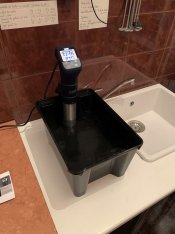
Update: I got a sous vide device with a rated maximum capacity of 30 litres, plus a 20 litre plastic container that's large enough to hold four 1 litre bottles and the development tank.

IMG_1428.jpg

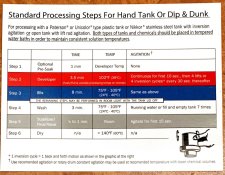
Then I got a CineStill CS41 colour simplified kit. It consists of a three-component developer, a three-component blix, and a stabilizer. The instructions couldn't be clearer.

IMG_1429_2.jpg

What strikes me is that they recommend a temperature of 39 degrees Centigrade, rather than the standard 37.8. But anyway, it's their kit, so they must know. I'll trust them on this.

But I have a problem. I've got a professional Greisinger digital thermometer, which is supposed to be accurate to a tenth of a degree. When the sous vide device says the water is at 38 degrees, my thermometer shows 35.6. And I don't know which of them to trust.
Should I trust the thermometer? Are these sous vide sticks known to be inaccurate? Or are they known to be accurate, and my thermometer is off?
 

eatfrog

Member
Allowing Ads
Joined
Oct 26, 2004
Messages
111
Location
Sweden
Format
35mm
What strikes me is that they recommend a temperature of 39 degrees Centigrade, rather than the standard 37.8. But anyway, it's their kit, so they must know. I'll trust them on this.
There is usually significant heat loss during the pouring of the liquids which means its better to aim for a higher temp since you will lose about 1c when you pour in the liquid. And then if you don't have a water bath for the development tank, you will lose yet more temperature. So that is probably why the recommend 39c instead of 38c.

But I have a problem. I've got a professional Greisinger digital thermometer, which is supposed to be accurate to a tenth of a degree. When the sous vide device says the water is at 38 degrees, my thermometer shows 35.6. And I don't know which of them to trust.
Should I trust the thermometer? Are these sous vide sticks known to be inaccurate? Or are they known to be accurate, and my thermometer is off?

Trust the thermometer for sure, my sous vide shows about 1c hotter than it actually is.
 

AgX

Member
Allowing Ads
Joined
Apr 5, 2007
Messages
29,972
Location
Germany
Format
Multi Format
But I have a problem. I've got a professional Greisinger digital thermometer, which is supposed to be accurate to a tenth of a degree. When the sous vide device says the water is at 38 degrees, my thermometer shows 35.6. And I don't know which of them to trust.
Should I trust the thermometer? Are these sous vide sticks known to be inaccurate? Or are they known to be accurate, and my thermometer is off?

As you said, Greisinger make professional tools, and they give in detail the error for their tools. Even their cheapest model was stated to be used as reference for other systems. It is them to trust and not a unknown kitchen appliance manufacturer who only states the resolution of his device.
 
Last edited:
OP
OP
Vlad Soare

Vlad Soare

Member
Allowing Ads
Joined
Jan 16, 2009
Messages
261
Location
Bucharest, R
Format
8x10 Format
There is usually significant heat loss during the pouring of the liquids which means its better to aim for a higher temp since you will lose about 1c when you pour in the liquid. And then if you don't have a water bath for the development tank, you will lose yet more temperature. So that is probably why the recommend 39c instead of 38c.
Yes, but on the other hand there's a note in the instructions (I mean the complete instructions, not the quick guide I posted above) which reads: "When not using a temperature control bath add 2 °F (1 °C) to the developer before processing". This seems to suggest that 39 °C is the actual development temperature, not just a starting point under the assumption that it will drop.
Or maybe they expect the temperature to drop anyway, even with a water bath, just not as much as without one?
 
OP
OP
Vlad Soare

Vlad Soare

Member
Allowing Ads
Joined
Jan 16, 2009
Messages
261
Location
Bucharest, R
Format
8x10 Format
Trust the thermometer for sure, my sous vide shows about 1c hotter than it actually is.
As you said, Greisinger make professional tools, and they give the error for their tools. It is them to trust and no a unknown kitchen appliance manufacturer who only states the resolution of his device.
That's settled then. I will trust the thermometer.
Thanks.
 

AgX

Member
Allowing Ads
Joined
Apr 5, 2007
Messages
29,972
Location
Germany
Format
Multi Format
Another good reference is a high-resolution mercury stem thermometer. They typically have a high accuracy, but more important, they keep that forever (unless the fluid stem has seperated).
 
Photrio.com contains affiliate links to products. We may receive a commission for purchases made through these links.
To read our full affiliate disclosure statement please click Here.

PHOTRIO PARTNERS EQUALLY FUNDING OUR COMMUNITY:


Ilford ADOX Freestyle Photographic Stearman Press Weldon Color Lab Blue Moon Camera & Machine
Top Bottom